• The 2 Gigawatt Grid Ceiling: Why US Cloud Architects Are Designing for Carbon-Aware Spatial Load Shifting
    For the past decade, cloud system architecture treated power and cooling as infinite abstract utilities managed by AWS, Azure, or GCP. You provisioned instances, autoscale groups expanded, and the underlying datacenter absorbed the draw.


    In the US tech corridor, that abstraction has broken down.


    With PJM Interconnection facing over 70 GW of prospective large-load requests and regional transmission queues stretching 5 to 7 years, regulatory bodies (FERC) and regional transmission organizations (RTOs) are capping unbacked firm grid access. The limiting constraint on US enterprise AI compute is no longer chip availability—it is electrical grid interconnects and substation thermal limits.


    Engineering teams scaling massive AI pipelines cannot wait for multi-year transmission line overhauls. Instead, top infrastructure architects are transitioning from static, monolithic datacenter footprints to Grid-Aware Spatial Load Shifting:


    1. Decoupling Batch Pre-training from Real-Time Inference
    Inference workloads require strict low-latency proximity to end users (e.g., US-East / US-West metros). Massive batch jobs—such as fine-tuning, synthetic data generation, and offline embedding runs—do not.


    System schedulers must treat electrical grid marginal emissions and real-time megawatt pricing (locational marginal pricing, or LMP) as dynamic orchestration parameters.


    When grid reserve margins tighten in PJM (Mid-Atlantic) during peak summer or winter heating alerts, control planes must automatically throttle or migrate non-urgent checkpoint jobs to regions with surplus renewable generation (such as ERCOT wind during off-peak hours or MISO hydro/solar).


    2. Hardware-Aware Dynamic Power Throttling
    Training clusters generate extreme step-function load spikes during distributed all-reduce synchronization barriers.


    Instead of designing power delivery strictly for unmitigated peak wattage (which drives up capacity interconnection costs), modern orchestrators enforce dynamic power-capping at the server baseboard management controller (BMC) level.


    By shaving off the top 10% of transient power spikes via micro-throttling clock frequencies during communication phases, facilities fit up to 20% more accelerator density within existing utility interconnection limits.


    3. Ephemeral Cross-Region Checkpointing (Disaster & Curtailment Recovery)
    As grid operators debate conditional curtailment rules for unsupported high-density loads, applications must treat cluster power as potentially non-firm.


    Production distributed training jobs must implement sub-minute distributed checkpointing to asynchronous object stores. If a facility receives a Demand Response (DR) signal, workloads pause cleanly, state flushes, and worker pools rehydrate in alternative geographic zones without corrupted weights.


    Software engineers used to optimize for bytes and cycles. The next generation of lead cloud architects must master megawatt curves, transmission topology, and grid elasticity.


    Discussion Question
    As US power constraints reshape datacenter capacity across major tech hubs, is your team actively engineering carbon-aware or energy-scheduled workload migration across cloud regions, or are you still relying on single-region multi-zone provisioning?


    CTA
    Join Techawks USA: Connect with lead cloud infrastructure architects, principal systems engineers, and DevOps directors discussing large-scale cloud resilience, power-constrained architectures, and next-gen US tech infrastructure. Link in bio/comments.
    The 2 Gigawatt Grid Ceiling: Why US Cloud Architects Are Designing for Carbon-Aware Spatial Load Shifting For the past decade, cloud system architecture treated power and cooling as infinite abstract utilities managed by AWS, Azure, or GCP. You provisioned instances, autoscale groups expanded, and the underlying datacenter absorbed the draw. In the US tech corridor, that abstraction has broken down. With PJM Interconnection facing over 70 GW of prospective large-load requests and regional transmission queues stretching 5 to 7 years, regulatory bodies (FERC) and regional transmission organizations (RTOs) are capping unbacked firm grid access. The limiting constraint on US enterprise AI compute is no longer chip availability—it is electrical grid interconnects and substation thermal limits. Engineering teams scaling massive AI pipelines cannot wait for multi-year transmission line overhauls. Instead, top infrastructure architects are transitioning from static, monolithic datacenter footprints to Grid-Aware Spatial Load Shifting: 1. Decoupling Batch Pre-training from Real-Time Inference Inference workloads require strict low-latency proximity to end users (e.g., US-East / US-West metros). Massive batch jobs—such as fine-tuning, synthetic data generation, and offline embedding runs—do not. System schedulers must treat electrical grid marginal emissions and real-time megawatt pricing (locational marginal pricing, or LMP) as dynamic orchestration parameters. When grid reserve margins tighten in PJM (Mid-Atlantic) during peak summer or winter heating alerts, control planes must automatically throttle or migrate non-urgent checkpoint jobs to regions with surplus renewable generation (such as ERCOT wind during off-peak hours or MISO hydro/solar). 2. Hardware-Aware Dynamic Power Throttling Training clusters generate extreme step-function load spikes during distributed all-reduce synchronization barriers. Instead of designing power delivery strictly for unmitigated peak wattage (which drives up capacity interconnection costs), modern orchestrators enforce dynamic power-capping at the server baseboard management controller (BMC) level. By shaving off the top 10% of transient power spikes via micro-throttling clock frequencies during communication phases, facilities fit up to 20% more accelerator density within existing utility interconnection limits. 3. Ephemeral Cross-Region Checkpointing (Disaster & Curtailment Recovery) As grid operators debate conditional curtailment rules for unsupported high-density loads, applications must treat cluster power as potentially non-firm. Production distributed training jobs must implement sub-minute distributed checkpointing to asynchronous object stores. If a facility receives a Demand Response (DR) signal, workloads pause cleanly, state flushes, and worker pools rehydrate in alternative geographic zones without corrupted weights. Software engineers used to optimize for bytes and cycles. The next generation of lead cloud architects must master megawatt curves, transmission topology, and grid elasticity. Discussion Question As US power constraints reshape datacenter capacity across major tech hubs, is your team actively engineering carbon-aware or energy-scheduled workload migration across cloud regions, or are you still relying on single-region multi-zone provisioning? CTA Join Techawks USA: Connect with lead cloud infrastructure architects, principal systems engineers, and DevOps directors discussing large-scale cloud resilience, power-constrained architectures, and next-gen US tech infrastructure. Link in bio/comments.
    0 Commenti 0 condivisioni 54 Views 0 Anteprima
  • Agentic AI Runtime Sandboxing: Why Running Autonomous Agents in Standard Containers is a Security Anti-Pattern
    The Myth:


    "Standard container isolation (Docker/K8s pods) with role-based IAM provides sufficient security boundaries for autonomous coding and orchestration agents."


    The Fact:


    Containers share the host Linux kernel. When an autonomous agent receives permission to generate, compile, and execute arbitrary code or shell commands, it operates with the container’s inherited ambient identity. If credentials exist within the guest environment or egress is unmediated, a compromised agent harness can read environment variables, pivot laterally via internal metadata services (e.g., IMDSv2), and cause tool-call amplification cascades.


    Anti-Pattern vs. Zero-Trust Agent Sandbox Runtime
    Plaintext
    [ANTI-PATTERN: AMBIENT IDENTITY IN SHARED RUNTIME]
    User Prompt / Webhook ---> [ Agent Pod (Docker/K8s) ]
    |-- Service Account Key in Env / Root FS
    |-- Direct VPC Egress to Cloud APIs
    +---> Tool Hallucination / Injection
    |---> Uncontrolled Cloud Resource Deletion


    [PRODUCTION RESILIENT PATTERN: HARNESS SEPARATION & EPHEMERAL MICROVMS]
    Agent Orchestrator (Outside Sandbox)
    |
    v (Validates Policy & Token Budget)
    [ Egress / Ingress Policy Gateway ] <--- Injects Ephemeral Backend Credentials
    | (Zero ambient secrets in sandbox)
    v
    [ Isolated Hardware MicroVM / gVisor ] (Resume <500ms via Snapshot)
    |-- Immutable Root OS Template (Copy-on-Write)
    |-- No direct VPC / Default Deny Network Interface
    |-- Mediated Proxy Tool Calls with HMAC / Attestation
    +-- Real-time Audit Trail (Identity attributed to Agent, not Host)
    Production-Grade Engineering Principles for Agent Sandboxing
    Decouple the Decision Harness from the Execution Sandbox:


    Never execute commands in the same environment where the model orchestrates decisions. The agent harness (model calls, state tracking, and planning) must live outside the execution sandbox. Tool invocations must be dispatched over a mediated, audited boundary to ephemeral environments.


    Eliminate Ambient Guest Credentials:


    Never pass cloud service account tokens, database passwords, or persistent API keys into the execution environment. Route all outbound tool requests through an external API/Agent Gateway that enforces fine-grained authorization, validates destination registries, and injects short-lived credentials just-in-time.


    Adopt MicroVM or Kernel-Level Isolation (Firecracker / Cloud Hypervisor):


    Standard container primitives (runc, Linux namespaces, cgroups) are inadequate against adversarial code execution. Production-grade agent platforms run untrusted agent code in dedicated hardware-isolated microVMs or syscall-intercepting sandboxes (like gVisor) with suspend/resume snapshot capabilities to retain sub-500ms start times.


    Default-Deny Egress with Semantic Policy Enforcement:


    Strip microVM sandboxes of public network interfaces and unrestricted internal VPC routes. Force every connection through a mediation proxy with semantic guardrails, rate-limits, and token spending caps to protect against runaway recursive loops and data exfiltration.


    Discussion Question
    As autonomous agents execute multi-step tool calls directly in enterprise workflows, where does your team draw the boundary: do you isolate tasks using ephemeral microVM snapshots per session, or do you rely on static container sandboxes with syscall filtering (e.g., seccomp/gVisor)? What trade-offs have you faced between boot latency and hypervisor-level security?


    CTA
    Looking to master high-scale AI infrastructure, distributed systems security, and the future of enterprise engineering?


    👉 Join Techawks USA — Connect with staff architects, cloud systems engineers, and infrastructure leads building next-generation autonomous platforms.
    Agentic AI Runtime Sandboxing: Why Running Autonomous Agents in Standard Containers is a Security Anti-Pattern The Myth: "Standard container isolation (Docker/K8s pods) with role-based IAM provides sufficient security boundaries for autonomous coding and orchestration agents." The Fact: Containers share the host Linux kernel. When an autonomous agent receives permission to generate, compile, and execute arbitrary code or shell commands, it operates with the container’s inherited ambient identity. If credentials exist within the guest environment or egress is unmediated, a compromised agent harness can read environment variables, pivot laterally via internal metadata services (e.g., IMDSv2), and cause tool-call amplification cascades. Anti-Pattern vs. Zero-Trust Agent Sandbox Runtime Plaintext [ANTI-PATTERN: AMBIENT IDENTITY IN SHARED RUNTIME] User Prompt / Webhook ---> [ Agent Pod (Docker/K8s) ] |-- Service Account Key in Env / Root FS |-- Direct VPC Egress to Cloud APIs +---> Tool Hallucination / Injection |---> Uncontrolled Cloud Resource Deletion [PRODUCTION RESILIENT PATTERN: HARNESS SEPARATION & EPHEMERAL MICROVMS] Agent Orchestrator (Outside Sandbox) | v (Validates Policy & Token Budget) [ Egress / Ingress Policy Gateway ] <--- Injects Ephemeral Backend Credentials | (Zero ambient secrets in sandbox) v [ Isolated Hardware MicroVM / gVisor ] (Resume <500ms via Snapshot) |-- Immutable Root OS Template (Copy-on-Write) |-- No direct VPC / Default Deny Network Interface |-- Mediated Proxy Tool Calls with HMAC / Attestation +-- Real-time Audit Trail (Identity attributed to Agent, not Host) Production-Grade Engineering Principles for Agent Sandboxing Decouple the Decision Harness from the Execution Sandbox: Never execute commands in the same environment where the model orchestrates decisions. The agent harness (model calls, state tracking, and planning) must live outside the execution sandbox. Tool invocations must be dispatched over a mediated, audited boundary to ephemeral environments. Eliminate Ambient Guest Credentials: Never pass cloud service account tokens, database passwords, or persistent API keys into the execution environment. Route all outbound tool requests through an external API/Agent Gateway that enforces fine-grained authorization, validates destination registries, and injects short-lived credentials just-in-time. Adopt MicroVM or Kernel-Level Isolation (Firecracker / Cloud Hypervisor): Standard container primitives (runc, Linux namespaces, cgroups) are inadequate against adversarial code execution. Production-grade agent platforms run untrusted agent code in dedicated hardware-isolated microVMs or syscall-intercepting sandboxes (like gVisor) with suspend/resume snapshot capabilities to retain sub-500ms start times. Default-Deny Egress with Semantic Policy Enforcement: Strip microVM sandboxes of public network interfaces and unrestricted internal VPC routes. Force every connection through a mediation proxy with semantic guardrails, rate-limits, and token spending caps to protect against runaway recursive loops and data exfiltration. Discussion Question As autonomous agents execute multi-step tool calls directly in enterprise workflows, where does your team draw the boundary: do you isolate tasks using ephemeral microVM snapshots per session, or do you rely on static container sandboxes with syscall filtering (e.g., seccomp/gVisor)? What trade-offs have you faced between boot latency and hypervisor-level security? CTA Looking to master high-scale AI infrastructure, distributed systems security, and the future of enterprise engineering? 👉 Join Techawks USA — Connect with staff architects, cloud systems engineers, and infrastructure leads building next-generation autonomous platforms.
    0 Commenti 0 condivisioni 176 Views 0 Anteprima
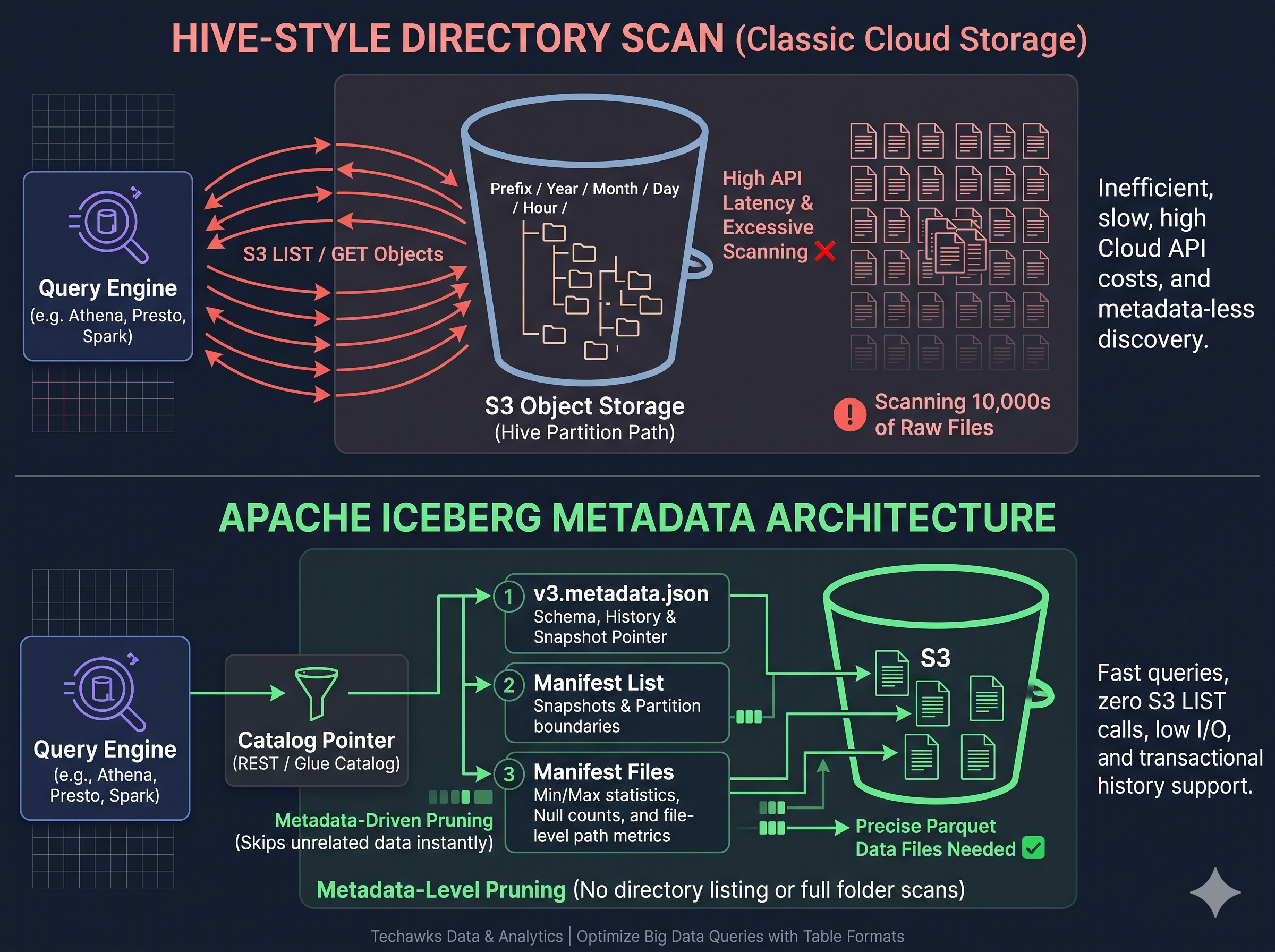
  • Stop Directory-Scanning Your S3 Bucket: Optimize Big Data Queries with Apache Iceberg Metadata
    Traditional object storage (like AWS S3 or Google Cloud Storage) is not a database. It does not understand rows, columns, or transactions—it only knows files.


    When you write partitioned queries over giant Hive-style data lakes, your query engine (like Presto, Athena, or Spark) has to call costly LIST operations on object storage to find out which files to read. At scale (petabytes of data), this directory-level path-resolution process becomes a massive latency bottleneck.


    Apache Iceberg solves this by introducing a highly structured metadata layer that keeps a precise, stateful inventory of every data file, entirely bypassing filesystem-level file-discovery scans.


    Traditional Hive-Style Approach
    [ Query Engine ] ──> [ S3 LIST files/date=2026-10-22/* ] (Slow Directory Scanning)
    │
    ▼
    10,000s of Raw Parquet Files ❌ (High I/O Overhead)


    The Apache Iceberg Model
    [ Query Engine ] ──> [ Catalog (REST / Unity / Glue) ]
    │
    ▼
    [ Iceberg Metadata Files ]
    • Metadata Pointer (v3.metadata.json)
    • Manifest List (Snapshots)
    • Manifest File (Exact physical file paths & statistics)
    │
    ▼
    [ Selective File Reads ] (Zero Directory Scans)
    The 3 Metadata Tiers Making Your Lakehouse Fast
    To verify and query data efficiently, Iceberg avoids "guessing" where data is located by creating three tiers of read-optimized metadata:


    1. The Manifest File (The File Level):


    An Iceberg manifest is an Avro-format file that tracks the exact path of every Parquet data file, along with critical column-level statistics (min/max values, null counts). Before even opening a single data file, the engine uses this manifest to discard entire files that do not match the query’s filter, a process called file-level pruning.


    2. The Manifest List (The Snapshot Level):


    A manifest list collects groups of manifests to represent a single snapshot of the table at a specific point in time. It stores partition boundaries for each manifest, allowing the engine to skip whole groups of files before scanning file-level metrics.


    3. The Metadata File (The Schema & History Level):


    This top-level file stores the table’s current schema, its historical partition specs, and a chronological log of previous snapshots. This allows your queries to perform safe, ACID-compliant time-travel queries by letting you query exact points in time simply by referencing an older snapshot ID.


    By replacing dynamic folder searches with direct, statistics-driven metadata lookups, you can drop data catalog scanning bottlenecks entirely and turn your generic object store into a high-performance database.


    Discussion Question
    Is your organization currently migrating Hive-partitioned S3/Blob storage lakes over to Apache Iceberg or Delta Lake? What was your experience with latency improvements when switching from directory-level scans to metadata-driven querying?


    CTA
    Want to master modern data pipelines, data lakehouse architectures, and cloud-scale query performance alongside thousands of senior data engineers?


    👉 Join the Data Science & Analytics Community today: [techawks.io/join-data]
    Stop Directory-Scanning Your S3 Bucket: Optimize Big Data Queries with Apache Iceberg Metadata Traditional object storage (like AWS S3 or Google Cloud Storage) is not a database. It does not understand rows, columns, or transactions—it only knows files. When you write partitioned queries over giant Hive-style data lakes, your query engine (like Presto, Athena, or Spark) has to call costly LIST operations on object storage to find out which files to read. At scale (petabytes of data), this directory-level path-resolution process becomes a massive latency bottleneck. Apache Iceberg solves this by introducing a highly structured metadata layer that keeps a precise, stateful inventory of every data file, entirely bypassing filesystem-level file-discovery scans. Traditional Hive-Style Approach [ Query Engine ] ──> [ S3 LIST files/date=2026-10-22/* ] (Slow Directory Scanning) │ ▼ 10,000s of Raw Parquet Files ❌ (High I/O Overhead) The Apache Iceberg Model [ Query Engine ] ──> [ Catalog (REST / Unity / Glue) ] │ ▼ [ Iceberg Metadata Files ] • Metadata Pointer (v3.metadata.json) • Manifest List (Snapshots) • Manifest File (Exact physical file paths & statistics) │ ▼ [ Selective File Reads ] (Zero Directory Scans) The 3 Metadata Tiers Making Your Lakehouse Fast To verify and query data efficiently, Iceberg avoids "guessing" where data is located by creating three tiers of read-optimized metadata: 1. The Manifest File (The File Level): An Iceberg manifest is an Avro-format file that tracks the exact path of every Parquet data file, along with critical column-level statistics (min/max values, null counts). Before even opening a single data file, the engine uses this manifest to discard entire files that do not match the query’s filter, a process called file-level pruning. 2. The Manifest List (The Snapshot Level): A manifest list collects groups of manifests to represent a single snapshot of the table at a specific point in time. It stores partition boundaries for each manifest, allowing the engine to skip whole groups of files before scanning file-level metrics. 3. The Metadata File (The Schema & History Level): This top-level file stores the table’s current schema, its historical partition specs, and a chronological log of previous snapshots. This allows your queries to perform safe, ACID-compliant time-travel queries by letting you query exact points in time simply by referencing an older snapshot ID. By replacing dynamic folder searches with direct, statistics-driven metadata lookups, you can drop data catalog scanning bottlenecks entirely and turn your generic object store into a high-performance database. Discussion Question Is your organization currently migrating Hive-partitioned S3/Blob storage lakes over to Apache Iceberg or Delta Lake? What was your experience with latency improvements when switching from directory-level scans to metadata-driven querying? CTA Want to master modern data pipelines, data lakehouse architectures, and cloud-scale query performance alongside thousands of senior data engineers? 👉 Join the Data Science & Analytics Community today: [techawks.io/join-data]
    0 Commenti 0 condivisioni 184 Views 0 Anteprima
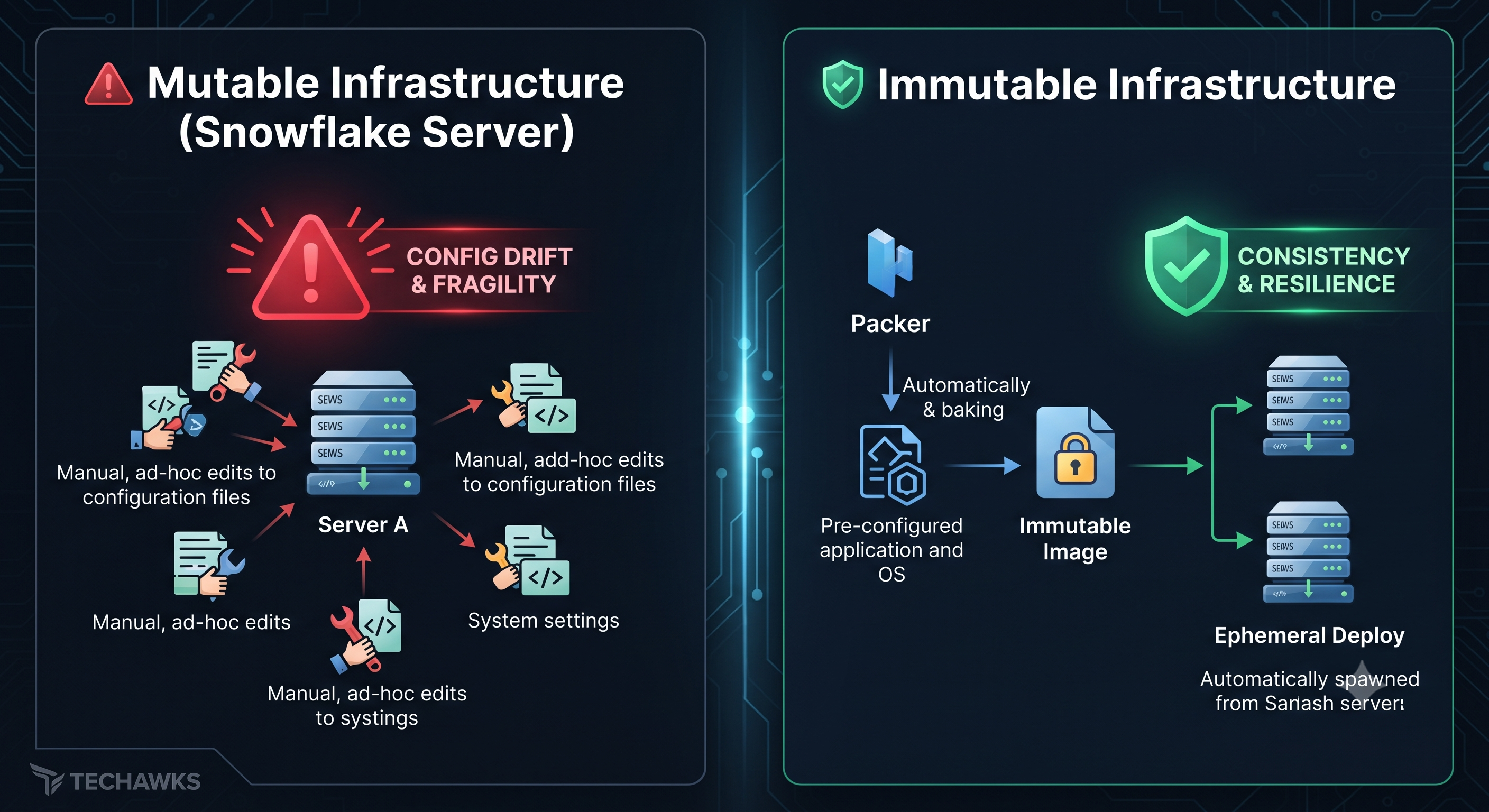
  • Immutable Infrastructure: The 4-Step Checklist to Eliminate Configuration Drift in Production
    As cloud environments scale across multi-region clusters and automated microservices, configuration drift remains one of the most insidious threats to system stability. When servers or containers are modified over time through manual patches or hotfixes, staging and production environments diverge—making troubleshooting a nightmare and disaster recovery unpredictable.


    True cloud-native resilience relies on immutable infrastructure: the principle that servers are never modified after creation. If a change is needed, you destroy the instance and deploy a fresh, pre-configured image or container built from version-controlled code.


    Use this 4-step checklist to enforce immutability across your cloud pipeline:


    Bake Images Instead of Configuring In-Place: Use tools like Packer or Docker to pre-install all dependencies, runtime environments, and application binaries into a locked immutable image before deployment.


    Lock Down Runtime Storage: Mount production container filesystems as read-only. Prevent runtime processes or applications from writing to local disk storage, forcing all persistent data into managed external databases or object stores.


    Automate Infrastructure as Code (IaC): Manage all cloud networking, security groups, and compute resources through declarative code (Terraform, OpenTofu, or Pulumi) with automated drift detection enabled in your pipelines.


    Enforce Ephemeral Compute Policies: Configure auto-scaling groups and container orchestrators (like Kubernetes) to regularly cycle and replace worker nodes, ensuring infrastructure stays fresh and resilient against lingering state corruption.


    Discussion Question: How does your engineering team handle configuration updates in production? Are you strictly enforcing image rebuilding or relying on automated configuration management tools? Let’s discuss below!


    CTA (Join Cloud, DevOps & Open Source): Want to master modern cloud architecture, infrastructure as code, and robust DevOps patterns? Join the Cloud, DevOps & Open Source community:
    Immutable Infrastructure: The 4-Step Checklist to Eliminate Configuration Drift in Production As cloud environments scale across multi-region clusters and automated microservices, configuration drift remains one of the most insidious threats to system stability. When servers or containers are modified over time through manual patches or hotfixes, staging and production environments diverge—making troubleshooting a nightmare and disaster recovery unpredictable. True cloud-native resilience relies on immutable infrastructure: the principle that servers are never modified after creation. If a change is needed, you destroy the instance and deploy a fresh, pre-configured image or container built from version-controlled code. Use this 4-step checklist to enforce immutability across your cloud pipeline: Bake Images Instead of Configuring In-Place: Use tools like Packer or Docker to pre-install all dependencies, runtime environments, and application binaries into a locked immutable image before deployment. Lock Down Runtime Storage: Mount production container filesystems as read-only. Prevent runtime processes or applications from writing to local disk storage, forcing all persistent data into managed external databases or object stores. Automate Infrastructure as Code (IaC): Manage all cloud networking, security groups, and compute resources through declarative code (Terraform, OpenTofu, or Pulumi) with automated drift detection enabled in your pipelines. Enforce Ephemeral Compute Policies: Configure auto-scaling groups and container orchestrators (like Kubernetes) to regularly cycle and replace worker nodes, ensuring infrastructure stays fresh and resilient against lingering state corruption. Discussion Question: How does your engineering team handle configuration updates in production? Are you strictly enforcing image rebuilding or relying on automated configuration management tools? Let’s discuss below! CTA (Join Cloud, DevOps & Open Source): Want to master modern cloud architecture, infrastructure as code, and robust DevOps patterns? Join the Cloud, DevOps & Open Source community:
    0 Commenti 0 condivisioni 322 Views 0 Anteprima
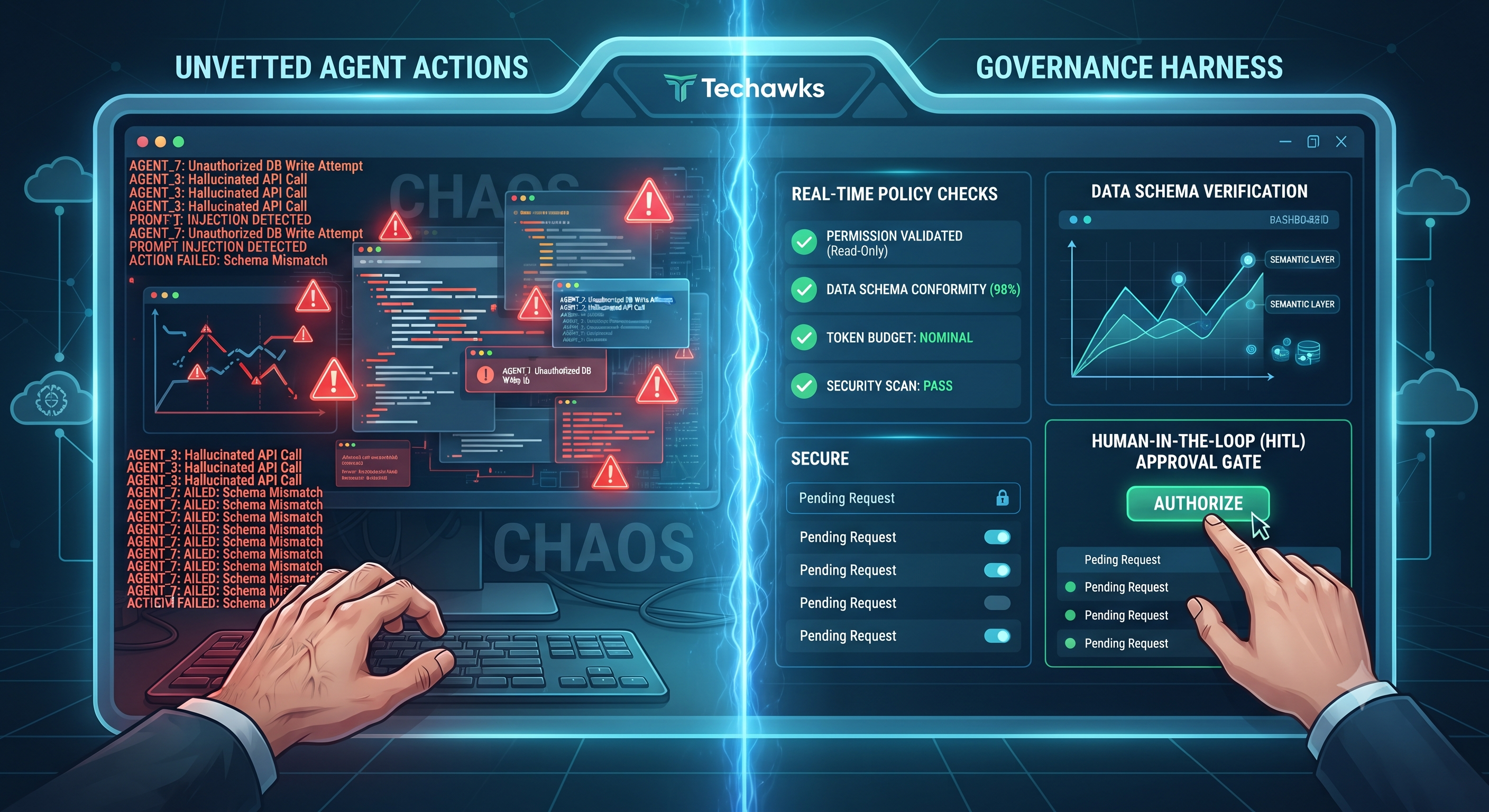
  • From Proof-of-Concept to Production: Governing the Enterprise AI Agentic Era


    As US enterprises accelerate their shift from simple AI experimentation to large-scale agentic deployments, a critical operational reality is taking center stage: autonomous agents are only as reliable as their governance harness.


    Industry surveys from major advisory and research groups reveal that while nearly 90% of organizations regularly utilize AI in various business functions, turning that adoption into sustainable financial and operational return remains a major challenge. The friction no longer stems from model capability; it comes from disconnected data foundations, lack of architectural context, and security blind spots. When autonomous agents are granted the power to execute multi-step workflows across cloud environments, databases, and APIs, naive prompt execution creates unacceptable security risks.


    Why This Matters
    To cross the chasm from experimental pilot to core enterprise infrastructure, tech organizations must implement robust oversight layers. Security and engineering leaders are discovering that an effective AI harness requires treating autonomy not as a single model call, but as a heavily governed, multi-layered system with strict operational boundaries.


    Mini-Tutorial: Implementing an Enterprise AI Governance Harness
    Strengthen your production AI deployment and eliminate silent agent failures by establishing these three architectural controls:


    Step 1: Build a Context-Rich Semantic Data Layer. Ensure your agents query clean, structured, and version-controlled data models rather than messy, fragmented legacy tables that trigger hallucinations and inconsistent logic.


    Step 2: Deploy Multi-Layer AI Guardrails. Integrate runtime security harnesses (such as policy engines and token-budget constraints) that actively intercept agent outputs, validate permissions, and block unauthorized data access or external transmissions.


    Step 3: Mandate Human-in-the-Loop (HITL) Authorizations. Program explicit approval gates for high-impact actions—such as financial transactions, database writes, or production code deployments—so human operators maintain final operational control.


    Discussion Question
    How is your organization balancing the push for rapid agentic automation with enterprise security and governance requirements? Let’s talk strategy below! 👇


    CTA (Join Techawks USA)
    Ready to connect with top US tech leaders, engineers, and innovators navigating the frontier of enterprise AI? Join Techawks USA today to share architecture playbooks, scale your systems, and lead the future of technology!
    From Proof-of-Concept to Production: Governing the Enterprise AI Agentic Era As US enterprises accelerate their shift from simple AI experimentation to large-scale agentic deployments, a critical operational reality is taking center stage: autonomous agents are only as reliable as their governance harness. Industry surveys from major advisory and research groups reveal that while nearly 90% of organizations regularly utilize AI in various business functions, turning that adoption into sustainable financial and operational return remains a major challenge. The friction no longer stems from model capability; it comes from disconnected data foundations, lack of architectural context, and security blind spots. When autonomous agents are granted the power to execute multi-step workflows across cloud environments, databases, and APIs, naive prompt execution creates unacceptable security risks. Why This Matters To cross the chasm from experimental pilot to core enterprise infrastructure, tech organizations must implement robust oversight layers. Security and engineering leaders are discovering that an effective AI harness requires treating autonomy not as a single model call, but as a heavily governed, multi-layered system with strict operational boundaries. Mini-Tutorial: Implementing an Enterprise AI Governance Harness Strengthen your production AI deployment and eliminate silent agent failures by establishing these three architectural controls: Step 1: Build a Context-Rich Semantic Data Layer. Ensure your agents query clean, structured, and version-controlled data models rather than messy, fragmented legacy tables that trigger hallucinations and inconsistent logic. Step 2: Deploy Multi-Layer AI Guardrails. Integrate runtime security harnesses (such as policy engines and token-budget constraints) that actively intercept agent outputs, validate permissions, and block unauthorized data access or external transmissions. Step 3: Mandate Human-in-the-Loop (HITL) Authorizations. Program explicit approval gates for high-impact actions—such as financial transactions, database writes, or production code deployments—so human operators maintain final operational control. Discussion Question How is your organization balancing the push for rapid agentic automation with enterprise security and governance requirements? Let’s talk strategy below! 👇 CTA (Join Techawks USA) Ready to connect with top US tech leaders, engineers, and innovators navigating the frontier of enterprise AI? Join Techawks USA today to share architecture playbooks, scale your systems, and lead the future of technology!
    0 Commenti 0 condivisioni 874 Views 0 Anteprima
  • Why "Restart to Resize" Is Dying: How In-Place Pod Scaling & Scheduler Preemption Fix Kubernetes Overprovisioning


    For over a decade, horizontal scaling (HPA) was the default Kubernetes reaction to traffic surges. But for stateful workloads—databases, distributed caches, and LLM inference engines with gigabytes of weights loaded into memory—horizontal scaling is often too slow, expensive, or architecturally impossible.


    Until recently, vertical scaling (VPA) carried a painful tradeoff: updating a container's resource requests or limits required recreating the Pod.


    Recreating a pod means:
    Severing active TCP sessions and draining connections.
    Forcing stateful nodes to warm their local memory, page caches, and scratch disks from scratch.


    Increasing initialization latencies from milliseconds to minutes.


    The Architectural Shift: Dynamic In-Place Scaling Meets Scheduler Preemption
    Cloud-native operations have matured beyond destructive restarts. Through the progression of In-Place Pod Vertical Scaling and centralized Scheduler Preemption for In-Place Resizing, the control plane now treats resource boundaries as dynamic parameters rather than immutable pod specs:


    Zero-Downtime Resource Expansion: When a container hits its memory or CPU threshold, the control plane updates the cgroups hierarchy directly via the Kubelet on the existing host without terminating the process or cycling PID 1.


    Centralized Scheduler Coordination: Instead of letting local Kubelets make ad-hoc, conflicting eviction decisions during a resize, the centralized scheduler evaluates pods in a Deferred resize state. It tracks capacity reservations to prevent double-allocation and scheduling races.


    Localized, Node-Scoped Preemption: When a high-priority pod needs immediate vertical headroom on a saturated node, the scheduler evaluates eligible lower-priority victim pods strictly localized to that specific host. It initiates graceful evictions under Pod Disruption Budgets (PDBs) to clear host headroom dynamically.


    Treating infrastructure capacity as elastic at the node level eliminates the need to over-provision static headroom "just in case." You can run tight cluster bin-packing while maintaining the responsiveness needed for unpredictable, latency-sensitive workloads.


    Discussion Question
    For workloads with high warm-up overhead (like Redis, JVM services, or inference models), do you currently over-provision static limits to avoid pod restarts, or are you adopting in-place cgroup vertical scaling?


    CTA
    Stop wasting compute and engineer truly resilient cloud-native infrastructure. Connect with SREs, platform engineers, and cloud architects inside Cloud, DevOps & Open Source to exchange production Kubernetes configurations, capacity planning playbooks, and GitOps workflows.
    Why "Restart to Resize" Is Dying: How In-Place Pod Scaling & Scheduler Preemption Fix Kubernetes Overprovisioning For over a decade, horizontal scaling (HPA) was the default Kubernetes reaction to traffic surges. But for stateful workloads—databases, distributed caches, and LLM inference engines with gigabytes of weights loaded into memory—horizontal scaling is often too slow, expensive, or architecturally impossible. Until recently, vertical scaling (VPA) carried a painful tradeoff: updating a container's resource requests or limits required recreating the Pod. Recreating a pod means: Severing active TCP sessions and draining connections. Forcing stateful nodes to warm their local memory, page caches, and scratch disks from scratch. Increasing initialization latencies from milliseconds to minutes. The Architectural Shift: Dynamic In-Place Scaling Meets Scheduler Preemption Cloud-native operations have matured beyond destructive restarts. Through the progression of In-Place Pod Vertical Scaling and centralized Scheduler Preemption for In-Place Resizing, the control plane now treats resource boundaries as dynamic parameters rather than immutable pod specs: Zero-Downtime Resource Expansion: When a container hits its memory or CPU threshold, the control plane updates the cgroups hierarchy directly via the Kubelet on the existing host without terminating the process or cycling PID 1. Centralized Scheduler Coordination: Instead of letting local Kubelets make ad-hoc, conflicting eviction decisions during a resize, the centralized scheduler evaluates pods in a Deferred resize state. It tracks capacity reservations to prevent double-allocation and scheduling races. Localized, Node-Scoped Preemption: When a high-priority pod needs immediate vertical headroom on a saturated node, the scheduler evaluates eligible lower-priority victim pods strictly localized to that specific host. It initiates graceful evictions under Pod Disruption Budgets (PDBs) to clear host headroom dynamically. Treating infrastructure capacity as elastic at the node level eliminates the need to over-provision static headroom "just in case." You can run tight cluster bin-packing while maintaining the responsiveness needed for unpredictable, latency-sensitive workloads. Discussion Question For workloads with high warm-up overhead (like Redis, JVM services, or inference models), do you currently over-provision static limits to avoid pod restarts, or are you adopting in-place cgroup vertical scaling? CTA Stop wasting compute and engineer truly resilient cloud-native infrastructure. Connect with SREs, platform engineers, and cloud architects inside Cloud, DevOps & Open Source to exchange production Kubernetes configurations, capacity planning playbooks, and GitOps workflows.
    0 Commenti 0 condivisioni 442 Views 0 Anteprima
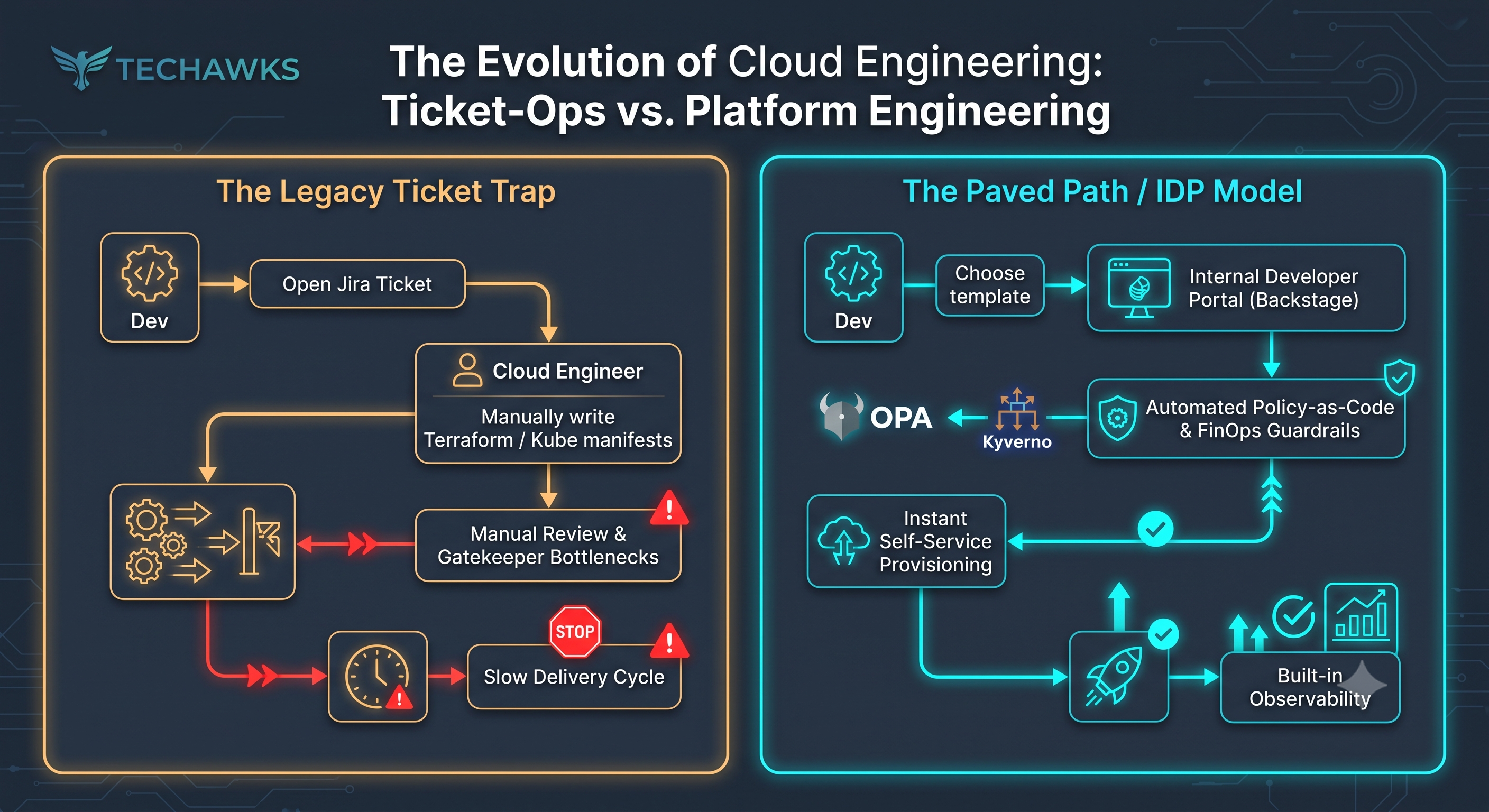
  • Why "Ticket-Ops" Is Killing Your Cloud Career (And How Platform Thinking Saves It)


    Gartner projected that 80% of large engineering organizations would establish dedicated platform teams by 2026—and looking across modern infrastructure stacks today, that reality is already here.


    Yet, far too many cloud engineers remain stuck in the "DevOps reactive trap":
    A developer needs an RDS cluster or S3 bucket -> They open a Jira ticket.
    You manually write HCL, run plan, get sign-off, and apply.
    A deployment breaks -> You get paged at 2 AM because nobody else understands the manifest.
    This is not DevOps; it is glorified operations disguised as automation.
    When AI coding assistants and automation tooling can generate boilerplate Terraform and Kubernetes manifests in seconds, the cloud engineers commanding top-tier career leverage aren’t the ones typing YAML—they are Platform Engineers treating infrastructure as an internal product.
    Here is how you shift your career from Reactive Operator to Platform Architect:


    1. Stop Provisioning Resources; Start Building "Golden Paths"
    Don’t hand developers raw cloud primitives where they can misconfigure security groups or incur run-away costs. Package your architecture into opinionated, self-service templates (via tools like Backstage or custom CLI workflows).
    Old way: Manually spinning up an EKS namespace and ingress on request.
    New way: Codifying a "Node.js service standard" where a developer runs one command to get repo scaffolding, automated CI/CD, RBAC, and telemetry out of the box.


    2. Trade "Manual Gates" for Policy-as-Code & FinOps Guardrails
    If you are the human bottleneck reviewing every pull request for IAM least-privilege or cost overruns, you don't scale.
    Enforce pre-commit and admission controls (using Kyverno, Open Policy Agent, or Infracost).
    Let code linters and CI policies block unencrypted storage or missing resource limits before you ever see a PR.


    3. Measure Value by "Developer Cognitive Load," Not Uptime
    Uptime is table stakes. High-leverage platform teams measure:
    Time to First Deploy: How fast can a new hire ship their first microservice to staging?
    Self-Service Adoption: Are engineers choosing your paved path over custom hacky pipelines?


    Career Takeaway: Your engineering value is no longer measured by how many cloud resources you personally manage. It’s measured by how many developers can safely deploy to production without ever having to speak with you.


    Discussion Question
    What is the single biggest bottleneck in your current deployment workflow: slow approval gates, cognitive overload on complex Helm charts, or ticket-driven infrastructure requests?


    CTA
    Ready to move past reactive DevOps and build scalable internal platforms?
    👉 Join Cloud, DevOps & Open Source on Techawks for production architectures, platform engineering blueprints, and open-source tooling breakdowns.
    Why "Ticket-Ops" Is Killing Your Cloud Career (And How Platform Thinking Saves It) Gartner projected that 80% of large engineering organizations would establish dedicated platform teams by 2026—and looking across modern infrastructure stacks today, that reality is already here. Yet, far too many cloud engineers remain stuck in the "DevOps reactive trap": A developer needs an RDS cluster or S3 bucket -> They open a Jira ticket. You manually write HCL, run plan, get sign-off, and apply. A deployment breaks -> You get paged at 2 AM because nobody else understands the manifest. This is not DevOps; it is glorified operations disguised as automation. When AI coding assistants and automation tooling can generate boilerplate Terraform and Kubernetes manifests in seconds, the cloud engineers commanding top-tier career leverage aren’t the ones typing YAML—they are Platform Engineers treating infrastructure as an internal product. Here is how you shift your career from Reactive Operator to Platform Architect: 1. Stop Provisioning Resources; Start Building "Golden Paths" Don’t hand developers raw cloud primitives where they can misconfigure security groups or incur run-away costs. Package your architecture into opinionated, self-service templates (via tools like Backstage or custom CLI workflows). Old way: Manually spinning up an EKS namespace and ingress on request. New way: Codifying a "Node.js service standard" where a developer runs one command to get repo scaffolding, automated CI/CD, RBAC, and telemetry out of the box. 2. Trade "Manual Gates" for Policy-as-Code & FinOps Guardrails If you are the human bottleneck reviewing every pull request for IAM least-privilege or cost overruns, you don't scale. Enforce pre-commit and admission controls (using Kyverno, Open Policy Agent, or Infracost). Let code linters and CI policies block unencrypted storage or missing resource limits before you ever see a PR. 3. Measure Value by "Developer Cognitive Load," Not Uptime Uptime is table stakes. High-leverage platform teams measure: Time to First Deploy: How fast can a new hire ship their first microservice to staging? Self-Service Adoption: Are engineers choosing your paved path over custom hacky pipelines? Career Takeaway: Your engineering value is no longer measured by how many cloud resources you personally manage. It’s measured by how many developers can safely deploy to production without ever having to speak with you. Discussion Question What is the single biggest bottleneck in your current deployment workflow: slow approval gates, cognitive overload on complex Helm charts, or ticket-driven infrastructure requests? CTA Ready to move past reactive DevOps and build scalable internal platforms? 👉 Join Cloud, DevOps & Open Source on Techawks for production architectures, platform engineering blueprints, and open-source tooling breakdowns.
    0 Commenti 0 condivisioni 620 Views 0 Anteprima
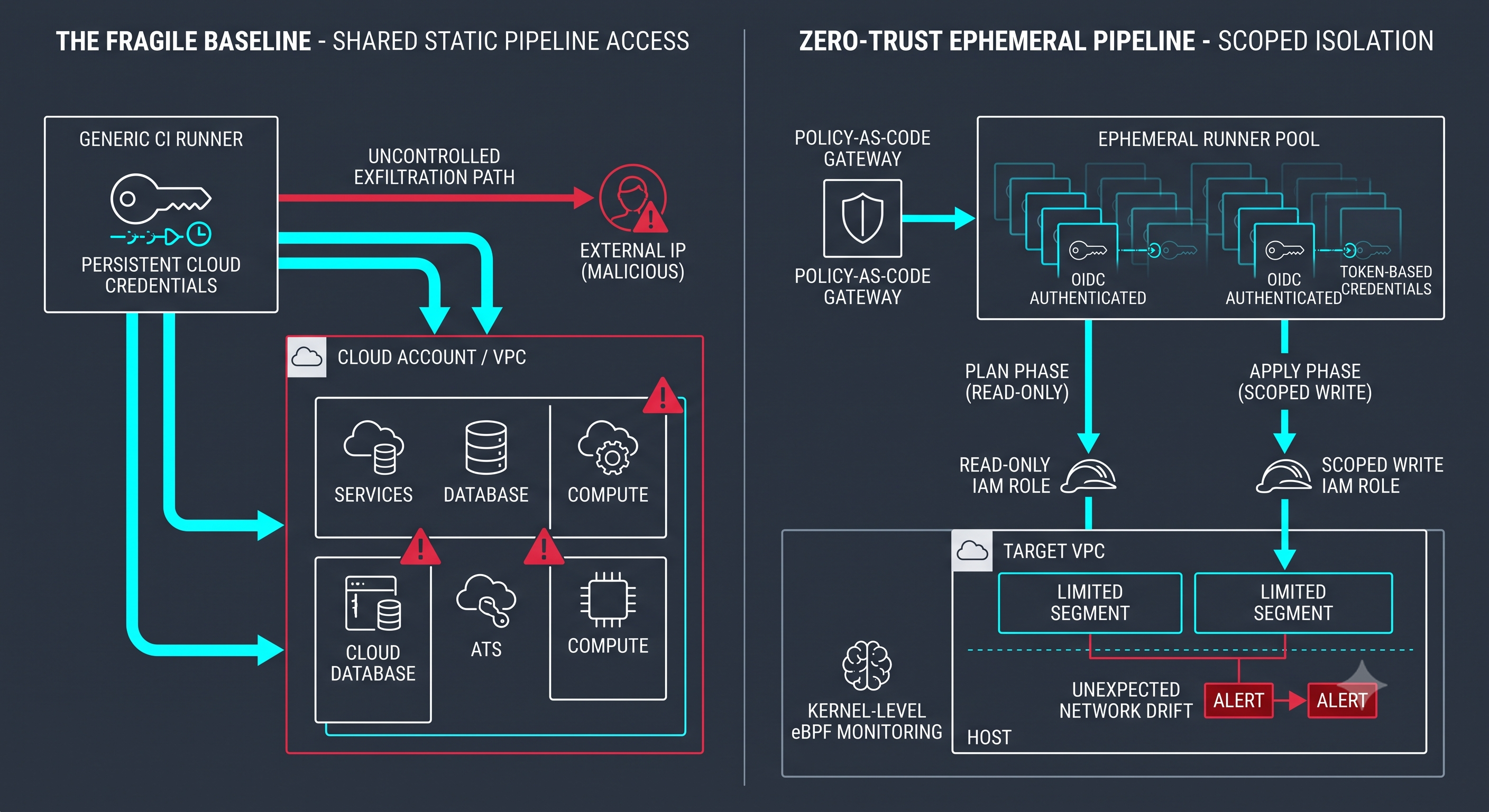
  • The Hidden Danger of "Permissive" Ephemeral Infrastructure: Hardening Your CI/CD & Cluster Control Plane


    As teams scale GitOps and platform engineering, infrastructure provisioning has become fully dynamic. Dynamic runners spin up, assume cloud IAM roles, apply Kubernetes manifests or IaC modules, and terminate.


    The trap? Ephemeral execution with static trust.


    Engineers often grant wide IAM permissions (e.g., * on S3 buckets, wide VPC modification, or cluster-admin service accounts) under the false assumption that because the runner lives for only 6 minutes, the blast radius is negligible. In practice, compromised third-party dependencies, malicious PR actions, or leaked pipeline context tokens convert short-lived environments into full control plane takeover vectors.
    Resilient cloud architecture demands that credential lifespans match the micro-task, not the entire build pipeline.


    Before your next release cycle, run this audit across your deployment pipelines:


    The Zero-Trust Ephemeral Infrastructure Checklist


    [ ] 1. Enforce Workload Identity Federation (No Static API Keys)
    Eliminate static access keys stored in CI variables. Mandate OIDC (OpenID Connect) federation (e.g., GitHub Actions/GitLab OIDC to AWS IAM, GCP Workload Identity, or Azure Federated Credentials) with strictly bounded audience and subject claims.


    [ ] 2. Scope IAM to Single Plan/Apply Phases (Task-Level Scoping)
    Decouple your pipeline roles: the "plan/spec" phase receives strictly read-only metadata permissions, while the "apply" phase receives narrow write access restricted to the targeted state file and VPC resources.


    [ ] 3. Adopt Kernel-Level Runtime Observability (eBPF)
    Traditional container logs miss unauthorized outbound connections or privilege escalations initiated inside dynamic runners. Deploy eBPF-based runtime monitoring (such as Cilium or Falco) to flag unexpected process execution at the host level.


    [ ] 4. Enforce Policy-as-Code Gates Before State Locking
    Integrate deterministic validation (Open Policy Agent/Rego, Kyverno, or Trivy) inside the pipeline. Block deployments automatically if a pull request introduces open security groups (0.0.0.0/0), elevated container privileges, or missing encryption tags.


    [ ] 5. Cap Token TTL to Sub-Hour Limits
    Set the maximum session duration for assumed STS/IAM roles to match the mean pipeline runtime (e.g., 15–30 minutes), preventing cached credential reuse in the event of an artifact leak.


    [ ] 6. Isolate Dynamic Runners in Dedicated VPCs
    Ensure dynamic runners and build agents do not run in the same internal network plane as staging or production databases. Enforce strict egress filtering—runners only connect to designated registries and cloud control-plane endpoints.


    Discussion Question
    How does your team enforce the boundary between read-only evaluation and write-level deployment privileges inside automated GitOps workflows?


    CTA
    Join Cloud, DevOps & Open Source — follow Techawks Cloud & DevOps for hands-on architectural blueprints, infrastructure teardowns, and actionable reliability checklists.
    The Hidden Danger of "Permissive" Ephemeral Infrastructure: Hardening Your CI/CD & Cluster Control Plane As teams scale GitOps and platform engineering, infrastructure provisioning has become fully dynamic. Dynamic runners spin up, assume cloud IAM roles, apply Kubernetes manifests or IaC modules, and terminate. The trap? Ephemeral execution with static trust. Engineers often grant wide IAM permissions (e.g., * on S3 buckets, wide VPC modification, or cluster-admin service accounts) under the false assumption that because the runner lives for only 6 minutes, the blast radius is negligible. In practice, compromised third-party dependencies, malicious PR actions, or leaked pipeline context tokens convert short-lived environments into full control plane takeover vectors. Resilient cloud architecture demands that credential lifespans match the micro-task, not the entire build pipeline. Before your next release cycle, run this audit across your deployment pipelines: The Zero-Trust Ephemeral Infrastructure Checklist [ ] 1. Enforce Workload Identity Federation (No Static API Keys) Eliminate static access keys stored in CI variables. Mandate OIDC (OpenID Connect) federation (e.g., GitHub Actions/GitLab OIDC to AWS IAM, GCP Workload Identity, or Azure Federated Credentials) with strictly bounded audience and subject claims. [ ] 2. Scope IAM to Single Plan/Apply Phases (Task-Level Scoping) Decouple your pipeline roles: the "plan/spec" phase receives strictly read-only metadata permissions, while the "apply" phase receives narrow write access restricted to the targeted state file and VPC resources. [ ] 3. Adopt Kernel-Level Runtime Observability (eBPF) Traditional container logs miss unauthorized outbound connections or privilege escalations initiated inside dynamic runners. Deploy eBPF-based runtime monitoring (such as Cilium or Falco) to flag unexpected process execution at the host level. [ ] 4. Enforce Policy-as-Code Gates Before State Locking Integrate deterministic validation (Open Policy Agent/Rego, Kyverno, or Trivy) inside the pipeline. Block deployments automatically if a pull request introduces open security groups (0.0.0.0/0), elevated container privileges, or missing encryption tags. [ ] 5. Cap Token TTL to Sub-Hour Limits Set the maximum session duration for assumed STS/IAM roles to match the mean pipeline runtime (e.g., 15–30 minutes), preventing cached credential reuse in the event of an artifact leak. [ ] 6. Isolate Dynamic Runners in Dedicated VPCs Ensure dynamic runners and build agents do not run in the same internal network plane as staging or production databases. Enforce strict egress filtering—runners only connect to designated registries and cloud control-plane endpoints. Discussion Question How does your team enforce the boundary between read-only evaluation and write-level deployment privileges inside automated GitOps workflows? CTA Join Cloud, DevOps & Open Source — follow Techawks Cloud & DevOps for hands-on architectural blueprints, infrastructure teardowns, and actionable reliability checklists.
    0 Commenti 0 condivisioni 540 Views 0 Anteprima
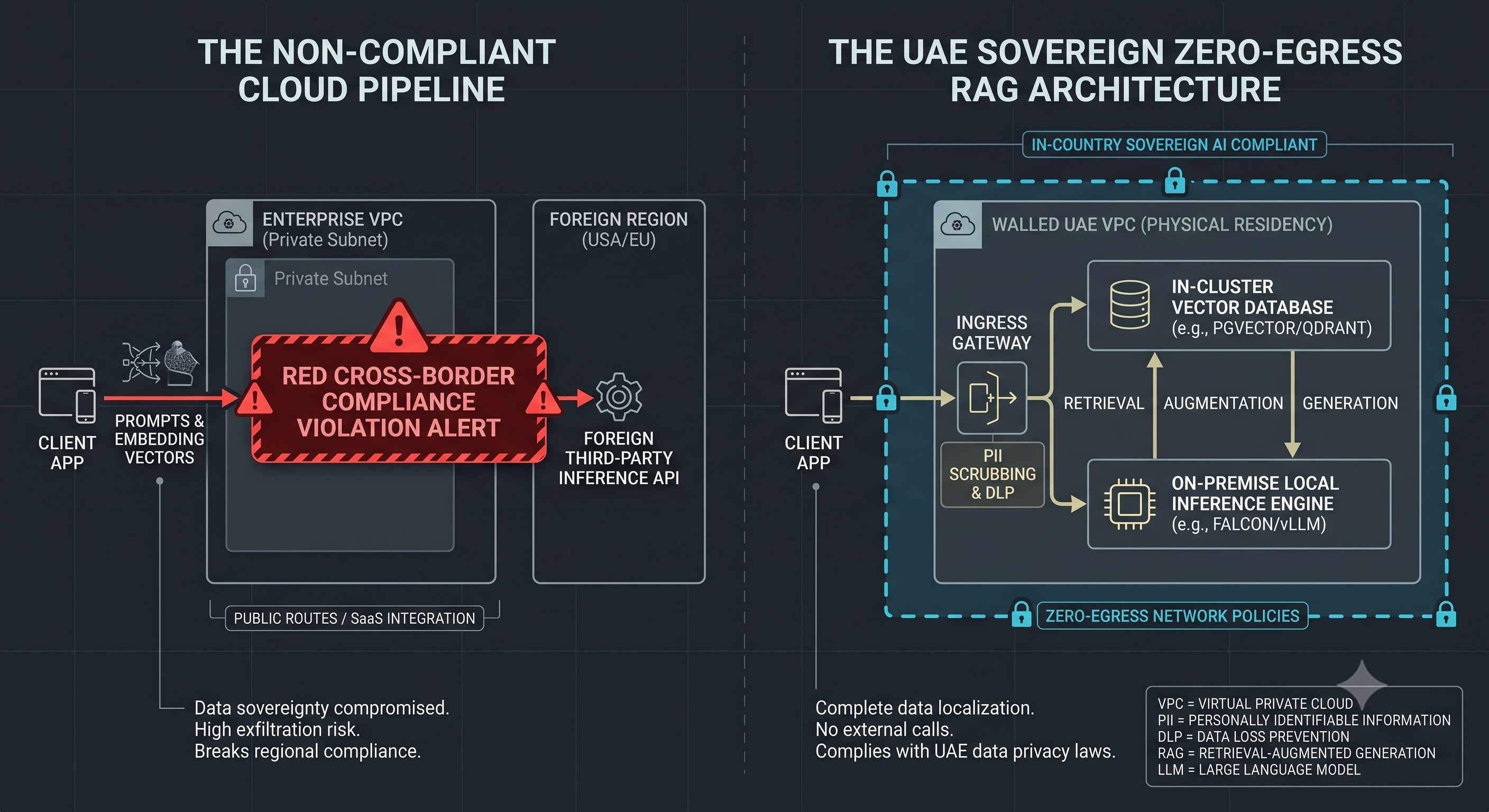
  • Architecting Zero-Egress RAG for UAE Sovereign AI Compliance


    With UAE regulatory enforcement intensifying around cross-border telemetry and data residency, enterprise engineering teams in Dubai and Abu Dhabi face a hard constraint: critical citizen data, corporate IP, and regulated customer records cannot leave national borders.


    Sending vector embeddings, raw prompt contexts, or fine-tuning datasets to public SaaS inference endpoints outside the country breaks compliance by design. Sovereign AI is not just about choosing an open-weight base model—it is about enforcing strict, zero-egress data planes.


    Here is an architectural blueprint to build an in-country, zero-egress RAG pipeline using open-weight models (such as Falcon or Jais) running entirely on sovereign UAE compute.


    1. Isolate the Compute and Model Tier
    Deploy your foundational model within local boundaries (e.g., Azure UAE Central/North regions, sovereign GPU providers like Core42, or air-gapped on-premise infrastructure).
    Pull open-weight checkpoints (e.g., Falcon-2 or Jais-13b-chat) and run inference through high-throughput engines like vLLM or TGI (Text Generation Inference) isolated inside your private VPC.


    Disable all outbound public internet routing on your model worker nodes:
    Bash
    # Verify no default outbound route exists on the inference subnet
    ip route show | grep default
    # Ensure traffic to external endpoints drops immediately
    curl --connect-timeout 3 https://api.openai.com || echo "Egress blocked: Verified."


    2. Deploy Local Vector Stores with Hardware-Isolated Tenants
    Avoid managed multi-tenant vector clouds hosted outside the GCC. Host an internal instance of Qdrant, pgvector, or Milvus within your secure cluster:
    Enforce TLS 1.3 encryption for in-flight embedding ingestion.
    Generate embeddings in-VPC using open embedding models (such as bge-m3 or local multilingual BERT variants) so that raw documents are tokenized and vectorized without exposing plaintext payloads to external networks.


    3. Implement Ingress Sanitization and Redaction
    Before enterprise context enters your retrieval pipeline:
    Run a local Named Entity Recognition (NER) model at your ingress gateway to detect Emirates IDs, payment data, and sensitive PII.
    Enforce prompt scrubbing and strict Data Loss Prevention (DLP) rules prior to context injection.


    4. Audit VPC Telemetry and DNS Leaks
    Even if inference is local, client SDKs often default to sending background usage analytics or crash metrics to overseas SaaS telemetry endpoints.
    Route cluster DNS queries through an internal, logging DNS resolver (e.g., CoreDNS).
    Configure network security groups to explicitly drop UDP/TCP port 53 traffic aimed at public resolvers (8.8.8.8, 1.1.1.1), terminating all internal name resolution within your UAE private network.
    Building sovereign AI infrastructure shifts data protection from an operational policy document into an immutable infrastructure constraint.


    Discussion Question
    When deploying local generative models across UAE enterprise workloads, are you containerizing self-hosted open-weight models in private VPCs, or relying on dedicated, UAE-domiciled sovereign cloud managed endpoints?


    CTA (Join Techawks UAE)
    Join the Techawks UAE community to exchange architectural patterns, deployment playbooks, and systems engineering benchmarks with developers and cloud architects across the Emirates.
    Architecting Zero-Egress RAG for UAE Sovereign AI Compliance With UAE regulatory enforcement intensifying around cross-border telemetry and data residency, enterprise engineering teams in Dubai and Abu Dhabi face a hard constraint: critical citizen data, corporate IP, and regulated customer records cannot leave national borders. Sending vector embeddings, raw prompt contexts, or fine-tuning datasets to public SaaS inference endpoints outside the country breaks compliance by design. Sovereign AI is not just about choosing an open-weight base model—it is about enforcing strict, zero-egress data planes. Here is an architectural blueprint to build an in-country, zero-egress RAG pipeline using open-weight models (such as Falcon or Jais) running entirely on sovereign UAE compute. 1. Isolate the Compute and Model Tier Deploy your foundational model within local boundaries (e.g., Azure UAE Central/North regions, sovereign GPU providers like Core42, or air-gapped on-premise infrastructure). Pull open-weight checkpoints (e.g., Falcon-2 or Jais-13b-chat) and run inference through high-throughput engines like vLLM or TGI (Text Generation Inference) isolated inside your private VPC. Disable all outbound public internet routing on your model worker nodes: Bash # Verify no default outbound route exists on the inference subnet ip route show | grep default # Ensure traffic to external endpoints drops immediately curl --connect-timeout 3 https://api.openai.com || echo "Egress blocked: Verified." 2. Deploy Local Vector Stores with Hardware-Isolated Tenants Avoid managed multi-tenant vector clouds hosted outside the GCC. Host an internal instance of Qdrant, pgvector, or Milvus within your secure cluster: Enforce TLS 1.3 encryption for in-flight embedding ingestion. Generate embeddings in-VPC using open embedding models (such as bge-m3 or local multilingual BERT variants) so that raw documents are tokenized and vectorized without exposing plaintext payloads to external networks. 3. Implement Ingress Sanitization and Redaction Before enterprise context enters your retrieval pipeline: Run a local Named Entity Recognition (NER) model at your ingress gateway to detect Emirates IDs, payment data, and sensitive PII. Enforce prompt scrubbing and strict Data Loss Prevention (DLP) rules prior to context injection. 4. Audit VPC Telemetry and DNS Leaks Even if inference is local, client SDKs often default to sending background usage analytics or crash metrics to overseas SaaS telemetry endpoints. Route cluster DNS queries through an internal, logging DNS resolver (e.g., CoreDNS). Configure network security groups to explicitly drop UDP/TCP port 53 traffic aimed at public resolvers (8.8.8.8, 1.1.1.1), terminating all internal name resolution within your UAE private network. Building sovereign AI infrastructure shifts data protection from an operational policy document into an immutable infrastructure constraint. Discussion Question When deploying local generative models across UAE enterprise workloads, are you containerizing self-hosted open-weight models in private VPCs, or relying on dedicated, UAE-domiciled sovereign cloud managed endpoints? CTA (Join Techawks UAE) Join the Techawks UAE community to exchange architectural patterns, deployment playbooks, and systems engineering benchmarks with developers and cloud architects across the Emirates.
    0 Commenti 0 condivisioni 652 Views 0 Anteprima
  • Upgrading Edge Ingress to Hybrid Post-Quantum Key Exchange (ML-KEM-768)


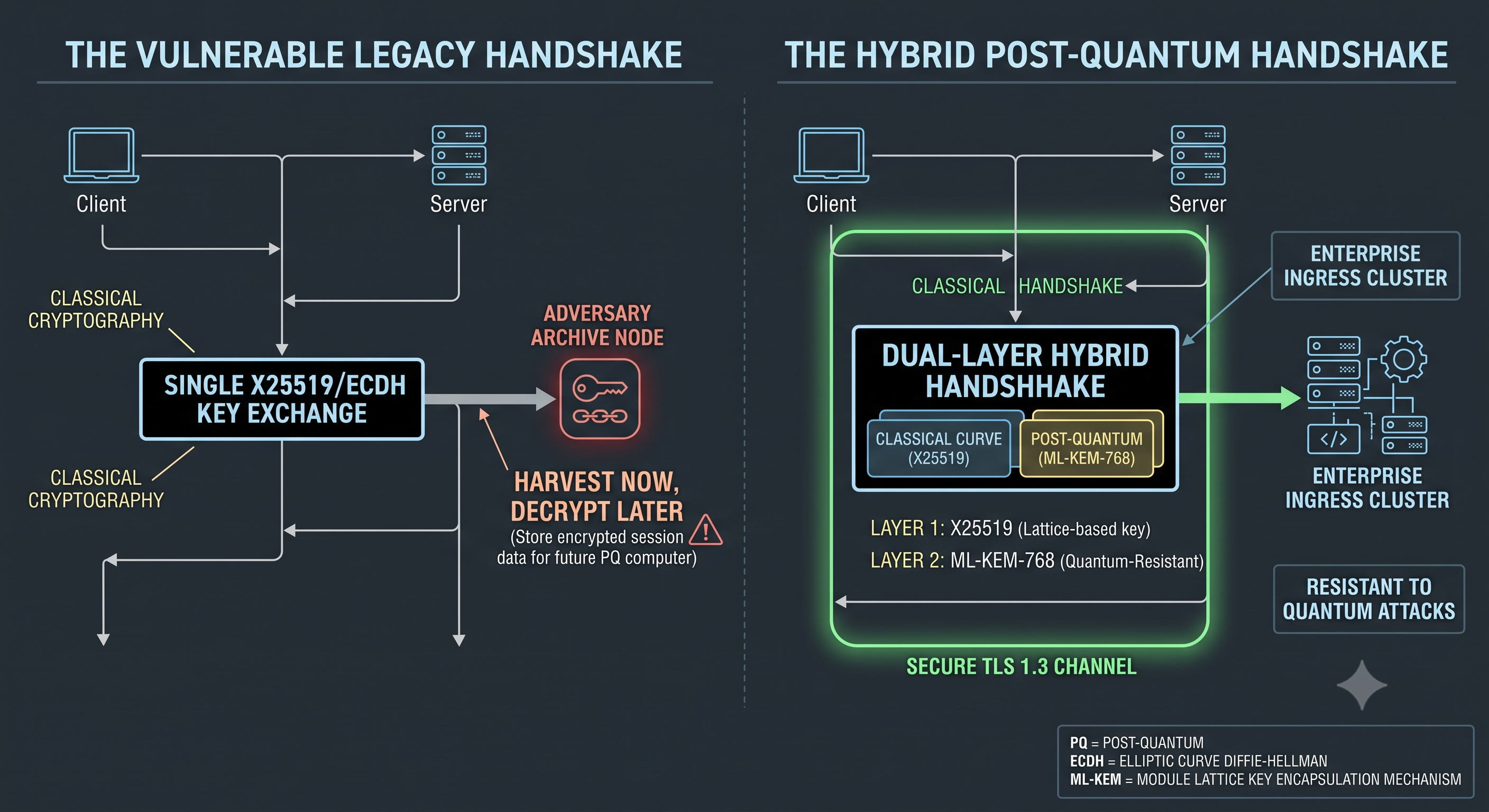
    "Harvest Now, Decrypt Later" (HNDL) is not a future vulnerability—adversaries are actively intercepting and storing encrypted traffic passing through UK internet exchanges. For UK engineering teams handling sensitive customer data, IP, or financial payloads with a 5+ year shelf-life, securing transit channels requires moving to hybrid key encapsulation right now.
    The UK National Cyber Security Centre (NCSC) guidance prioritises hybrid implementations as the bridge to complete quantum resistance: pairing classical curves with lattice-based algorithms so that legacy compliance and performance remain intact while establishing post-quantum security.
    Here is a practical tutorial to audit and test hybrid PQC on your ingress layer:


    1. Understand the Hybrid Mechanism
    Instead of negotiating a single secret over classical Elliptic Curve Diffie-Hellman (ECDH), hybrid key exchange (such as X25519Kyber768Draft00 / X25519MLKEM768) performs two handshakes simultaneously inside TLS 1.3:
    Classical component: Standard X25519 ensures backward compatibility and baseline cryptographic guarantees.
    Lattice component: ML-KEM-768 (standardised from Kyber) provides quantum-resistant encapsulation.
    The resulting shared secret is derived through HKDF (HMAC-based Extract-and-Expand Key Derivation Function) from both public keys, meaning an adversary must break both schemes to decrypt the payload.


    2. Audit Client Hello Sizes and MTU Fragmentation
    ML-KEM-768 public keys and ciphertexts are significantly larger than classical 32-byte X25519 keys (~1,184 bytes).
    Verify whether your edge proxies, WAFs, or upstream cloud load balancers drop Client Hello packets exceeding typical MTU thresholds (1,500 bytes).
    Ensure your ingress gateway supports TCP segmentation and TLS fragmentation properly without dropping truncated handshakes.


    3. Configure Ingress Testing (Envoy / OpenSSL 3.x / BoringSSL)
    In your edge proxy configuration (e.g., Envoy or modern NGINX built against an ML-KEM-capable OpenSSL/BoringSSL branch):
    Verify supported TLS 1.3 cipher suites and key exchange groups:
    YAML
    tls_certificates:
    - certificate_chain: { filename: "/etc/ssl/certs/ingress.crt" }
    private_key: { filename: "/etc/ssl/private/ingress.key" }
    tls_params:
    tls_minimum_protocol_version: TLSv1_3
    ecdh_curves:
    - X25519MLKEM768
    - X25519
    Deploy the configuration to a canary staging cluster.


    4. Validate via CLI
    Test your endpoint using a PQC-enabled build of curl or openssl:
    Bash
    openssl s_client -connect api.staging.internal:443 -tls1_3 -curves X25519MLKEM768
    Inspect the output to confirm Temp Key: ML-KEM-768 + X25519 was successfully agreed upon during the TLS 1.3 handshake.


    Discussion Question
    Has your team audited packet fragmentation risks for larger PQC key exchanges on existing reverse proxies, or are you waiting for cloud ingress providers to toggle it by default?


    CTA (Join Techawks UK)
    Join the Techawks UK community to connect with local systems engineers, platform leads, and cloud architects deploying resilient, quantum-ready infrastructure.
    Upgrading Edge Ingress to Hybrid Post-Quantum Key Exchange (ML-KEM-768) "Harvest Now, Decrypt Later" (HNDL) is not a future vulnerability—adversaries are actively intercepting and storing encrypted traffic passing through UK internet exchanges. For UK engineering teams handling sensitive customer data, IP, or financial payloads with a 5+ year shelf-life, securing transit channels requires moving to hybrid key encapsulation right now. The UK National Cyber Security Centre (NCSC) guidance prioritises hybrid implementations as the bridge to complete quantum resistance: pairing classical curves with lattice-based algorithms so that legacy compliance and performance remain intact while establishing post-quantum security. Here is a practical tutorial to audit and test hybrid PQC on your ingress layer: 1. Understand the Hybrid Mechanism Instead of negotiating a single secret over classical Elliptic Curve Diffie-Hellman (ECDH), hybrid key exchange (such as X25519Kyber768Draft00 / X25519MLKEM768) performs two handshakes simultaneously inside TLS 1.3: Classical component: Standard X25519 ensures backward compatibility and baseline cryptographic guarantees. Lattice component: ML-KEM-768 (standardised from Kyber) provides quantum-resistant encapsulation. The resulting shared secret is derived through HKDF (HMAC-based Extract-and-Expand Key Derivation Function) from both public keys, meaning an adversary must break both schemes to decrypt the payload. 2. Audit Client Hello Sizes and MTU Fragmentation ML-KEM-768 public keys and ciphertexts are significantly larger than classical 32-byte X25519 keys (~1,184 bytes). Verify whether your edge proxies, WAFs, or upstream cloud load balancers drop Client Hello packets exceeding typical MTU thresholds (1,500 bytes). Ensure your ingress gateway supports TCP segmentation and TLS fragmentation properly without dropping truncated handshakes. 3. Configure Ingress Testing (Envoy / OpenSSL 3.x / BoringSSL) In your edge proxy configuration (e.g., Envoy or modern NGINX built against an ML-KEM-capable OpenSSL/BoringSSL branch): Verify supported TLS 1.3 cipher suites and key exchange groups: YAML tls_certificates: - certificate_chain: { filename: "/etc/ssl/certs/ingress.crt" } private_key: { filename: "/etc/ssl/private/ingress.key" } tls_params: tls_minimum_protocol_version: TLSv1_3 ecdh_curves: - X25519MLKEM768 - X25519 Deploy the configuration to a canary staging cluster. 4. Validate via CLI Test your endpoint using a PQC-enabled build of curl or openssl: Bash openssl s_client -connect api.staging.internal:443 -tls1_3 -curves X25519MLKEM768 Inspect the output to confirm Temp Key: ML-KEM-768 + X25519 was successfully agreed upon during the TLS 1.3 handshake. Discussion Question Has your team audited packet fragmentation risks for larger PQC key exchanges on existing reverse proxies, or are you waiting for cloud ingress providers to toggle it by default? CTA (Join Techawks UK) Join the Techawks UK community to connect with local systems engineers, platform leads, and cloud architects deploying resilient, quantum-ready infrastructure.
    0 Commenti 0 condivisioni 676 Views 0 Anteprima
  • Beyond the White House Post-Quantum Cryptography Mandates: How to Implement Hybrid TLS in Your Stack


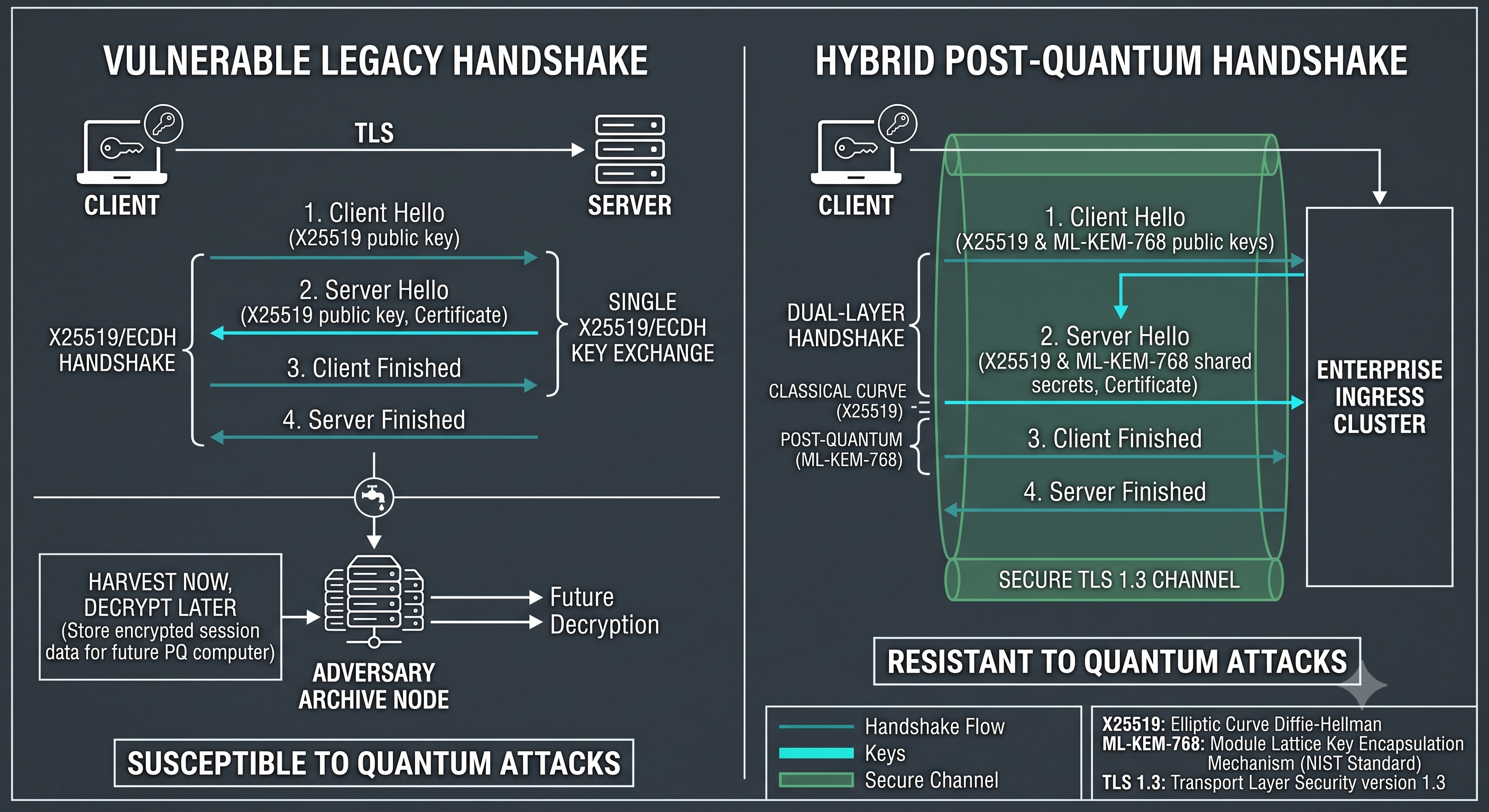
    Adversaries do not need a functional cryptographically relevant quantum computer today to compromise your enterprise data; they only need to intercept and archive encrypted traffic now and crack it once hardware catches up.


    With the Office of Management and Budget (OMB) and CISA enforcing aggressive migration milestones—and major cloud edge networks already serving post-quantum traffic by default—US platform and security engineering teams must shift to crypto-agility.


    The standard operational approach isn't an overnight rip-and-replace of RSA or ECC. It is deploying hybrid post-quantum key exchange (X25519 + ML-KEM).


    Here is the three-step pattern to introduce post-quantum resilience to your ingress and microservice boundaries today:


    1. Enable Hybrid Key Encapsulation (ML-KEM) at the Ingress Edge
    Modern TLS 1.3 supports hybrid key establishment. A hybrid handshake binds a classical algorithm (like X25519) with a post-quantum algorithm (like ML-KEM-768):
    The connection remains fully secure even if the post-quantum primitive has unexpected implementation vulnerabilities.
    The session key is protected against future quantum decryption even if the classical key exchange is eventually broken.
    Configure your reverse proxy, CDN, or gateway (e.g., Envoy, Cloudflare, AWS CloudFront) to prioritize post-quantum hybrid cipher groups (X25519MLKEM768) in the ClientHello negotiation.


    2. Audit MTU Sizes and Packet Fragmentation Limits
    Post-quantum cryptographic artifacts (keys, ciphertexts, and signatures) are significantly larger than traditional elliptic-curve parameters:
    ML-KEM keys and ciphertexts expand the initial TLS handshake size, which can push TCP payloads past standard 1500-byte MTUs.
    Benchmark internal service-to-service gRPC or mTLS meshes under post-quantum cipher suites. If middleboxes, legacy firewalls, or load balancers drop fragmented initial packets, your connections will experience silent handshake timeouts.


    3. Build a Software Inventory of Cryptographic Primitives (CBOM)
    You cannot migrate what you cannot see. Replace hardcoded cryptographic libraries across your codebase:
    Generate a Cryptography Bill of Materials (CBOM) using automated code scanners to identify every instance of hardcoded RSA-2048, ECDH, or legacy TLS configurations.


    Wrap cryptographic operations behind policy-driven service abstractions so algorithm upgrades require configuration changes rather than code rewrites.


    Discussion Question
    Has your engineering team begun testing hybrid post-quantum cipher suites on your edge reverse proxies, or is cryptographic migration still isolated to security compliance reviews?


    CTA
    Ready to build resilient, future-proof cloud infrastructure and navigate US security compliance standards?


    👉 Join the Techawks USA Community to collaborate with senior infrastructure architects, access security migration playbooks, and participate in peer-led engineering teardowns.
    Beyond the White House Post-Quantum Cryptography Mandates: How to Implement Hybrid TLS in Your Stack Adversaries do not need a functional cryptographically relevant quantum computer today to compromise your enterprise data; they only need to intercept and archive encrypted traffic now and crack it once hardware catches up. With the Office of Management and Budget (OMB) and CISA enforcing aggressive migration milestones—and major cloud edge networks already serving post-quantum traffic by default—US platform and security engineering teams must shift to crypto-agility. The standard operational approach isn't an overnight rip-and-replace of RSA or ECC. It is deploying hybrid post-quantum key exchange (X25519 + ML-KEM). Here is the three-step pattern to introduce post-quantum resilience to your ingress and microservice boundaries today: 1. Enable Hybrid Key Encapsulation (ML-KEM) at the Ingress Edge Modern TLS 1.3 supports hybrid key establishment. A hybrid handshake binds a classical algorithm (like X25519) with a post-quantum algorithm (like ML-KEM-768): The connection remains fully secure even if the post-quantum primitive has unexpected implementation vulnerabilities. The session key is protected against future quantum decryption even if the classical key exchange is eventually broken. Configure your reverse proxy, CDN, or gateway (e.g., Envoy, Cloudflare, AWS CloudFront) to prioritize post-quantum hybrid cipher groups (X25519MLKEM768) in the ClientHello negotiation. 2. Audit MTU Sizes and Packet Fragmentation Limits Post-quantum cryptographic artifacts (keys, ciphertexts, and signatures) are significantly larger than traditional elliptic-curve parameters: ML-KEM keys and ciphertexts expand the initial TLS handshake size, which can push TCP payloads past standard 1500-byte MTUs. Benchmark internal service-to-service gRPC or mTLS meshes under post-quantum cipher suites. If middleboxes, legacy firewalls, or load balancers drop fragmented initial packets, your connections will experience silent handshake timeouts. 3. Build a Software Inventory of Cryptographic Primitives (CBOM) You cannot migrate what you cannot see. Replace hardcoded cryptographic libraries across your codebase: Generate a Cryptography Bill of Materials (CBOM) using automated code scanners to identify every instance of hardcoded RSA-2048, ECDH, or legacy TLS configurations. Wrap cryptographic operations behind policy-driven service abstractions so algorithm upgrades require configuration changes rather than code rewrites. Discussion Question Has your engineering team begun testing hybrid post-quantum cipher suites on your edge reverse proxies, or is cryptographic migration still isolated to security compliance reviews? CTA Ready to build resilient, future-proof cloud infrastructure and navigate US security compliance standards? 👉 Join the Techawks USA Community to collaborate with senior infrastructure architects, access security migration playbooks, and participate in peer-led engineering teardowns.
    0 Commenti 0 condivisioni 653 Views 0 Anteprima
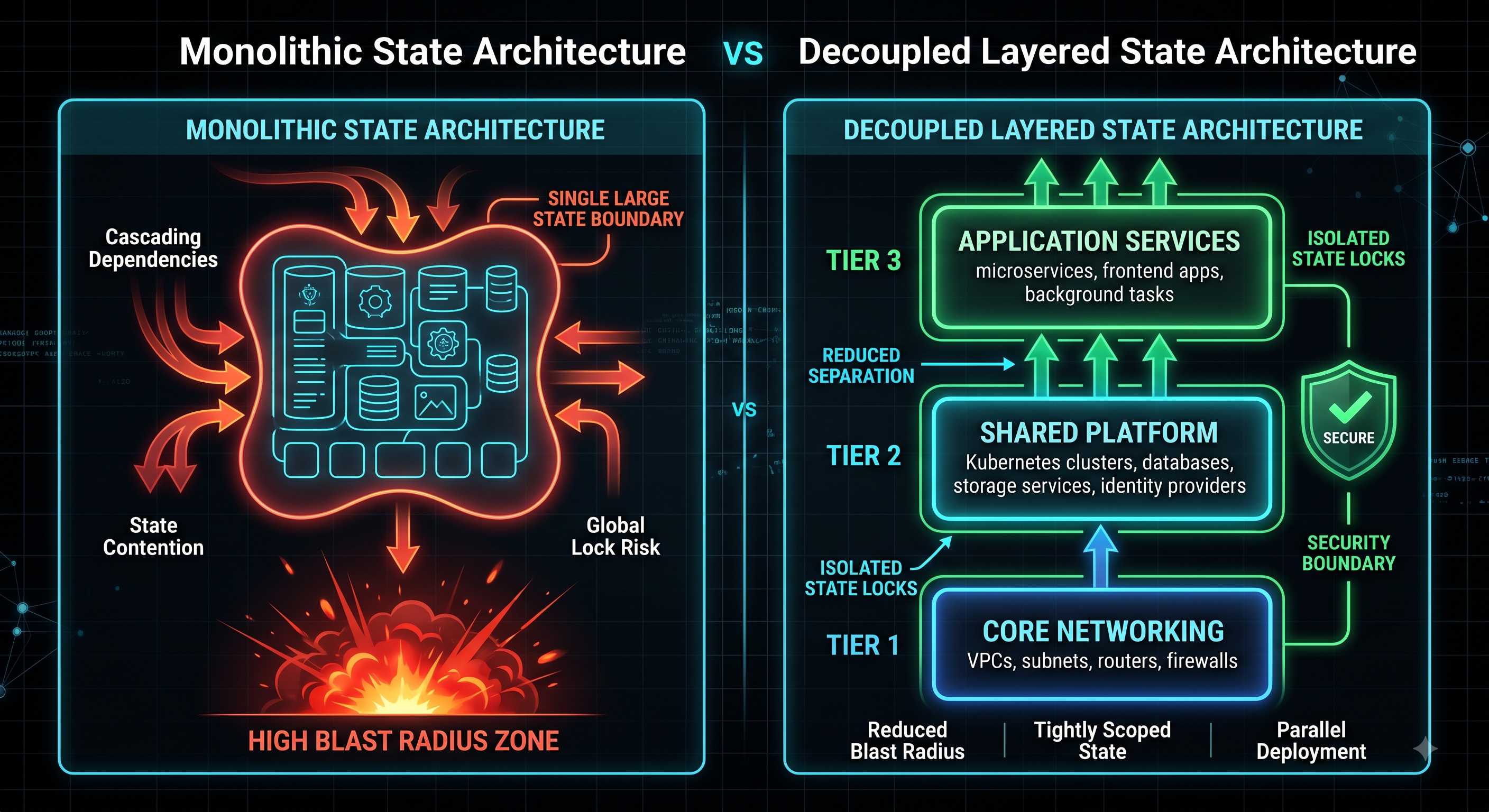
  • Monolithic Terraform vs. Micro-State Architecture: Where Do You Draw the Blast Radius Line?


    As infrastructure scales, Infrastructure as Code (IaC) architectures inevitably face a structural crossroads: do you keep environments grouped for easier reference, or decouple them into micro-states to minimize the blast radius?
    A massive, centralized state file creates lock contention across teams, slows down execution plans to a crawl, and increases the risk of accidental drift. However, over-fragmenting state files introduces dependency sprawl, complex data-sharing layers via terraform_remote_state, and orchestration friction.
    To balance safety and operational velocity, mature platform teams structure their IaC layers around stability and lifecycle frequency:


    Layer 1: Foundational / Infrequent Changes (Low Blast Risk)
    VPCs, subnets, transit gateways, and IAM base roles. These change rarely and should live in dedicated, tightly locked state files.


    Layer 2: Core Platform & Data Services (Moderate Lifecycle)
    Managed Kubernetes clusters, shared databases, and ingress gateways. Decoupled from application-level logic to prevent infrastructure rebuilds during app updates.


    Layer 3: Ephemeral & Application Workloads (High Frequency)
    Serverless functions, routing rules, deployment manifests, and autoscaling groups. Managed through autonomous states or application-scoped pipelines.
    How does your engineering team manage this trade-off?
    Do you break states down by environment, by lifecycle tier, or by domain-driven feature teams?


    Key Takeaways
    Monolithic state files drastically increase the blast radius of inadvertent configuration errors and pipeline locks.
    Over-modularizing state files can lead to complex dependency management and orchestration overhead.
    Separate state files based on resource volatility: foundational networking vs. rapidly changing application tiers.
    Restrict write permissions to foundational state backends using automated CI/CD runners rather than local developer access.


    CTA
    Want to dive deep into cloud architecture patterns, GitOps workflows, and resilient DevOps infrastructure?


    Join Techawks Cloud, DevOps & Open Source to collaborate with practicing cloud engineers, exchange IaC blueprints, and level up your platform engineering skills.
    Monolithic Terraform vs. Micro-State Architecture: Where Do You Draw the Blast Radius Line? As infrastructure scales, Infrastructure as Code (IaC) architectures inevitably face a structural crossroads: do you keep environments grouped for easier reference, or decouple them into micro-states to minimize the blast radius? A massive, centralized state file creates lock contention across teams, slows down execution plans to a crawl, and increases the risk of accidental drift. However, over-fragmenting state files introduces dependency sprawl, complex data-sharing layers via terraform_remote_state, and orchestration friction. To balance safety and operational velocity, mature platform teams structure their IaC layers around stability and lifecycle frequency: Layer 1: Foundational / Infrequent Changes (Low Blast Risk) VPCs, subnets, transit gateways, and IAM base roles. These change rarely and should live in dedicated, tightly locked state files. Layer 2: Core Platform & Data Services (Moderate Lifecycle) Managed Kubernetes clusters, shared databases, and ingress gateways. Decoupled from application-level logic to prevent infrastructure rebuilds during app updates. Layer 3: Ephemeral & Application Workloads (High Frequency) Serverless functions, routing rules, deployment manifests, and autoscaling groups. Managed through autonomous states or application-scoped pipelines. How does your engineering team manage this trade-off? Do you break states down by environment, by lifecycle tier, or by domain-driven feature teams? Key Takeaways Monolithic state files drastically increase the blast radius of inadvertent configuration errors and pipeline locks. Over-modularizing state files can lead to complex dependency management and orchestration overhead. Separate state files based on resource volatility: foundational networking vs. rapidly changing application tiers. Restrict write permissions to foundational state backends using automated CI/CD runners rather than local developer access. CTA Want to dive deep into cloud architecture patterns, GitOps workflows, and resilient DevOps infrastructure? Join Techawks Cloud, DevOps & Open Source to collaborate with practicing cloud engineers, exchange IaC blueprints, and level up your platform engineering skills.
    0 Commenti 0 condivisioni 571 Views 0 Anteprima
Pagine in Evidenza