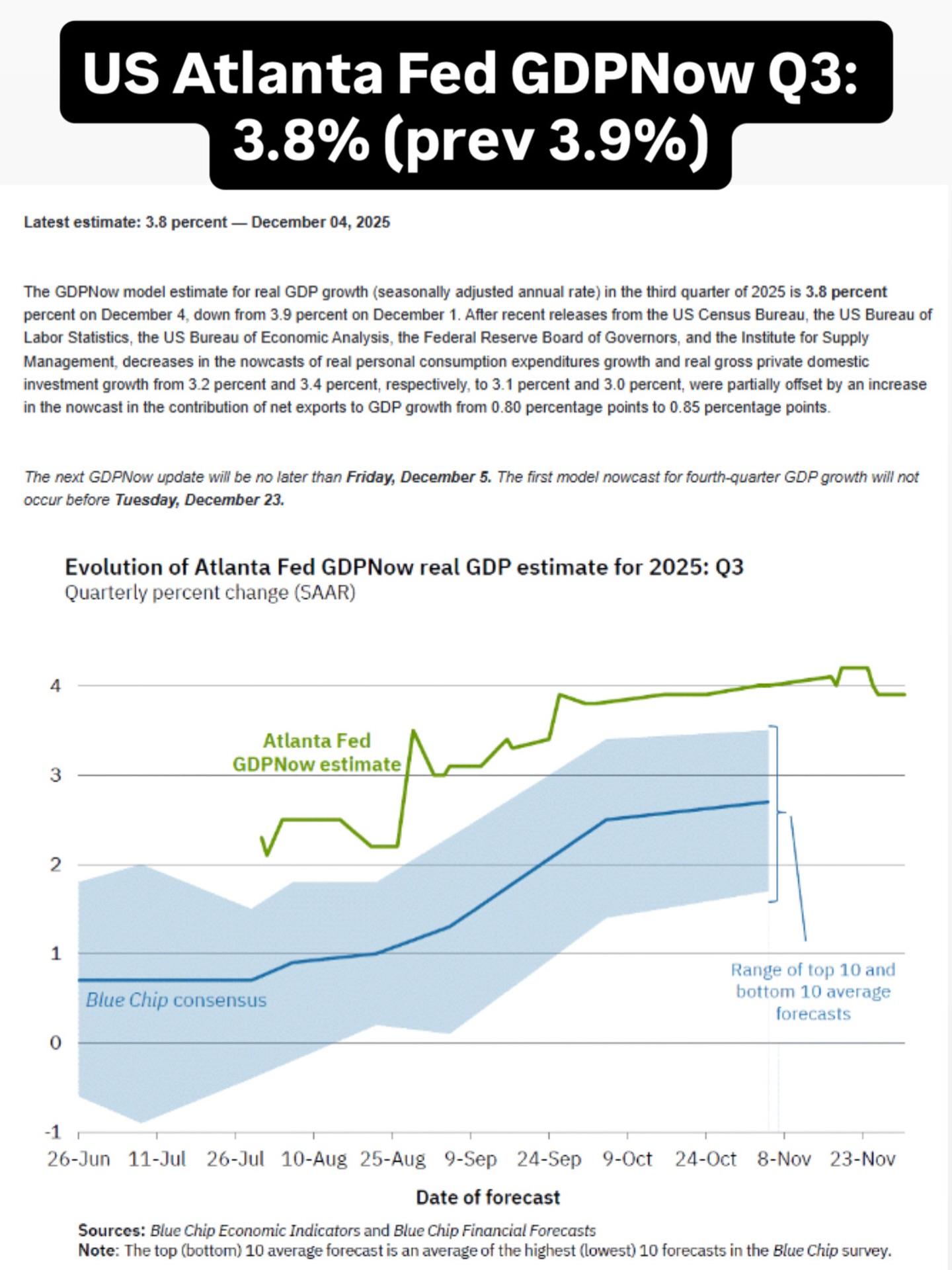
• The Atlanta Fed just revised its GDPNow estimate for Q3 down slightly from 3.9% to 3.8%. Still strong, still above trend, and still well above what most forecasters expected just a few months ago.

    But here’s the interesting part:

    While the US economy continues to outperform expectations, other major economies are showing cracks:

    Japan is wrestling with rising bond yields and the limits of yield curve control.

    Europe is stagnating.

    China is fighting deflationary pressure and structural debt issues.

    Meanwhile, US growth remains resilient driven by consumer spending, investment, and ongoing fiscal momentum.

    A number like 3.8% doesn’t sound dramatic, but in a world of slowing growth, this level of momentum makes a statement. The US continues to be the global outlier the economy everyone bets against, yet the one capital keeps flowing back to.

    No wonder global investors overweight US equities and Treasuries. The U.S. isn’t just participating in the global cycle it’s defining it.

    The real question:

    Does this strength give the Fed room to stay tighter for longer, or does it simply delay the slowdown the market keeps trying to price in?

    Because if the economy really is this strong rate cuts aren’t a certainty. They become a negotiation.

    #GDP #Economy #Macro #AtlantaFed #Growth #Finance #Markets #USMarket #Investing #RecessionNarrative #DataDriven
    The Atlanta Fed just revised its GDPNow estimate for Q3 down slightly from 3.9% to 3.8%. Still strong, still above trend, and still well above what most forecasters expected just a few months ago. But here’s the interesting part: While the US economy continues to outperform expectations, other major economies are showing cracks: Japan is wrestling with rising bond yields and the limits of yield curve control. Europe is stagnating. China is fighting deflationary pressure and structural debt issues. Meanwhile, US growth remains resilient driven by consumer spending, investment, and ongoing fiscal momentum. A number like 3.8% doesn’t sound dramatic, but in a world of slowing growth, this level of momentum makes a statement. The US continues to be the global outlier the economy everyone bets against, yet the one capital keeps flowing back to. No wonder global investors overweight US equities and Treasuries. The U.S. isn’t just participating in the global cycle it’s defining it. The real question: Does this strength give the Fed room to stay tighter for longer, or does it simply delay the slowdown the market keeps trying to price in? Because if the economy really is this strong rate cuts aren’t a certainty. They become a negotiation. #GDP #Economy #Macro #AtlantaFed #Growth #Finance #Markets #USMarket #Investing #RecessionNarrative #DataDriven
    ·136 Views ·0 previzualizare
  • Japan is quietly becoming the most important macro story in the world. How long can this go on for?

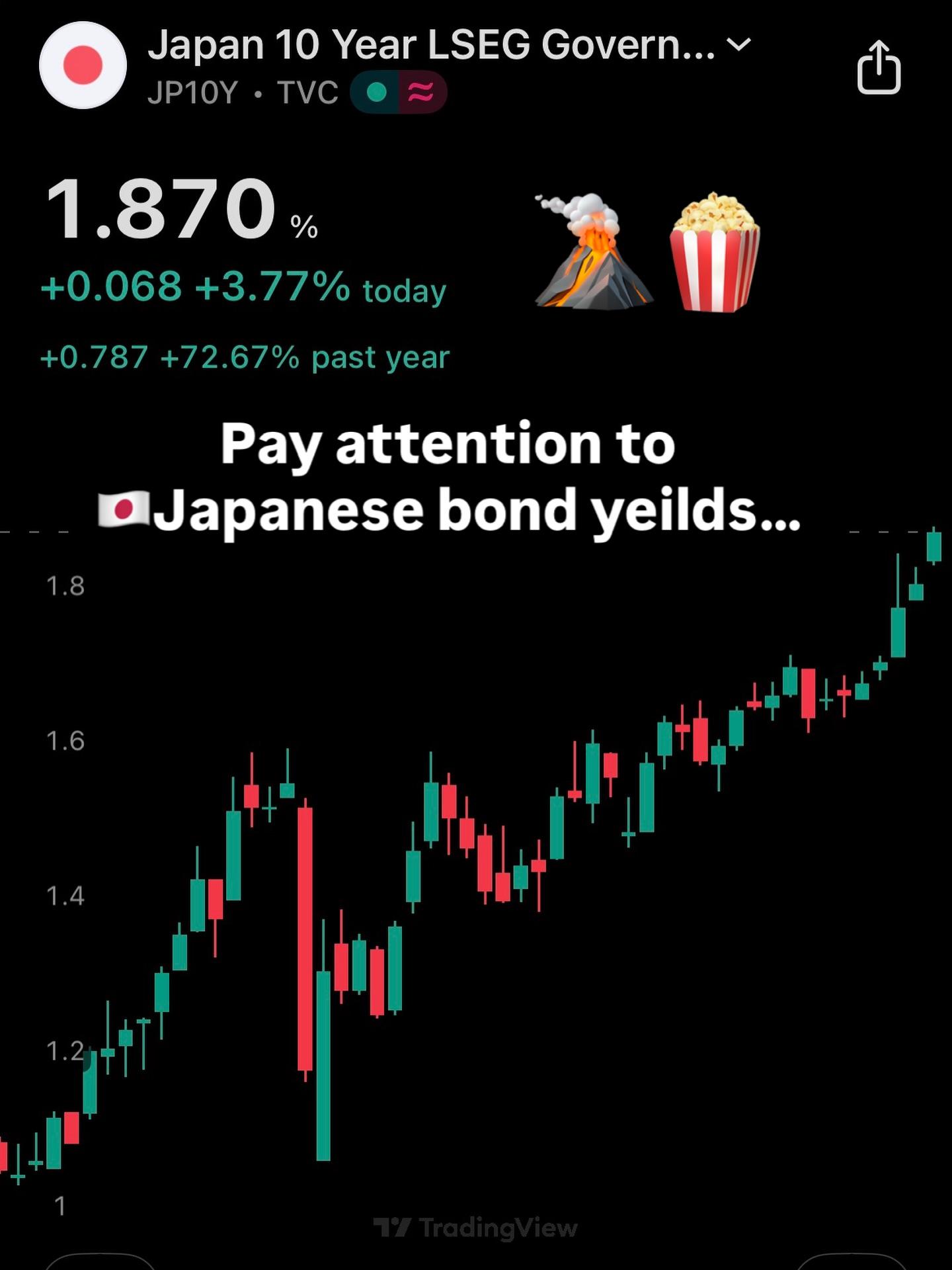
    The country with the highest debt to GDP ratio on earth is now facing rising yields. The 10 year Japanese government bond is pushing toward 2 percent up more than 70 percent in a year.

    Japan has lived in a world of near zero rates for decades. A world where its central bank could buy its own bonds indefinitely, keep yields pinned down, and create the illusion of stability. That era is ending.

    The Bank of Japan has tried every tool: negative rates, quantitative easing, and now yield curve control. But there’s a simple truth: markets eventually overpower intervention.

    If the BoJ keeps buying bonds to suppress yields, the currency weakens.

    If it stops buying, yields spike and debt service costs explode.

    Japan is stuck between two bad choices.

    The debt burden is over 250 percent of GDP. Higher rates mean higher interest expenses, and that means more borrowing just to pay the interest. The problem becomes exponential.

    If yield curve control breaks, you will see one of two outcomes:

    A currency crisis the yen collapses to absorb the pressure.

    A bond crisis yields blow out and force deleveraging at a scale Japan hasn’t seen in modern history.

    For years investors believed Japan could never break. Zero rates were permanent. Demographics were destiny. Now the market is testing that assumption.

    Japan matters because it’s the endgame experiment:
    What happens when a government prints for decades, monetizes debt, and finally runs out of tools?

    Everyone focuses on the United States. But if Japan snaps first, it will be a global shockwave.

    How does this end? Incredibly slowly… then all at once.

    Liquidity is what everyone is grasping for 😮‍💨

    #japan #macro #markets #bonds #economics #investing #finance #interestrates #debt #yen #bankofjapan #globalmacro #riskmanagement #wealthbuilding #economy #marketanalysis
    Japan is quietly becoming the most important macro story in the world. How long can this go on for? The country with the highest debt to GDP ratio on earth is now facing rising yields. The 10 year Japanese government bond is pushing toward 2 percent up more than 70 percent in a year. Japan has lived in a world of near zero rates for decades. A world where its central bank could buy its own bonds indefinitely, keep yields pinned down, and create the illusion of stability. That era is ending. The Bank of Japan has tried every tool: negative rates, quantitative easing, and now yield curve control. But there’s a simple truth: markets eventually overpower intervention. If the BoJ keeps buying bonds to suppress yields, the currency weakens. If it stops buying, yields spike and debt service costs explode. Japan is stuck between two bad choices. The debt burden is over 250 percent of GDP. Higher rates mean higher interest expenses, and that means more borrowing just to pay the interest. The problem becomes exponential. If yield curve control breaks, you will see one of two outcomes: A currency crisis the yen collapses to absorb the pressure. A bond crisis yields blow out and force deleveraging at a scale Japan hasn’t seen in modern history. For years investors believed Japan could never break. Zero rates were permanent. Demographics were destiny. Now the market is testing that assumption. Japan matters because it’s the endgame experiment: What happens when a government prints for decades, monetizes debt, and finally runs out of tools? Everyone focuses on the United States. But if Japan snaps first, it will be a global shockwave. How does this end? Incredibly slowly… then all at once. Liquidity is what everyone is grasping for 😮‍💨 #japan #macro #markets #bonds #economics #investing #finance #interestrates #debt #yen #bankofjapan #globalmacro #riskmanagement #wealthbuilding #economy #marketanalysis
    ·290 Views ·0 previzualizare
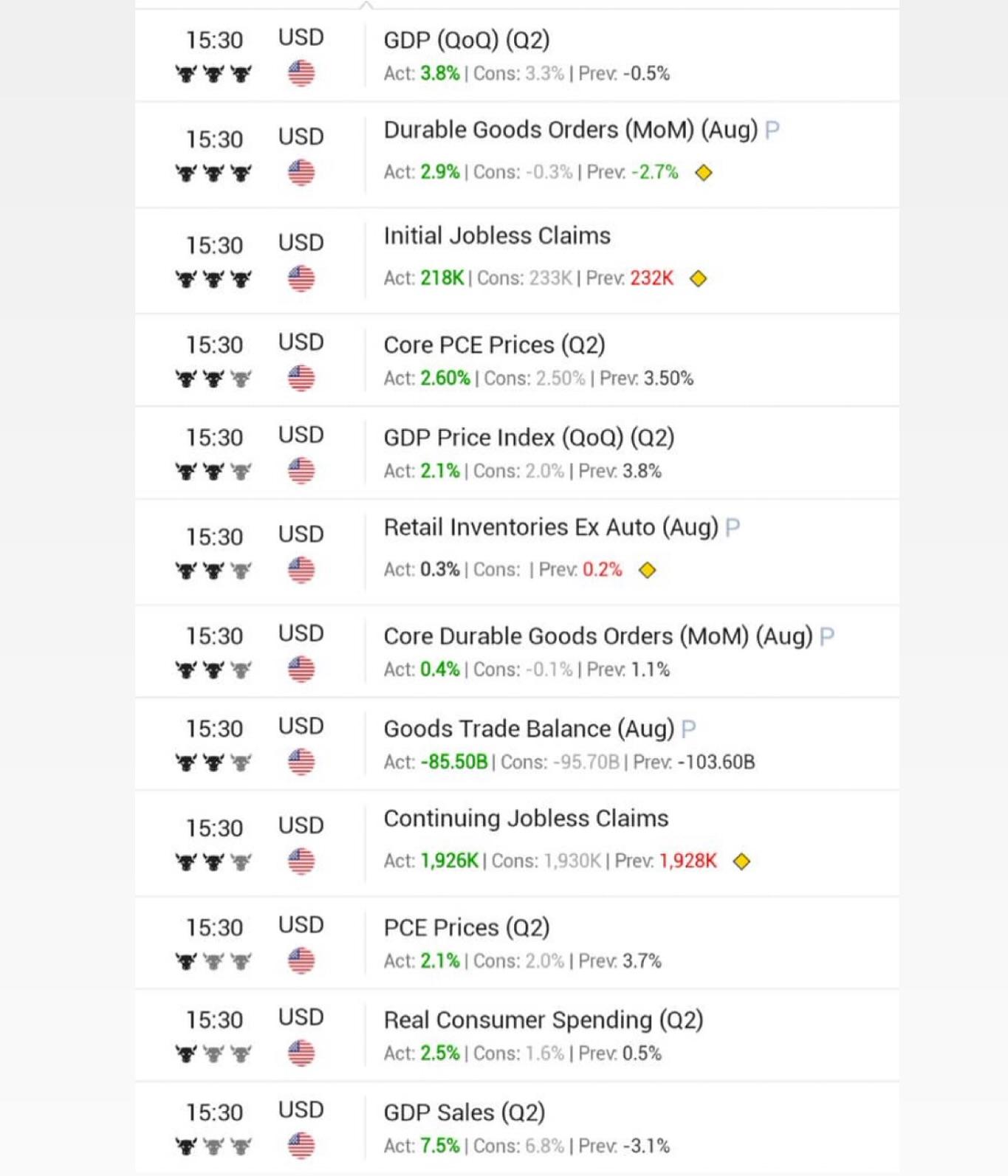
  • Morning Economic Data:

    *Q2 GDP: Beat
    *Q2 Consumer Spending: Beat
    *Jobless Claims: Beat
    *Continuing Jobless Claims: Beat
    *Durable Goods Orders: Beat
    *Core Durable Goods Orders: Beat

    Soooooooooo he’s cutting rates next month?

    #economics
    🇺🇸 Morning Economic Data: *Q2 GDP: Beat 🟢 *Q2 Consumer Spending: Beat 🟢 *Jobless Claims: Beat 🟢 *Continuing Jobless Claims: Beat 🟢 *Durable Goods Orders: Beat 🟢 *Core Durable Goods Orders: Beat 🟢 Soooooooooo he’s cutting rates next month? 🍿🎡🎪 #economics
    ·120 Views ·0 previzualizare
  • Tens of thousands of students, teachers, and workers will march in the streets in cities across Argentina on September 17, for the Federal University March. This will be the third mass protest to defend university funding against Argentine President Javier Milei’s austerity policies. The protest will coincide with a teachers’ strike that is taking place in national higher education institutions.

    On Wednesday, September 10, 2025, Milei vetoed the University Financing Law, which was set to increase funding for Argentina’s public universities. The University Financing Law was approved by the Senate on August 22, 2025, and was intended to:
    -Adjust teaching and non-teaching salaries in line with inflation
    -Update operating expenses
    -Provide funds for infrastructure, scholarships, strategic careers, and academic activities
    -Progressively increase the university budget from 1% of GDP in 2026 to 1.5% in 2031

    by Santiago Oroz (@santi.oroz) of El Grito del Sur (@elgritodelsur).
    Read the full article on our website.
    Tens of thousands of students, teachers, and workers will march in the streets in cities across Argentina on September 17, for the Federal University March. This will be the third mass protest to defend university funding against Argentine President Javier Milei’s austerity policies. The protest will coincide with a teachers’ strike that is taking place in national higher education institutions. On Wednesday, September 10, 2025, Milei vetoed the University Financing Law, which was set to increase funding for Argentina’s public universities. The University Financing Law was approved by the Senate on August 22, 2025, and was intended to: -Adjust teaching and non-teaching salaries in line with inflation -Update operating expenses -Provide funds for infrastructure, scholarships, strategic careers, and academic activities -Progressively increase the university budget from 1% of GDP in 2026 to 1.5% in 2031 📷 by Santiago Oroz (@santi.oroz) of El Grito del Sur (@elgritodelsur). 📲 Read the full article on our website.
    ·189 Views ·0 previzualizare
  • The resignation of Nepali PM KP Oli, amid massive youth-driven protests has raised many questions for the people of Nepal and its once united Left. While many have accused the uprising about merely being in response to a social media ban, the roots are much deeper.

    Atul Chandra and Pramesh Pokharel write, “It is tempting – especially from afar – to narrate this as a clash over digital freedoms. That would be analytically thin. For Gen-Z Nepalis, platforms are not just entertainment; they are job boards, news wires, organizing tools, and social lifelines. Shutting them off – after years of economic drift – felt like collective punishment. But the deeper story is structural: Nepal’s growth has been stabilized by remittances rather than transformed by domestic investment capable of producing dignified work. In FY 2024/25, the Department of Foreign Employment issued 839,266 exit labor permits – staggering out-migration for a country of ~30 million. Remittances hovered around 33% of GDP in 2024, among the highest ratios worldwide. These numbers speak to survival, not social progress; they are a referendum on a model that exports its youth to low-wage contracts while importing basics, and that depends on patronage rather than productivity.”

    Read the full article by Atul Chandra and Pramesh Pokharel on our website.
    The resignation of Nepali PM KP Oli, amid massive youth-driven protests has raised many questions for the people of Nepal and its once united Left. While many have accused the uprising about merely being in response to a social media ban, the roots are much deeper. Atul Chandra and Pramesh Pokharel write, “It is tempting – especially from afar – to narrate this as a clash over digital freedoms. That would be analytically thin. For Gen-Z Nepalis, platforms are not just entertainment; they are job boards, news wires, organizing tools, and social lifelines. Shutting them off – after years of economic drift – felt like collective punishment. But the deeper story is structural: Nepal’s growth has been stabilized by remittances rather than transformed by domestic investment capable of producing dignified work. In FY 2024/25, the Department of Foreign Employment issued 839,266 exit labor permits – staggering out-migration for a country of ~30 million. Remittances hovered around 33% of GDP in 2024, among the highest ratios worldwide. These numbers speak to survival, not social progress; they are a referendum on a model that exports its youth to low-wage contracts while importing basics, and that depends on patronage rather than productivity.” 📲 Read the full article by Atul Chandra and Pramesh Pokharel on our website.
    ·670 Views ·0 previzualizare
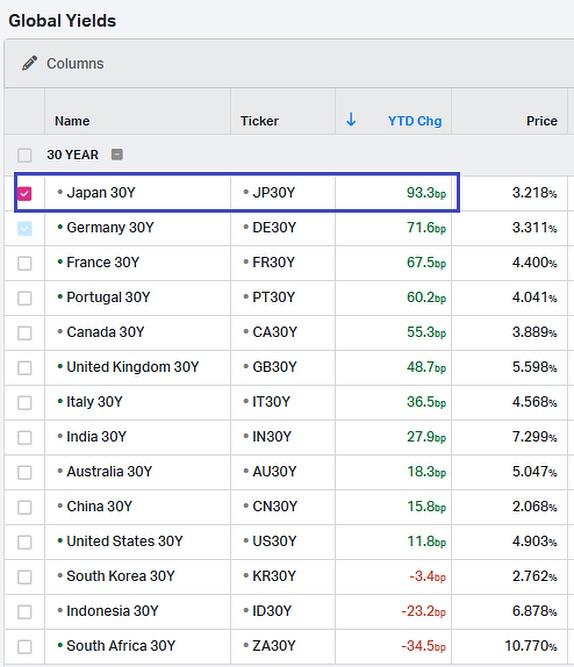
  • Japan’s 30-Year Yield has surged nearly 1ppt this year, now above 3.2%

    Why it matters: Japan carries the highest debt-to-GDP ratio in the developed world (250%+). Rising yields dramatically increase the cost of servicing that debt, straining government finances and raising the risk of fiscal stress. It also matters globally Japanese investors are among the biggest buyers of US Treasuries and European bonds. If they pull capital back home for higher returns, global borrowing costs could rise too.

    This isn’t just a Japan story it’s a warning signal for debt sustainability worldwide.

    #Bonds #GlobalMarkets #Japan #InterestRates #DebtCrisis #Finance #Investing #Economy #Markets #Treasuries #Macroeconomics
    Japan’s 30-Year Yield has surged nearly 1ppt this year, now above 3.2% 📈 Why it matters: Japan carries the highest debt-to-GDP ratio in the developed world (250%+). Rising yields dramatically increase the cost of servicing that debt, straining government finances and raising the risk of fiscal stress. It also matters globally Japanese investors are among the biggest buyers of US Treasuries and European bonds. If they pull capital back home for higher returns, global borrowing costs could rise too. This isn’t just a Japan story it’s a warning signal for debt sustainability worldwide. #Bonds #GlobalMarkets #Japan #InterestRates #DebtCrisis #Finance #Investing #Economy #Markets #Treasuries #Macroeconomics
    ·512 Views ·0 previzualizare
  • Fictional companies with trillion-dollar price tags? Yeah, that’s a thing

    Some of the richest “businesses” ever created exist only on screen or in books.

    From Dune’s CHOAM with a fictional $500 trillion value to WALL-E’s Buy N Large running Earth with $200 trillion, these names go way beyond Marvel’s Stark Industries or Batman’s Wayne Enterprises.

    Even cartoons like ACME and shows like Futurama imagined mega-corporations worth more than most countries today.

    Fiction might be fake, but the money they print in those universes? Bigger than real-life GDPs.

    Love fiction, tech, and wild valuations? Follow @Wealth

    #Fiction #Money #PopCulture #SciFi #Business
    Fictional companies with trillion-dollar price tags? Yeah, that’s a thing 💰 Some of the richest “businesses” ever created exist only on screen or in books. From Dune’s CHOAM with a fictional $500 trillion value to WALL-E’s Buy N Large running Earth with $200 trillion, these names go way beyond Marvel’s Stark Industries or Batman’s Wayne Enterprises. Even cartoons like ACME and shows like Futurama imagined mega-corporations worth more than most countries today. Fiction might be fake, but the money they print in those universes? Bigger than real-life GDPs. Love fiction, tech, and wild valuations? Follow @Wealth 🌟 #Fiction #Money #PopCulture #SciFi #Business
    ·390 Views ·0 previzualizare
  • A busy week ahead across global markets.

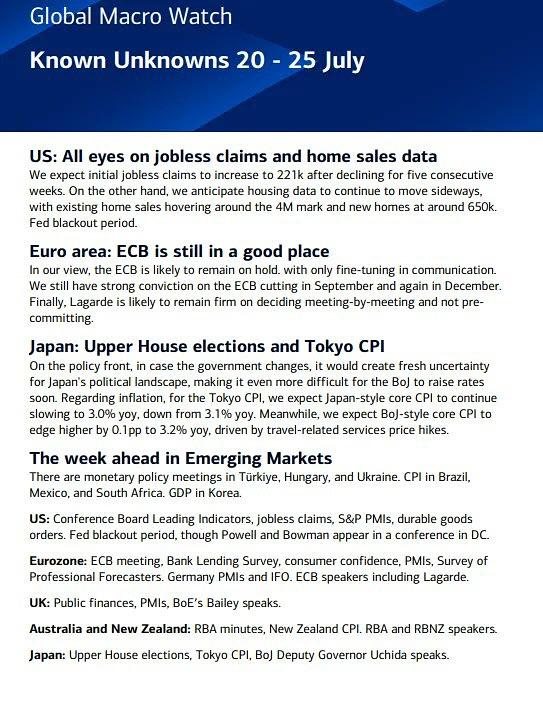
    In the US, jobless claims and housing data will be front and center. Europe eyes the ECB’s July meeting with steady rates expected, while Japan’s Upper House elections and CPI prints could shape BoJ policy signals. Emerging markets will navigate rate decisions, CPI releases, and GDP prints across Brazil, Mexico, Turkey, South Africa, and Korea.

    Earnings season heats up with major names like Tesla, Alphabet, Intel, and Dow reporting midweek. Macro meets micro.

    #GlobalMacro #EarningsSeason #ECB #BoJ #USJobs #EmergingMarkets #CPI #InterestRates #MarketsThisWeek #Macroeconomics #Investing #FinanceNews #MarketWatch #EarningsCalendar #EconomicOutlook
    A busy week ahead across global markets. In the US, jobless claims and housing data will be front and center. Europe eyes the ECB’s July meeting with steady rates expected, while Japan’s Upper House elections and CPI prints could shape BoJ policy signals. Emerging markets will navigate rate decisions, CPI releases, and GDP prints across Brazil, Mexico, Turkey, South Africa, and Korea. Earnings season heats up with major names like Tesla, Alphabet, Intel, and Dow reporting midweek. Macro meets micro. #GlobalMacro #EarningsSeason #ECB #BoJ #USJobs #EmergingMarkets #CPI #InterestRates #MarketsThisWeek #Macroeconomics #Investing #FinanceNews #MarketWatch #EarningsCalendar #EconomicOutlook
    ·1K Views ·0 previzualizare
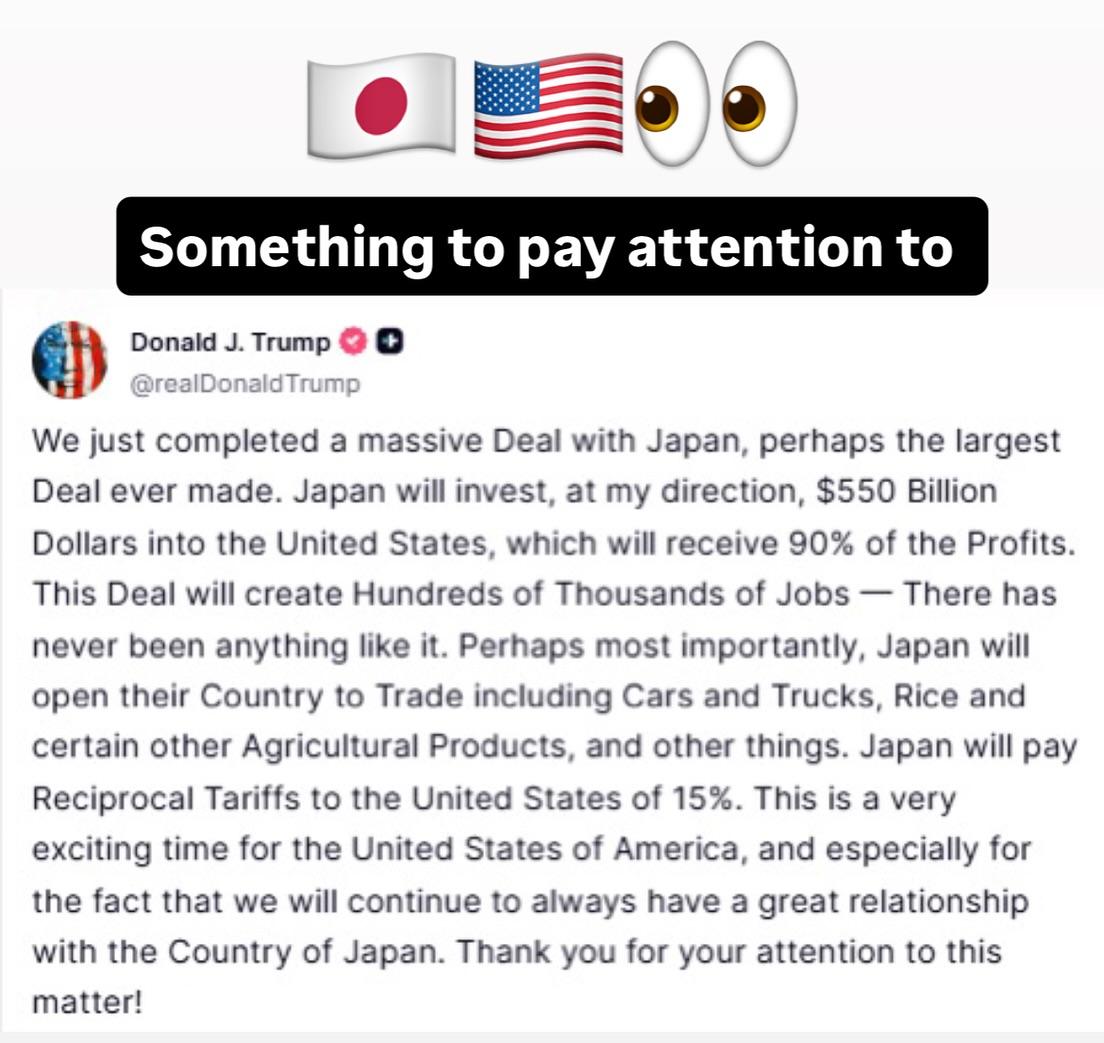
  • A $550B Japanese investment into the US as claimed in this announcement, would be more than just a bilateral trade deal it would represent a massive macro capital flow with global consequences.

    Japan, already one of the largest holders of U.S. Treasuries, would likely recycle this capital back into dollar assets, reinforcing demand for U.S. fixed income and potentially suppressing long-end yields. This dynamic strengthens the dollar structurally, reinforces its reserve status, and adds pressure to the yen.

    In FX markets, USD/JPY could push higher as Japanese capital is converted to dollars, further widening the interest rate differential between the Fed and the BoJ. Meanwhile, Japan’s own bond market would feel the liquidity drain unless the BoJ steps in with more accommodation, pushing JGB yields even lower and exacerbating yen weakness.

    Japan’s own fiscal dynamics are deeply sensitive to rates due to its massive debt burden (>260% debt-to-GDP). BOJ could step up bond purchases to suppress yields, preventing policy spillover from affecting domestic financing conditions.This would suppress the yen even more, creating the feedback loop.

    This kind of flow driven divergence between U.S. and Japan isn’t just a headline it’s a signal of how global imbalances and reserve dynamics drive currencies, yields, and policy reactions. Whether this deal is real or political theater, it’s the structural mechanics that matter.

    If only Trump knew a guy about currencies and macroeconomics… if only he knew someone who fully understood these dynamics with Japan and yields… anyway… it’s probably nothing…

    #macroeconomics #markets #stocks #stockmarket #ndx #sp500 #japan #usa
    A $550B Japanese investment into the US as claimed in this announcement, would be more than just a bilateral trade deal it would represent a massive macro capital flow with global consequences. Japan, already one of the largest holders of U.S. Treasuries, would likely recycle this capital back into dollar assets, reinforcing demand for U.S. fixed income and potentially suppressing long-end yields. This dynamic strengthens the dollar structurally, reinforces its reserve status, and adds pressure to the yen. In FX markets, USD/JPY could push higher as Japanese capital is converted to dollars, further widening the interest rate differential between the Fed and the BoJ. Meanwhile, Japan’s own bond market would feel the liquidity drain unless the BoJ steps in with more accommodation, pushing JGB yields even lower and exacerbating yen weakness. Japan’s own fiscal dynamics are deeply sensitive to rates due to its massive debt burden (>260% debt-to-GDP). BOJ could step up bond purchases to suppress yields, preventing policy spillover from affecting domestic financing conditions.This would suppress the yen even more, creating the feedback loop. This kind of flow driven divergence between U.S. and Japan isn’t just a headline it’s a signal of how global imbalances and reserve dynamics drive currencies, yields, and policy reactions. Whether this deal is real or political theater, it’s the structural mechanics that matter. If only Trump knew a guy about currencies and macroeconomics… if only he knew someone who fully understood these dynamics with Japan and yields… anyway… it’s probably nothing… #macroeconomics #markets #stocks #stockmarket #ndx #sp500 #japan #usa
    ·642 Views ·0 previzualizare
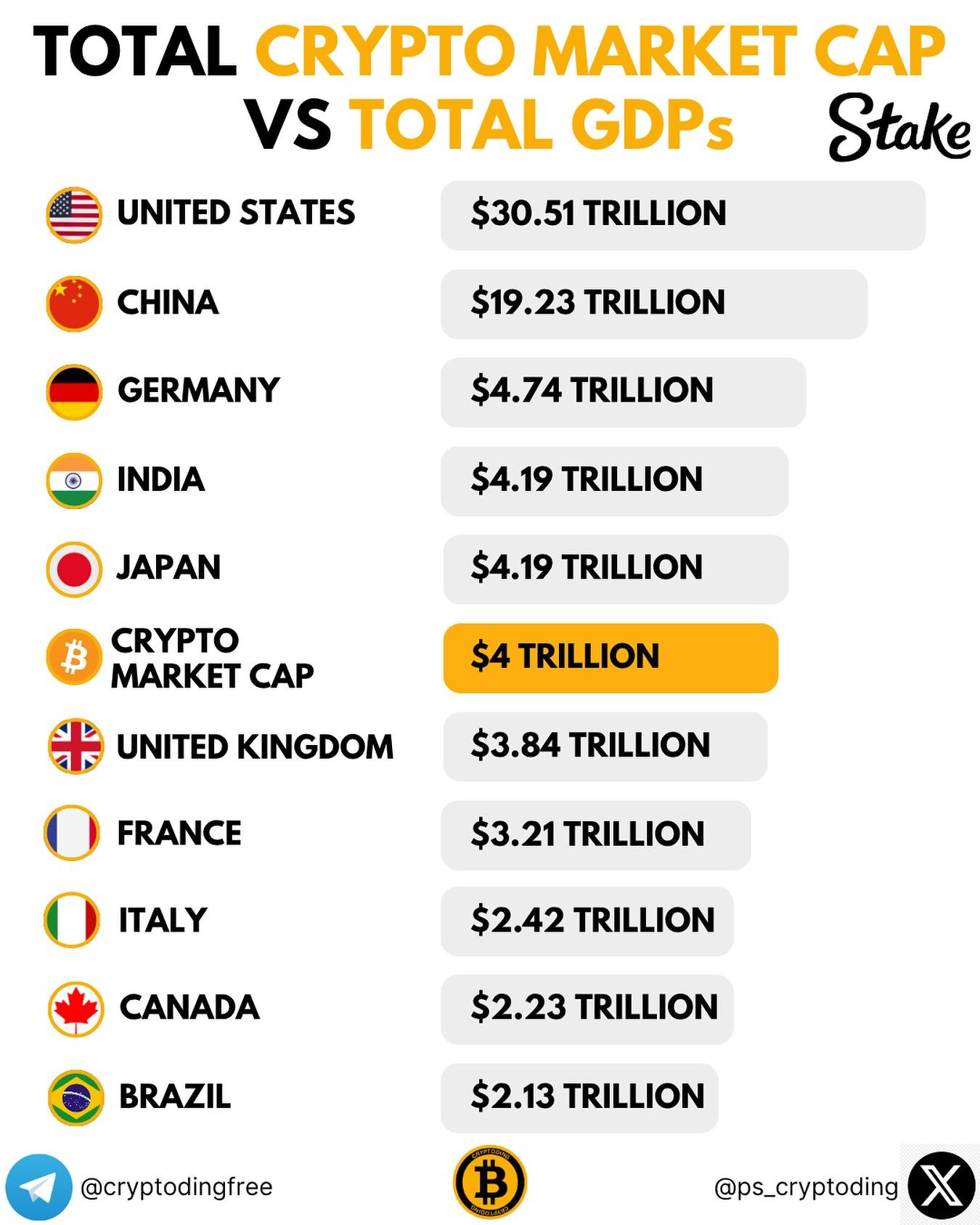
  • The total crypto market cap has now reached $4 trillion, officially surpassing the GDPs of major global economies like the UK, France, Italy, Canada, and Brazil. It’s now sitting just behind Japan and India in terms of scale — a massive milestone that shows how far crypto has come. From being seen as a niche digital asset class to now competing with entire national economies… this is more than just hype — it’s evolution.
    The total crypto market cap has now reached $4 trillion, officially surpassing the GDPs of major global economies like the UK, France, Italy, Canada, and Brazil. It’s now sitting just behind Japan and India in terms of scale — a massive milestone that shows how far crypto has come. From being seen as a niche digital asset class to now competing with entire national economies… this is more than just hype — it’s evolution.
    ·101 Views ·0 previzualizare
Sponsorizeaza Paginile
Techawks - Powered By Pantrade Blockchain https://techawks.com