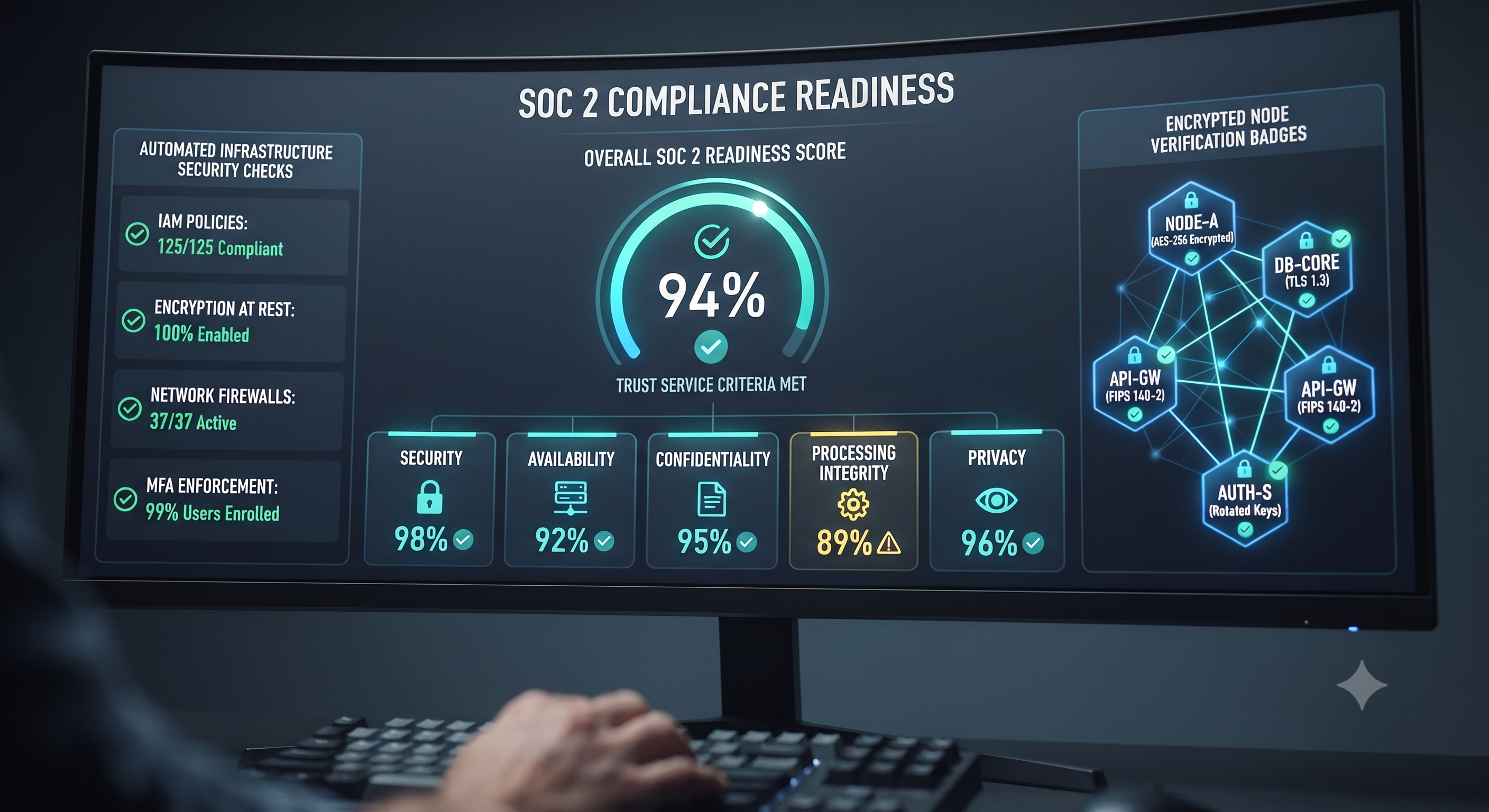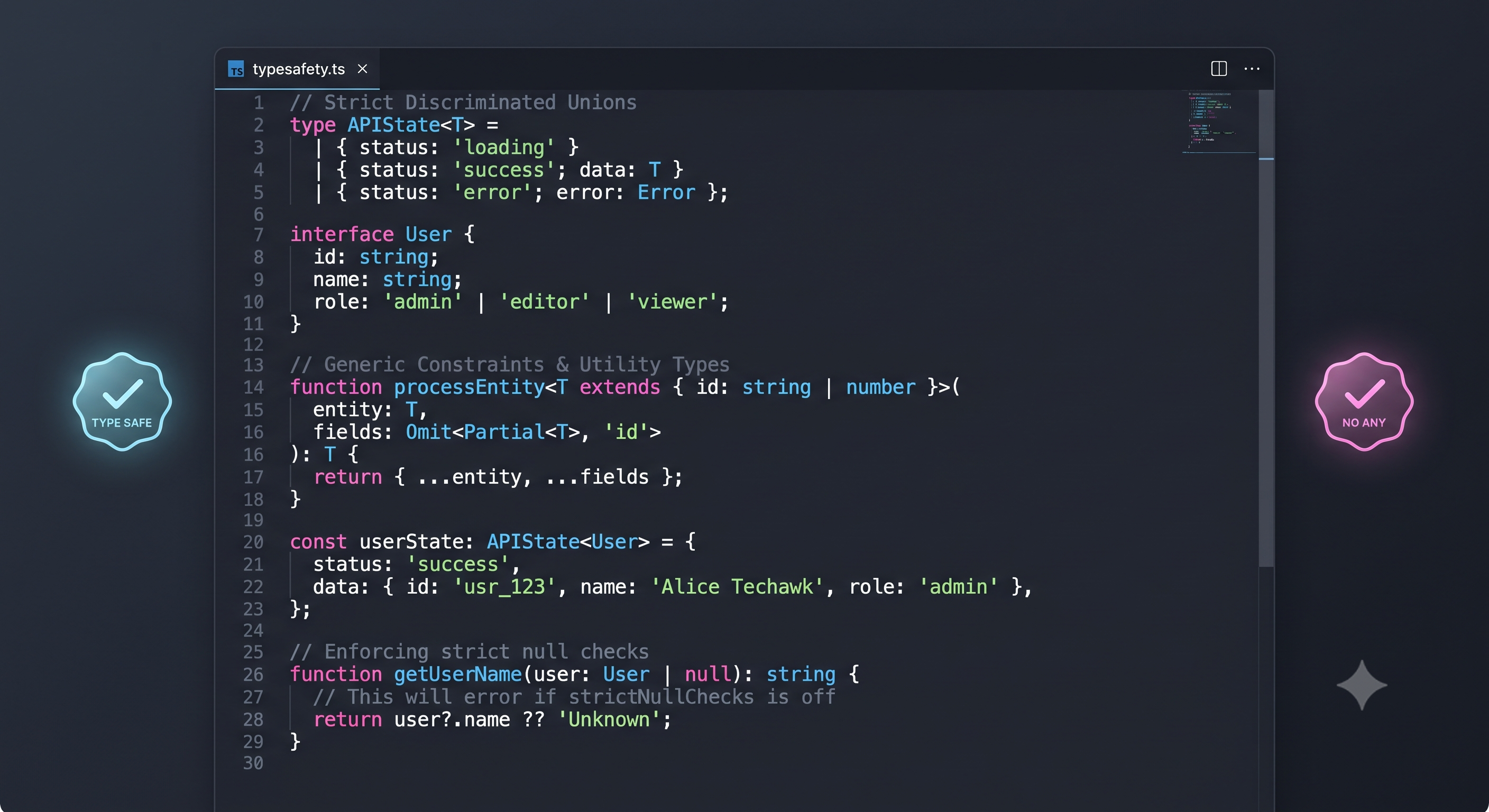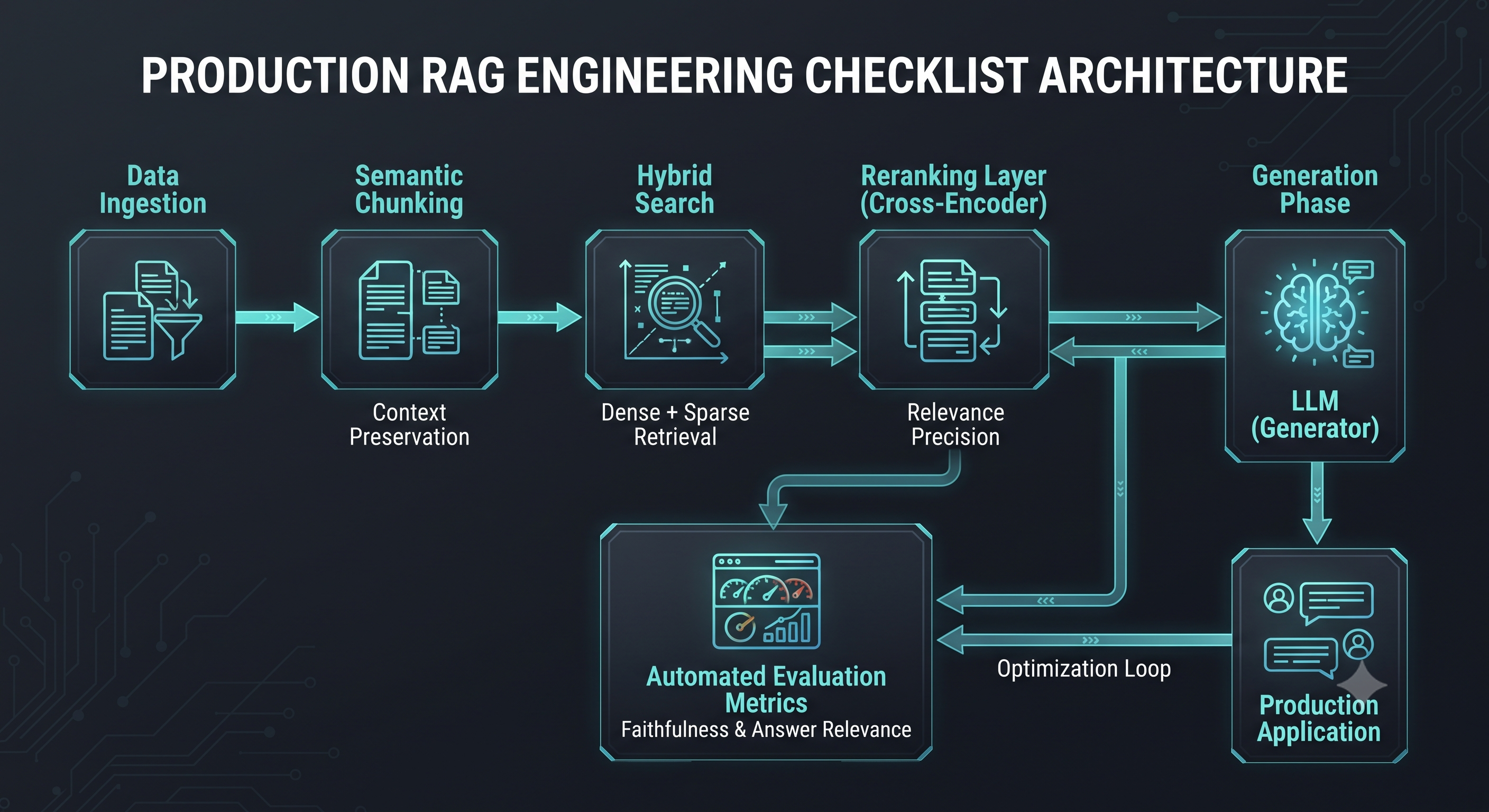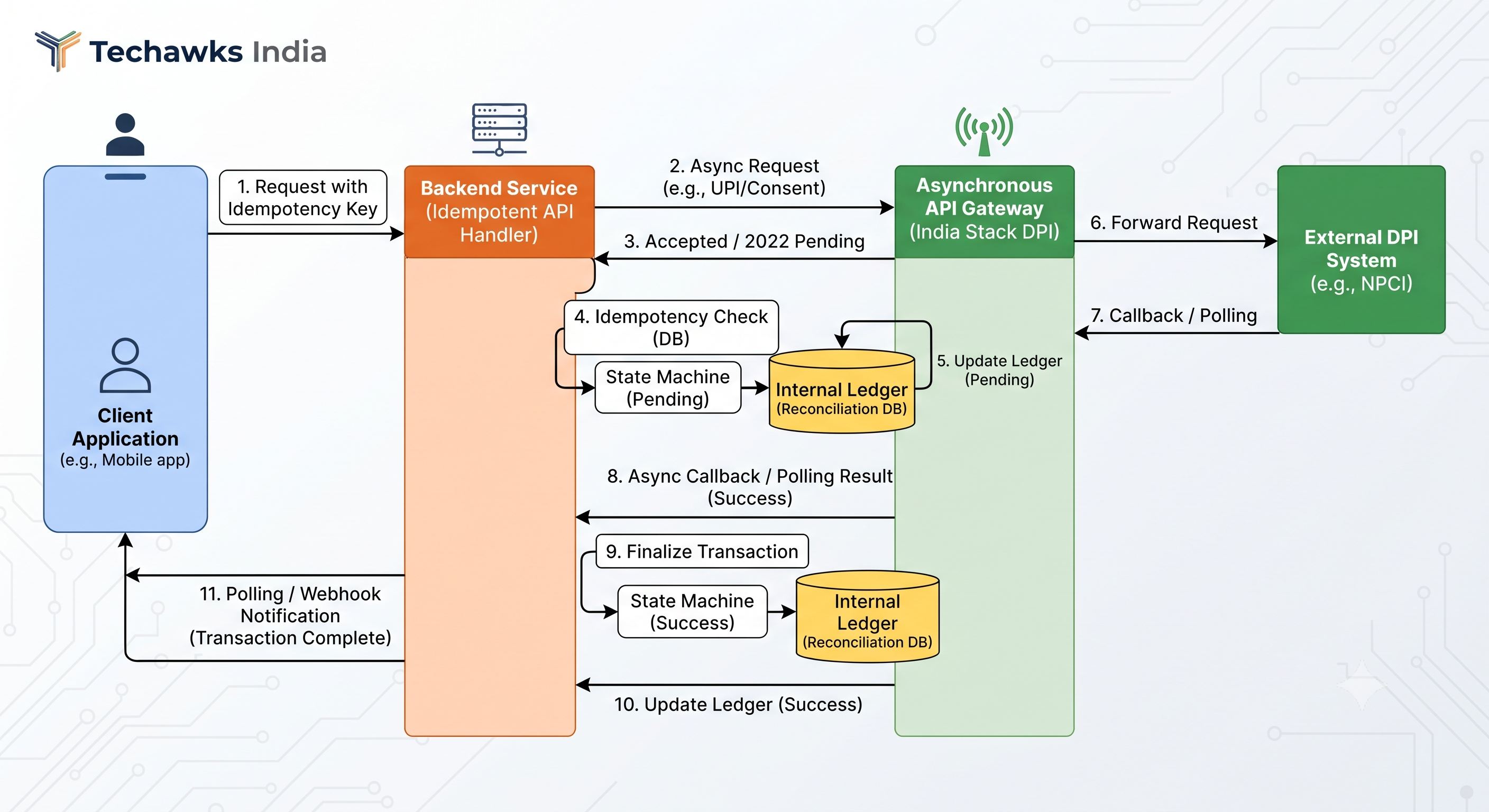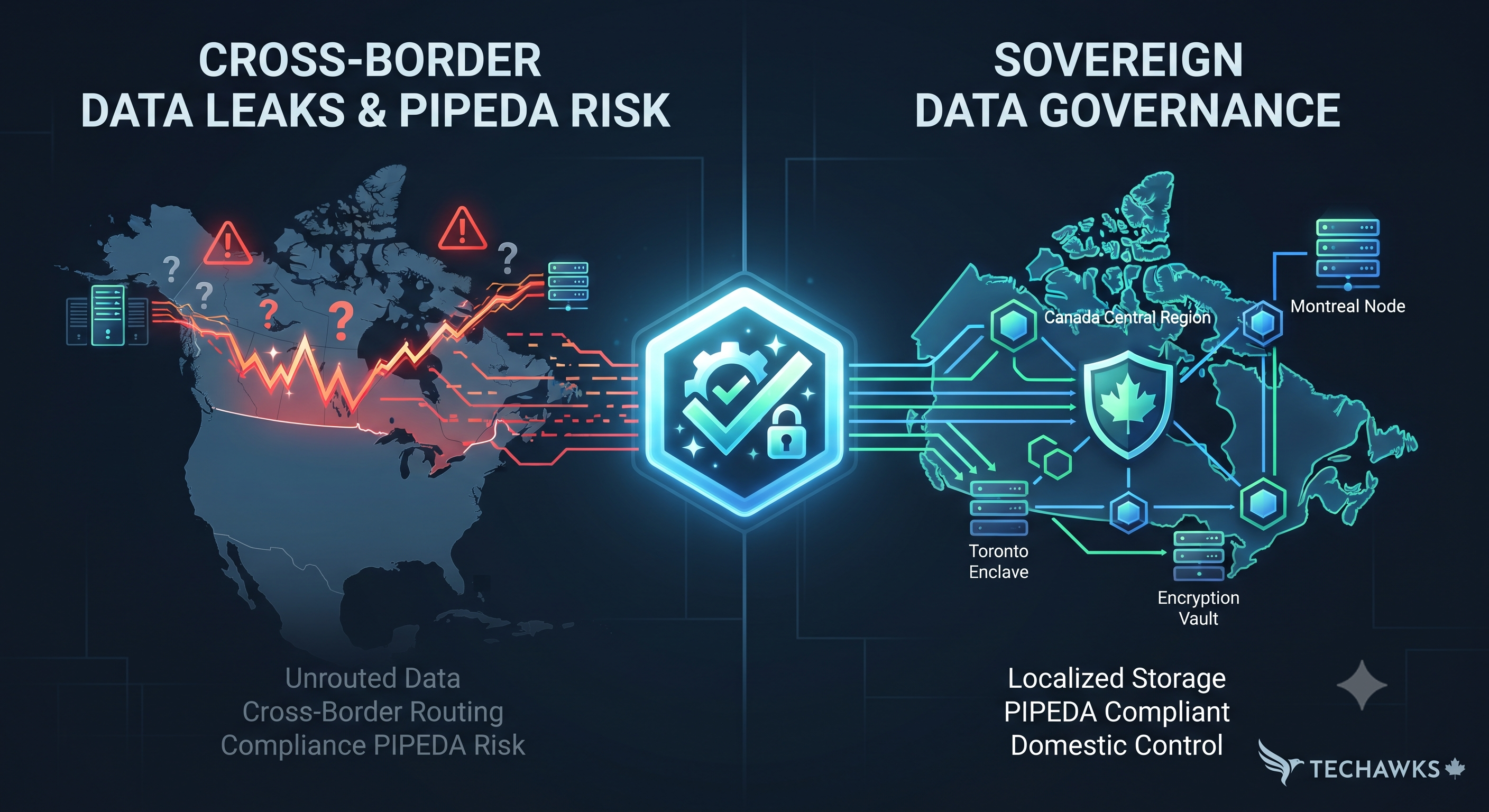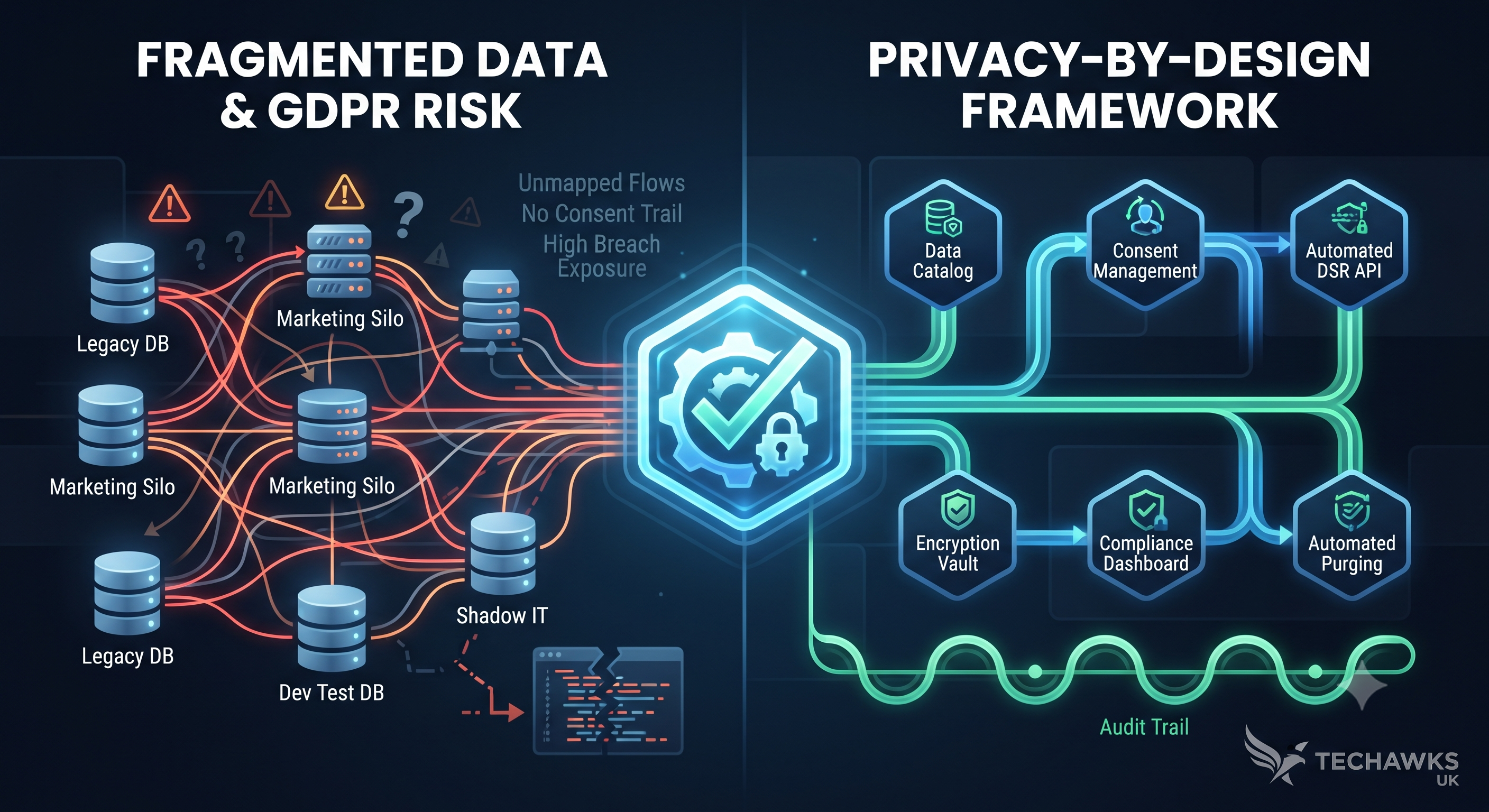
• Stop assuming multi-region means compliant: How Canadian engineering teams architect for Law 25 & PIPEDA Data Sovereignty.


    Building scalable applications in Canada requires balancing distributed performance with strict regulatory data residency obligations across federal and provincial jurisdictions (notably Quebec's Law 25 and public/health sector residency mandates in BC and Ontario).
    A naive global failover architecture that dumps all backups, telemetry, and database replicas into US cloud regions breaks data compliance boundaries.
    The Solution: Policy-Driven Sovereign Ingress & Key Isolation
    Canadian engineering teams are adopting Geofenced Data Segmentation & In-Country Cryptographic KMS:


    [ Canadian Users / Clients ] ──► [ Sovereign Ingress Gateway ]

    ┌──────────────────────────────┴──────────────────────────────┐
    ▼ (Regulated PII / Health / Quebec Law 25) ▼ (Sanitized / Analytical Events)
    [ In-Country Canadian Cloud Region ] [ Global Multi-Region Compute ]
    ├── AWS Canada Central / Azure Canada East / GCP Montreal ├── Anonymized Aggregations / Public Assets
    ├── In-Country Dedicated KMS (Keys Never Leave Canada) └── Cross-Region Async Processing
    └── Localized Vector DB & Primary RDBMS Replicas


    3 Core Architectural Steps for Canadian Software Teams:


    In-Country Key Management Service (KMS) Isolation:
    Encrypt all persistent storage (EBS/S3/RDS) using customer-managed keys (CMKs) hosted exclusively in Canadian cloud regions (e.g., ca-central-1 or canadaeast).
    Even if encrypted data is replicated for disaster recovery, keeping the cryptographic keys isolated within Canadian legal borders ensures foreign subpoenas cannot force unencrypted access.


    Automated Privacy Impact Assessment (PIA) Gateways:
    Implement automated data tagging and schema classification at the API Gateway layer.
    Personal Identifiable Information (PII) belonging to Quebec or Canadian residents is automatically pinned to local database shards, preventing silent replication to cross-border endpoints without explicit consent telemetry.


    Localized Cold & Warm Observability Pipelines:
    Application logs and distributed tracing spans often leak sensitive customer tokens and addresses.
    Route real-time logs through local redaction workers before streaming to global SIEM/monitoring tools (e.g., Datadog, Splunk), ensuring unmasked log archives remain in Canadian object storage.


    Discussion Question
    For Canadian cloud architects, DevOps leads, and software engineers: How are you managing cross-border compliance—are you running fully isolated in-country VPCs in ca-central-1, or implementing application-level field encryption with localized KMS keys? Let’s share architectural patterns below.


    CTA
    Build compliant, high-performance systems with Techawks Canada.
    Join our Techawks Canada community to connect with local cloud engineers, software architects, and tech leaders building world-class infrastructure across Toronto, Vancouver, Montreal, and beyond: [Join Techawks Canada Community]
    Stop assuming multi-region means compliant: How Canadian engineering teams architect for Law 25 & PIPEDA Data Sovereignty. Building scalable applications in Canada requires balancing distributed performance with strict regulatory data residency obligations across federal and provincial jurisdictions (notably Quebec's Law 25 and public/health sector residency mandates in BC and Ontario). A naive global failover architecture that dumps all backups, telemetry, and database replicas into US cloud regions breaks data compliance boundaries. The Solution: Policy-Driven Sovereign Ingress & Key Isolation Canadian engineering teams are adopting Geofenced Data Segmentation & In-Country Cryptographic KMS: [ Canadian Users / Clients ] ──► [ Sovereign Ingress Gateway ] │ ┌──────────────────────────────┴──────────────────────────────┐ ▼ (Regulated PII / Health / Quebec Law 25) ▼ (Sanitized / Analytical Events) [ In-Country Canadian Cloud Region ] [ Global Multi-Region Compute ] ├── AWS Canada Central / Azure Canada East / GCP Montreal ├── Anonymized Aggregations / Public Assets ├── In-Country Dedicated KMS (Keys Never Leave Canada) └── Cross-Region Async Processing └── Localized Vector DB & Primary RDBMS Replicas 3 Core Architectural Steps for Canadian Software Teams: In-Country Key Management Service (KMS) Isolation: Encrypt all persistent storage (EBS/S3/RDS) using customer-managed keys (CMKs) hosted exclusively in Canadian cloud regions (e.g., ca-central-1 or canadaeast). Even if encrypted data is replicated for disaster recovery, keeping the cryptographic keys isolated within Canadian legal borders ensures foreign subpoenas cannot force unencrypted access. Automated Privacy Impact Assessment (PIA) Gateways: Implement automated data tagging and schema classification at the API Gateway layer. Personal Identifiable Information (PII) belonging to Quebec or Canadian residents is automatically pinned to local database shards, preventing silent replication to cross-border endpoints without explicit consent telemetry. Localized Cold & Warm Observability Pipelines: Application logs and distributed tracing spans often leak sensitive customer tokens and addresses. Route real-time logs through local redaction workers before streaming to global SIEM/monitoring tools (e.g., Datadog, Splunk), ensuring unmasked log archives remain in Canadian object storage. Discussion Question For Canadian cloud architects, DevOps leads, and software engineers: How are you managing cross-border compliance—are you running fully isolated in-country VPCs in ca-central-1, or implementing application-level field encryption with localized KMS keys? Let’s share architectural patterns below. CTA Build compliant, high-performance systems with Techawks Canada. Join our Techawks Canada community to connect with local cloud engineers, software architects, and tech leaders building world-class infrastructure across Toronto, Vancouver, Montreal, and beyond: [Join Techawks Canada Community]
    0 Reacties 0 aandelen 159 Views 0 voorbeeld
  • Building Sovereign AI in the Gulf: How UAE enterprise architects enforce Data Residency and On-Premise LLM Governance.


    As UAE enterprises across banking, healthcare, logistics, and government accelerate AI adoption, architectures that rely on naive external API calls introduce non-compliance risks around cross-border data transfers.
    The modern standard across the UAE tech ecosystem is Hybrid Sovereign AI Routing:


    [ Enterprise App / Channels ] ──► [ Sovereign Policy Gateway ]

    ┌──────────────────────────────┴──────────────────────────────┐
    ▼ (PII / Sensitive / Regulated) ▼ (Sanitized / Public Data)
    [ In-Country UAE Cloud / Sovereign LLM ] [ Frontier Global API / Public Cloud ]
    ├── Hosted on UAE Cloud Regions (e.g., G42/Core42, local AWS/Azure) ├── PII Masking / Token Redaction Layer
    ├── Falcon / Open-Weights Models with Arabic Dialect Support └── High-Entropy Multi-Modal Reasoning
    └── FedNet & TDRA Compliant Perimeter
    3 Architectural Pillars for UAE AI Engineering:
    Deterministic PII Classification & Token Redaction:


    Before any payload leaves your local perimeter, an inline edge filter evaluates prompts against UAE-specific data patterns (e.g., Emirates ID formats, local phone prefixes, CBUAE financial identifiers).
    Sensitive records are either stripped via reversible format-preserving tokenization or diverted strictly to sovereign on-soil compute clusters.


    Leveraging In-Country Open Weights & Sovereign Infrastructure:
    Enterprise teams are deploying open-weight foundational models (such as the UAE’s open-source Falcon series or fine-tuned LLaMA/Mistral models) inside localized UAE data centers and sovereign cloud regions (e.g., local Core42, Microsoft UAE, AWS UAE).
    This guarantees that embeddings, vector databases, and inference execution never traverse international boundaries.


    Bilingual & Localized Retrieval Augmented Generation (RAG):
    Generic embedding models frequently underperform on Arabic morphological root variations and Gulf-specific terminology.
    Production systems implement bilingual hybrid search—pairing specialized Arabic dense vector encoders with BM25 sparse keyword indices—ensuring high precision across both Arabic and English institutional datasets.


    Discussion Question
    For software architects, data engineers, and CTOs in the UAE: How is your team balancing the trade-off between frontier cloud model capabilities and local UAE data residency compliance? Are you deploying private open-weight models on-soil or implementing zero-retention enterprise cloud agreements? Let's discuss below.


    CTA
    Architect scalable, compliant systems with Techawks UAE.
    Join our Techawks UAE community to connect with local architects, developers, and technology leaders shaping the future of digital infrastructure and AI in the Emirates: [Join Techawks UAE Community]
    Building Sovereign AI in the Gulf: How UAE enterprise architects enforce Data Residency and On-Premise LLM Governance. As UAE enterprises across banking, healthcare, logistics, and government accelerate AI adoption, architectures that rely on naive external API calls introduce non-compliance risks around cross-border data transfers. The modern standard across the UAE tech ecosystem is Hybrid Sovereign AI Routing: [ Enterprise App / Channels ] ──► [ Sovereign Policy Gateway ] │ ┌──────────────────────────────┴──────────────────────────────┐ ▼ (PII / Sensitive / Regulated) ▼ (Sanitized / Public Data) [ In-Country UAE Cloud / Sovereign LLM ] [ Frontier Global API / Public Cloud ] ├── Hosted on UAE Cloud Regions (e.g., G42/Core42, local AWS/Azure) ├── PII Masking / Token Redaction Layer ├── Falcon / Open-Weights Models with Arabic Dialect Support └── High-Entropy Multi-Modal Reasoning └── FedNet & TDRA Compliant Perimeter 3 Architectural Pillars for UAE AI Engineering: Deterministic PII Classification & Token Redaction: Before any payload leaves your local perimeter, an inline edge filter evaluates prompts against UAE-specific data patterns (e.g., Emirates ID formats, local phone prefixes, CBUAE financial identifiers). Sensitive records are either stripped via reversible format-preserving tokenization or diverted strictly to sovereign on-soil compute clusters. Leveraging In-Country Open Weights & Sovereign Infrastructure: Enterprise teams are deploying open-weight foundational models (such as the UAE’s open-source Falcon series or fine-tuned LLaMA/Mistral models) inside localized UAE data centers and sovereign cloud regions (e.g., local Core42, Microsoft UAE, AWS UAE). This guarantees that embeddings, vector databases, and inference execution never traverse international boundaries. Bilingual & Localized Retrieval Augmented Generation (RAG): Generic embedding models frequently underperform on Arabic morphological root variations and Gulf-specific terminology. Production systems implement bilingual hybrid search—pairing specialized Arabic dense vector encoders with BM25 sparse keyword indices—ensuring high precision across both Arabic and English institutional datasets. Discussion Question For software architects, data engineers, and CTOs in the UAE: How is your team balancing the trade-off between frontier cloud model capabilities and local UAE data residency compliance? Are you deploying private open-weight models on-soil or implementing zero-retention enterprise cloud agreements? Let's discuss below. CTA Architect scalable, compliant systems with Techawks UAE. Join our Techawks UAE community to connect with local architects, developers, and technology leaders shaping the future of digital infrastructure and AI in the Emirates: [Join Techawks UAE Community]
    0 Reacties 0 aandelen 161 Views 0 voorbeeld
  • Stop hardcoding RSA & ECC: How US engineering teams are architecting Cryptographic Agility for NIST's Post-Quantum Standards.


    The transition to Post-Quantum Cryptography (PQC) finalized by NIST (FIPS 203 ML-KEM, FIPS 204 ML-DSA, and FIPS 205 SLH-DSA) introduces fundamental shifts in cryptographic parameter sizes and computational profiles:
    Public Key & Ciphertext Explosion: An ML-KEM-768 public key is 1,184 bytes (compared to 64 bytes for ECDSA P-256). A naive replacement causes packet fragmentation across standard network MTU thresholds (1,500 bytes), stalling TCP/TLS handshakes.
    Harvest Now, Decrypt Later (HNDL): Adversaries are actively capturing encrypted transit traffic today to decrypt retrospectively once cryptanalytically relevant quantum computers emerge.


    The Architectural Solution: Cryptographic Agility (Crypto-Agility)
    US enterprise systems, cloud platforms, and defense-adjacent infrastructure are deprecating direct cryptographic library bindings in favor of an Abstracted Cryptography Layer (ACL):


    [ Application Business Logic / Microservices ]


    [ Cryptographic Abstraction API ]
    (Decoupled Key Management, Signing & Encapsulation)

    ┌────────────┴────────────┐
    ▼ ▼
    [ Classical Provider ] [ Quantum-Safe Provider ]
    (ECDH / RSA-4096) (ML-KEM / ML-DSA FIPS 203/204)
    │ │
    └────────────┬────────────┘

    [ Hybrid TLS 1.3 Handshake ]
    (Combined Classical + Post-Quantum Key Exchange)


    3 Engineering Steps to Make Your Stack Quantum-Agile:
    Adopt Hybrid Key Encapsulation (X25519 + ML-KEM):


    Do not cut over to pure post-quantum algorithms immediately. Implement hybrid key exchanges in TLS 1.3 (e.g., X25519MLKEM768).
    Why: It guarantees security against classical attacks even if an implementation flaw is discovered in early lattice-based math, while protecting long-life data against HNDL threats today.


    Decouple Crypto Primitives from Database Schemas & Network Buffers:
    Audit your relational schemas, JWT tokens, and API header buffers. If database columns storing signatures or public keys are hardcoded to VARCHAR(64) or CHAR(256), expand storage fields to handle kilobyte-scale post-quantum keys.


    Automate Cryptographic Bill of Materials (CBOM):
    Use automated static analysis and dynamic tracing tools to scan source repositories and container images for hardcoded crypto dependencies, deprecated ciphers, and unpinned certificate validation routines.


    Discussion Question
    For US cloud, backend, and security architects: Has your organization started inventorying cryptographic dependencies (CBOM) or benchmarking Hybrid TLS (X25519 + ML-KEM) overhead on ingress controllers? Where are you seeing the biggest serialization friction? Let’s share notes below.


    CTA
    Stay ahead of US enterprise and infrastructure architecture with Techawks USA.
    Join our Techawks USA community to connect with local systems engineers, architects, and engineering leaders building resilient, modern software stacks: [Join Techawks USA Community]
    Stop hardcoding RSA & ECC: How US engineering teams are architecting Cryptographic Agility for NIST's Post-Quantum Standards. The transition to Post-Quantum Cryptography (PQC) finalized by NIST (FIPS 203 ML-KEM, FIPS 204 ML-DSA, and FIPS 205 SLH-DSA) introduces fundamental shifts in cryptographic parameter sizes and computational profiles: Public Key & Ciphertext Explosion: An ML-KEM-768 public key is 1,184 bytes (compared to 64 bytes for ECDSA P-256). A naive replacement causes packet fragmentation across standard network MTU thresholds (1,500 bytes), stalling TCP/TLS handshakes. Harvest Now, Decrypt Later (HNDL): Adversaries are actively capturing encrypted transit traffic today to decrypt retrospectively once cryptanalytically relevant quantum computers emerge. The Architectural Solution: Cryptographic Agility (Crypto-Agility) US enterprise systems, cloud platforms, and defense-adjacent infrastructure are deprecating direct cryptographic library bindings in favor of an Abstracted Cryptography Layer (ACL): [ Application Business Logic / Microservices ] │ ▼ [ Cryptographic Abstraction API ] (Decoupled Key Management, Signing & Encapsulation) │ ┌────────────┴────────────┐ ▼ ▼ [ Classical Provider ] [ Quantum-Safe Provider ] (ECDH / RSA-4096) (ML-KEM / ML-DSA FIPS 203/204) │ │ └────────────┬────────────┘ ▼ [ Hybrid TLS 1.3 Handshake ] (Combined Classical + Post-Quantum Key Exchange) 3 Engineering Steps to Make Your Stack Quantum-Agile: Adopt Hybrid Key Encapsulation (X25519 + ML-KEM): Do not cut over to pure post-quantum algorithms immediately. Implement hybrid key exchanges in TLS 1.3 (e.g., X25519MLKEM768). Why: It guarantees security against classical attacks even if an implementation flaw is discovered in early lattice-based math, while protecting long-life data against HNDL threats today. Decouple Crypto Primitives from Database Schemas & Network Buffers: Audit your relational schemas, JWT tokens, and API header buffers. If database columns storing signatures or public keys are hardcoded to VARCHAR(64) or CHAR(256), expand storage fields to handle kilobyte-scale post-quantum keys. Automate Cryptographic Bill of Materials (CBOM): Use automated static analysis and dynamic tracing tools to scan source repositories and container images for hardcoded crypto dependencies, deprecated ciphers, and unpinned certificate validation routines. Discussion Question For US cloud, backend, and security architects: Has your organization started inventorying cryptographic dependencies (CBOM) or benchmarking Hybrid TLS (X25519 + ML-KEM) overhead on ingress controllers? Where are you seeing the biggest serialization friction? Let’s share notes below. CTA Stay ahead of US enterprise and infrastructure architecture with Techawks USA. Join our Techawks USA community to connect with local systems engineers, architects, and engineering leaders building resilient, modern software stacks: [Join Techawks USA Community]
    0 Reacties 0 aandelen 159 Views 0 voorbeeld
  • Scaling beyond 100M API calls: How Indian fintechs architect high-concurrency systems for UPI switches.


    Processing instant payment flows across heterogeneous banking switches requires an architecture designed for unpredictable network latency, partial network partitions, and strict non-repudiation.
    A standard synchronous database lock pattern fails under peak load because banking core systems (CBS) introduce variable 2s–5s response times, exhausting database connection pools and stalling API gateways.


    3 Core Architectural Patterns Powering Large-Scale Payment Switches:


    Strict Idempotency Keys & Distributed Distributed State Machines:
    Every initiate request is tagged with a unique, cryptographically signed idempotency token stored in a fast in-memory store (Redis cluster) with a Time-to-Live (TTL).
    If a user retries or a network timeout causes a retry, the switch routes to the existing transaction record rather than executing a duplicate debit.


    Asynchronous Two-Phase Payment Queuing:
    Instead of holding HTTP threads open while waiting for external bank APIs, the gateway commits the request to a distributed streaming event log (e.g., Apache Kafka or Pulsar).
    Worker pools consume messages, initiate external switch handshakes, and publish state updates via real-time WebSocket connections or Webhook event workers.


    Circuit Breakers & Dynamic Route Fallback:
    When an upstream Remitter or Beneficiary Bank switch experiences elevated error rates (e.g., HTTP 5xx or >3% timeouts over a 30-second sliding window), an automated circuit breaker (such as Resilience4j/Envoy-level rules) trips.
    Traffic dynamically routes to alternative acquiring switches or gracefully defers the transaction with clear user feedback rather than creating cascading pipeline bottlenecks.


    [ Client App ] ──► [ Edge API Gateway ] ──► [ Idempotency Layer ]


    [ Event Stream (Kafka/Pulsar) ]

    ┌────────────────┴────────────────┐
    ▼ ▼
    [ Payment Engine Worker ] [ Circuit Breaker / Health Monitor ]
    │ │
    ▼ ▼
    [ Bank Switch / NPCI ] [ Dynamic Route Evaluator ]


    Discussion Question
    For backend and infrastructure engineers in India: What is your primary architectural safeguard when dealing with unstable upstream third-party APIs—circuit breakers with fallback degraded modes, event-driven replay workers, or dead-letter queues? Let’s share production patterns below.


    CTA
    Build robust, scale-ready systems with Techawks India.
    Join our Techawks India community to connect with local developers, architects, and engineering leaders building the next generation of global and domestic tech products: [Join Techawks India Community]
    Scaling beyond 100M API calls: How Indian fintechs architect high-concurrency systems for UPI switches. Processing instant payment flows across heterogeneous banking switches requires an architecture designed for unpredictable network latency, partial network partitions, and strict non-repudiation. A standard synchronous database lock pattern fails under peak load because banking core systems (CBS) introduce variable 2s–5s response times, exhausting database connection pools and stalling API gateways. 3 Core Architectural Patterns Powering Large-Scale Payment Switches: Strict Idempotency Keys & Distributed Distributed State Machines: Every initiate request is tagged with a unique, cryptographically signed idempotency token stored in a fast in-memory store (Redis cluster) with a Time-to-Live (TTL). If a user retries or a network timeout causes a retry, the switch routes to the existing transaction record rather than executing a duplicate debit. Asynchronous Two-Phase Payment Queuing: Instead of holding HTTP threads open while waiting for external bank APIs, the gateway commits the request to a distributed streaming event log (e.g., Apache Kafka or Pulsar). Worker pools consume messages, initiate external switch handshakes, and publish state updates via real-time WebSocket connections or Webhook event workers. Circuit Breakers & Dynamic Route Fallback: When an upstream Remitter or Beneficiary Bank switch experiences elevated error rates (e.g., HTTP 5xx or >3% timeouts over a 30-second sliding window), an automated circuit breaker (such as Resilience4j/Envoy-level rules) trips. Traffic dynamically routes to alternative acquiring switches or gracefully defers the transaction with clear user feedback rather than creating cascading pipeline bottlenecks. [ Client App ] ──► [ Edge API Gateway ] ──► [ Idempotency Layer ] │ ▼ [ Event Stream (Kafka/Pulsar) ] │ ┌────────────────┴────────────────┐ ▼ ▼ [ Payment Engine Worker ] [ Circuit Breaker / Health Monitor ] │ │ ▼ ▼ [ Bank Switch / NPCI ] [ Dynamic Route Evaluator ] Discussion Question For backend and infrastructure engineers in India: What is your primary architectural safeguard when dealing with unstable upstream third-party APIs—circuit breakers with fallback degraded modes, event-driven replay workers, or dead-letter queues? Let’s share production patterns below. CTA Build robust, scale-ready systems with Techawks India. Join our Techawks India community to connect with local developers, architects, and engineering leaders building the next generation of global and domestic tech products: [Join Techawks India Community]
    0 Reacties 0 aandelen 161 Views 0 voorbeeld
  • Stop partition hell in your Data Lake: How Apache Iceberg metadata trees eliminate O(N) directory scan bottlenecks.


    Traditional data lakes organize files by directory paths (e.g., s3://lake/table/year=2026/month=08/day=17/file.parquet). This design forces the query engine to recursively crawl directory trees to figure out which files to read, causing object storage rate-limiting and high query latency.


    The Solution: Hierarchical Metadata Architecture


    Instead of using the file system layout as the source of truth, open table formats maintain an explicit, multi-layered metadata tree:


    Plaintext
    [ Catalog Pointer ] (Polaris, Nessie, Glue, REST)


    [ Metadata File (JSON) ] ── (Snapshot history, schema, partition spec)


    [ Manifest List (Avro) ] ── (List of manifest files + partition summary stats)


    [ Manifest Files (Avro) ] ── (Direct data file paths + column min/max stats)


    [ Data Files (Parquet/ORC) ] (Actual columnar data on S3/GCS/ADLS)
    The 3 Core Mechanics Every Data Professional Should Know:


    Two-Level Pruning (File-Level Skipping):
    Manifest List Level: The engine reads the manifest list to eliminate entire manifest files based on partition summary bounds.
    Manifest Level: The engine evaluates column-level min/max statistics to prune individual Parquet data files before touching object storage. Scan planning becomes O(1) in metadata lookups rather than O(N) in directory file crawls.


    Atomic Commits & Snapshot Isolation:
    Writes generate a new metadata tree without modifying existing files. Commits perform an atomic swap of the metadata file pointer at the catalog level. Readers always query a frozen, consistent snapshot—eliminating "partial read" anomalies during active pipeline writes.


    Hidden Partitioning & Partition Evolution:
    Users query raw columns (WHERE event_timestamp >= '2026-08-17') instead of artificial partition keys (event_date=...). The metadata handles timestamp-to-day transforms automatically. You can change your partitioning strategy (e.g., from monthly to daily) without rewriting historical data files.


    Takeaway for Data Architects:
    Decoupling table state from physical storage paths allows multiple disparate engines (Spark, Trino, Flink, DuckDB, Snowflake) to safely read and write to the same single source of truth on cloud object storage without vendor lock-in.


    Discussion Question
    For data engineers and analytics teams: Are you migrating legacy Hive/data lake tables to open table formats (Iceberg, Delta, or Hudi)? What has been your biggest hurdle—catalog standardization (REST/Polaris), compaction management, or real-time streaming commit tuning? Let's discuss below.


    CTA
    Master modern lakehouse architectures and data engineering with Techawks.
    Join our Data Science & Analytics community to access technical guides, query optimization deep-dives, and lakehouse benchmarks with data professionals worldwide: [Join Techawks Data & Analytics Community]
    Stop partition hell in your Data Lake: How Apache Iceberg metadata trees eliminate O(N) directory scan bottlenecks. Traditional data lakes organize files by directory paths (e.g., s3://lake/table/year=2026/month=08/day=17/file.parquet). This design forces the query engine to recursively crawl directory trees to figure out which files to read, causing object storage rate-limiting and high query latency. The Solution: Hierarchical Metadata Architecture Instead of using the file system layout as the source of truth, open table formats maintain an explicit, multi-layered metadata tree: Plaintext [ Catalog Pointer ] (Polaris, Nessie, Glue, REST) │ ▼ [ Metadata File (JSON) ] ── (Snapshot history, schema, partition spec) │ ▼ [ Manifest List (Avro) ] ── (List of manifest files + partition summary stats) │ ▼ [ Manifest Files (Avro) ] ── (Direct data file paths + column min/max stats) │ ▼ [ Data Files (Parquet/ORC) ] (Actual columnar data on S3/GCS/ADLS) The 3 Core Mechanics Every Data Professional Should Know: Two-Level Pruning (File-Level Skipping): Manifest List Level: The engine reads the manifest list to eliminate entire manifest files based on partition summary bounds. Manifest Level: The engine evaluates column-level min/max statistics to prune individual Parquet data files before touching object storage. Scan planning becomes O(1) in metadata lookups rather than O(N) in directory file crawls. Atomic Commits & Snapshot Isolation: Writes generate a new metadata tree without modifying existing files. Commits perform an atomic swap of the metadata file pointer at the catalog level. Readers always query a frozen, consistent snapshot—eliminating "partial read" anomalies during active pipeline writes. Hidden Partitioning & Partition Evolution: Users query raw columns (WHERE event_timestamp >= '2026-08-17') instead of artificial partition keys (event_date=...). The metadata handles timestamp-to-day transforms automatically. You can change your partitioning strategy (e.g., from monthly to daily) without rewriting historical data files. Takeaway for Data Architects: Decoupling table state from physical storage paths allows multiple disparate engines (Spark, Trino, Flink, DuckDB, Snowflake) to safely read and write to the same single source of truth on cloud object storage without vendor lock-in. Discussion Question For data engineers and analytics teams: Are you migrating legacy Hive/data lake tables to open table formats (Iceberg, Delta, or Hudi)? What has been your biggest hurdle—catalog standardization (REST/Polaris), compaction management, or real-time streaming commit tuning? Let's discuss below. CTA Master modern lakehouse architectures and data engineering with Techawks. Join our Data Science & Analytics community to access technical guides, query optimization deep-dives, and lakehouse benchmarks with data professionals worldwide: [Join Techawks Data & Analytics Community]
    0 Reacties 0 aandelen 111 Views 0 voorbeeld
  • Why Multi-Factor Authentication is not enough: The mechanics of Adversary-in-the-Middle (AiTM) and Session Token Theft.


    Traditional credential harvesting targeted usernames and passwords. Today, adversaries bypass standard MFA entirely by targeting the authenticated session cookie generated after a successful login.


    The 3-Stage Attack Chain (AiTM & Pass-the-Cookie):
    The Reverse Proxy Interception:
    Instead of hosting a static clone of a login page, the attacker deploys a reverse-proxy engine (e.g., Evilginx). When the victim clicks a phishing link, the proxy transparently relays HTTP requests between the victim and the legitimate Identity Provider (IdP).


    The Post-MFA Handshake:
    The victim enters their password and successfully approves the push notification or TOTP code. The legitimate IdP validates the login and emits an authentication session cookie / OAuth refresh token.


    Session Replay (Pass-the-Cookie):
    The proxy intercepts and saves that session cookie before passing it to the victim. The adversary injects this stolen token into their own browser. Because the session is already authenticated, the cloud service accepts the connection immediately—no MFA challenge triggered, no password needed.


    Plaintext
    Victim Browser ──► [ Adversary Proxy (AiTM) ] ──► [ Legitimate Identity Provider ]
    │ ▲
    │ (Relays Credentials & MFA Prompt) │
    ▼ │
    Steals Session Cookie ◄───────────────────────┘


    How Security Engineers Defend Against Token Theft:
    Deploy Phishing-Resistant MFA (FIDO2 / WebAuthn / Passkeys):
    Unlike SMS, TOTP apps, or push notifications, FIDO2 authentication cryptographically binds the authentication credential to the browser’s origin URL. If the user is on attacker-login.com, the hardware key refuses to sign the challenge for login.microsoftonline.com, terminating the attack at step 1.


    Continuous Access Evaluation (CAE) & Device Binding:
    Implement token protection policies that cryptographically bind session tokens to the physical device's Trusted Platform Module (TPM). If an attacker replays the cookie from an untrusted hardware fingerprint or non-compliant IP, the IdP revokes the token instantly.


    Identity Threat Detection and Response (ITDR):
    Monitor sign-in telemetry for impossible travel, unusual user-agent shifts on active sessions, and immediate anomalous persistence actions (e.g., automated mailbox forwarding rules created seconds after authentication).


    Discussion Question
    For SOC analysts, security engineers, and learners: How is your team handling post-authentication risk—are you migrating to FIDO2 passkeys, or relying on identity behavioral telemetry and CAE to revoke hijacked sessions? Let’s share notes below.


    CTA
    Build real-world defensive and offensive security skills with Techawks Cybersecurity.
    Join our Cybersecurity & Ethical Hacking community to break down attack chains, analyze detection engineering rules, and practice hands-on lab scenarios with security professionals worldwide: [Join Techawks Cybersecurity Community]
    Why Multi-Factor Authentication is not enough: The mechanics of Adversary-in-the-Middle (AiTM) and Session Token Theft. Traditional credential harvesting targeted usernames and passwords. Today, adversaries bypass standard MFA entirely by targeting the authenticated session cookie generated after a successful login. The 3-Stage Attack Chain (AiTM & Pass-the-Cookie): The Reverse Proxy Interception: Instead of hosting a static clone of a login page, the attacker deploys a reverse-proxy engine (e.g., Evilginx). When the victim clicks a phishing link, the proxy transparently relays HTTP requests between the victim and the legitimate Identity Provider (IdP). The Post-MFA Handshake: The victim enters their password and successfully approves the push notification or TOTP code. The legitimate IdP validates the login and emits an authentication session cookie / OAuth refresh token. Session Replay (Pass-the-Cookie): The proxy intercepts and saves that session cookie before passing it to the victim. The adversary injects this stolen token into their own browser. Because the session is already authenticated, the cloud service accepts the connection immediately—no MFA challenge triggered, no password needed. Plaintext Victim Browser ──► [ Adversary Proxy (AiTM) ] ──► [ Legitimate Identity Provider ] │ ▲ │ (Relays Credentials & MFA Prompt) │ ▼ │ Steals Session Cookie ◄───────────────────────┘ How Security Engineers Defend Against Token Theft: Deploy Phishing-Resistant MFA (FIDO2 / WebAuthn / Passkeys): Unlike SMS, TOTP apps, or push notifications, FIDO2 authentication cryptographically binds the authentication credential to the browser’s origin URL. If the user is on attacker-login.com, the hardware key refuses to sign the challenge for login.microsoftonline.com, terminating the attack at step 1. Continuous Access Evaluation (CAE) & Device Binding: Implement token protection policies that cryptographically bind session tokens to the physical device's Trusted Platform Module (TPM). If an attacker replays the cookie from an untrusted hardware fingerprint or non-compliant IP, the IdP revokes the token instantly. Identity Threat Detection and Response (ITDR): Monitor sign-in telemetry for impossible travel, unusual user-agent shifts on active sessions, and immediate anomalous persistence actions (e.g., automated mailbox forwarding rules created seconds after authentication). Discussion Question For SOC analysts, security engineers, and learners: How is your team handling post-authentication risk—are you migrating to FIDO2 passkeys, or relying on identity behavioral telemetry and CAE to revoke hijacked sessions? Let’s share notes below. CTA Build real-world defensive and offensive security skills with Techawks Cybersecurity. Join our Cybersecurity & Ethical Hacking community to break down attack chains, analyze detection engineering rules, and practice hands-on lab scenarios with security professionals worldwide: [Join Techawks Cybersecurity Community]
    0 Reacties 0 aandelen 83 Views 0 voorbeeld
  • Stop memorizing syntax: How to master Git under the hood (Blobs, Trees, and Commits).


    Git is not a system that tracks file differences or "diffs." Git is a content-addressable key-value store with a VCS interface on top.
    Whenever you commit, Git snapshots your entire working directory using three primary object types stored in the .git/objects directory:


    The Blob (Binary Large Object):
    Stores the raw data/contents of a single file (no file name, no metadata, just content).
    Keyed by the SHA hash of its content. If two files in different folders have identical code, Git stores only one Blob.


    The Tree Object (Directories):
    Acts like a directory listing.
    Contains pointers (hashes) to Blobs (files) and other Trees (subdirectories), along with file names, execution permissions, and directory structure.


    The Commit Object (Snapshots in Time):
    Points to a top-level Tree representing the project root at that instant.
    Contains metadata: author, timestamp, commit message, and a pointer to Parent Commit(s).


    Plaintext
    [ Commit Object ]
    ├── Parent Hash: a1b2c3...
    ├── Author: You <you@techawks.com>
    └── Root Tree Hash: d4e5f6...
    ├── "main.py" ──► [ Blob: 9a8b7c... ]
    └── "src/" ──► [ Sub-Tree: 1f2e3d... ]
    └── "utils.py" ──► [ Blob: 4e5d6c... ]
    Why This Changes How You Code:
    Branches are just 41-byte text files: A Git branch is not an expensive container; it is simply a text file in .git/refs/heads/ containing a 40-character SHA-1/SHA-256 hash pointing to a specific commit object.


    HEAD is just a pointer: HEAD simply points to your current branch reference or directly to a commit hash ("detached HEAD state").


    Rebase vs. Merge in Plain English:
    Merge: Creates a new commit object with two parent hashes, joining two branches of the graph.
    Rebase: Replays your series of commit objects sequentially onto a new base commit hash, creating entirely new SHA hashes for each replayed commit to keep history linear.


    Discussion Question
    For CS students and early engineers: What was the one Git command that completely broke your project before you learned how Git actually worked—git rebase, git reset --hard, or a recursive merge conflict? Let’s break down how to fix it in the comments.


    CTA
    Master foundational computer science with Techawks Students.
    Join our Students in Tech community to dive into systems design, data structures, and practical engineering guides alongside ambitious students and developers worldwide: [Join Techawks Students Community]
    Stop memorizing syntax: How to master Git under the hood (Blobs, Trees, and Commits). Git is not a system that tracks file differences or "diffs." Git is a content-addressable key-value store with a VCS interface on top. Whenever you commit, Git snapshots your entire working directory using three primary object types stored in the .git/objects directory: The Blob (Binary Large Object): Stores the raw data/contents of a single file (no file name, no metadata, just content). Keyed by the SHA hash of its content. If two files in different folders have identical code, Git stores only one Blob. The Tree Object (Directories): Acts like a directory listing. Contains pointers (hashes) to Blobs (files) and other Trees (subdirectories), along with file names, execution permissions, and directory structure. The Commit Object (Snapshots in Time): Points to a top-level Tree representing the project root at that instant. Contains metadata: author, timestamp, commit message, and a pointer to Parent Commit(s). Plaintext [ Commit Object ] ├── Parent Hash: a1b2c3... ├── Author: You <you@techawks.com> └── Root Tree Hash: d4e5f6... ├── "main.py" ──► [ Blob: 9a8b7c... ] └── "src/" ──► [ Sub-Tree: 1f2e3d... ] └── "utils.py" ──► [ Blob: 4e5d6c... ] Why This Changes How You Code: Branches are just 41-byte text files: A Git branch is not an expensive container; it is simply a text file in .git/refs/heads/ containing a 40-character SHA-1/SHA-256 hash pointing to a specific commit object. HEAD is just a pointer: HEAD simply points to your current branch reference or directly to a commit hash ("detached HEAD state"). Rebase vs. Merge in Plain English: Merge: Creates a new commit object with two parent hashes, joining two branches of the graph. Rebase: Replays your series of commit objects sequentially onto a new base commit hash, creating entirely new SHA hashes for each replayed commit to keep history linear. Discussion Question For CS students and early engineers: What was the one Git command that completely broke your project before you learned how Git actually worked—git rebase, git reset --hard, or a recursive merge conflict? Let’s break down how to fix it in the comments. CTA Master foundational computer science with Techawks Students. Join our Students in Tech community to dive into systems design, data structures, and practical engineering guides alongside ambitious students and developers worldwide: [Join Techawks Students Community]
    0 Reacties 0 aandelen 74 Views 0 voorbeeld
  • Mastering Zero Trust Data Governance in me-central-1: A Practical Guide for UAE Cloud Engineers


    In the UAE's rapidly evolving technology ecosystem, data protection regulations (such as Federal Decree-Law No. 45 of 2021) demand more than default infrastructure defaults. True cloud sovereignty requires implementing a Zero Trust Data Governance model where identity, key management, and transit layers explicitly enforce regional isolation.


    Here is a 3-step actionable framework to harden your UAE cloud architecture against data leakage and compliance gaps:


    1. Implement Policy-Based Ingress/Egress Isolation
    Prevent data from unexpectedly leaving the UAE region by configuring hard guardrails in your Infrastructure as Code (IaC) setup.
    Service Control Policies (SCPs): Set up organizational SCPs that deny all non-me-central-1 API actions for production data services (S3, RDS, DynamoDB).
    Kubernetes Egress Filtering: Use NetworkPolicies or CNI plugins (like Cilium) to restrict pod egress traffic solely to internal service endpoints and approved local APIs.


    2. Isolate Cryptographic Key Boundaries
    Data encryption at rest is only as secure as key accessibility. If key control resides outside local boundaries, cross-border jurisdictional risks remain.
    Regional KMS Binding: Ensure AWS KMS Customer Managed Keys (CMKs) or Azure Key Vault secrets are strictly provisioned inside UAE availability zones with local key policies.
    Automate Key Rotation: Configure automated 90-day rotation schedules via Terraform/YAML to minimize long-term key exposure without manual maintenance.


    3. Enforce Strict Intra-Cluster Encryption (mTLS)
    Protecting data in transit within local data centers is just as critical as protecting data at rest.
    Service Mesh Security: Deploy Mutual TLS (mTLS) across microservices using Istio or Linkerd to ensure all inter-pod communications are encrypted with TLS 1.3.
    Explicit Workload Identities: Authenticate pod-to-pod requests based on cryptographic workload identities rather than relying solely on network IP subnets.


    Key Takeaways
    IAM > Region Selection: Selecting me-central-1 fulfills physical storage needs, but explicit IAM condition policies prevent cross-border data exposure.
    Cryptographic Boundary Control: Keep key management native to local regions to comply with UAE PDPL standards.
    Zero Trust Transit: Mandate TLS 1.3 and mTLS across all service-to-service communication to secure data in motion.


    CTA
    Looking to build resilient, audit-ready cloud architecture tailored for the Emirates? Join Techawks UAE to exchange blueprints with local DevOps engineers, cloud architects, and security specialists.


    👉 [Join Techawks UAE Community]
    Mastering Zero Trust Data Governance in me-central-1: A Practical Guide for UAE Cloud Engineers In the UAE's rapidly evolving technology ecosystem, data protection regulations (such as Federal Decree-Law No. 45 of 2021) demand more than default infrastructure defaults. True cloud sovereignty requires implementing a Zero Trust Data Governance model where identity, key management, and transit layers explicitly enforce regional isolation. Here is a 3-step actionable framework to harden your UAE cloud architecture against data leakage and compliance gaps: 1. Implement Policy-Based Ingress/Egress Isolation Prevent data from unexpectedly leaving the UAE region by configuring hard guardrails in your Infrastructure as Code (IaC) setup. Service Control Policies (SCPs): Set up organizational SCPs that deny all non-me-central-1 API actions for production data services (S3, RDS, DynamoDB). Kubernetes Egress Filtering: Use NetworkPolicies or CNI plugins (like Cilium) to restrict pod egress traffic solely to internal service endpoints and approved local APIs. 2. Isolate Cryptographic Key Boundaries Data encryption at rest is only as secure as key accessibility. If key control resides outside local boundaries, cross-border jurisdictional risks remain. Regional KMS Binding: Ensure AWS KMS Customer Managed Keys (CMKs) or Azure Key Vault secrets are strictly provisioned inside UAE availability zones with local key policies. Automate Key Rotation: Configure automated 90-day rotation schedules via Terraform/YAML to minimize long-term key exposure without manual maintenance. 3. Enforce Strict Intra-Cluster Encryption (mTLS) Protecting data in transit within local data centers is just as critical as protecting data at rest. Service Mesh Security: Deploy Mutual TLS (mTLS) across microservices using Istio or Linkerd to ensure all inter-pod communications are encrypted with TLS 1.3. Explicit Workload Identities: Authenticate pod-to-pod requests based on cryptographic workload identities rather than relying solely on network IP subnets. Key Takeaways IAM > Region Selection: Selecting me-central-1 fulfills physical storage needs, but explicit IAM condition policies prevent cross-border data exposure. Cryptographic Boundary Control: Keep key management native to local regions to comply with UAE PDPL standards. Zero Trust Transit: Mandate TLS 1.3 and mTLS across all service-to-service communication to secure data in motion. CTA Looking to build resilient, audit-ready cloud architecture tailored for the Emirates? Join Techawks UAE to exchange blueprints with local DevOps engineers, cloud architects, and security specialists. 👉 [Join Techawks UAE Community]
    0 Reacties 0 aandelen 100 Views 0 voorbeeld
  • Data Residency & Sovereign Cloud: How UK Tech Leaders Stay Audit-Ready in eu-west-2


    Ensuring UK data sovereignty goes far beyond choosing a geographical region during resource provisioning. While pointing your deployment to eu-west-2 fulfills the physical storage requirement, true regulatory compliance (including post-Brexit UK GDPR standards) requires strict logical boundary controls, end-to-end encryption, and policy-driven infrastructure.
    Here is a practical 3-step checklist to ensure your cloud infrastructure strictly enforces UK data residency and privacy compliance:


    1. Enforce Region Lock at the IAM/Policy Level
    Never rely on developer discipline to keep resources in the UK. Use Infrastructure as Code (IaC) and cloud organization policies to explicitly deny resource creation outside eu-west-2.
    AWS Example: Implement a Service Control Policy (SCP) or IAM Condition key (aws:RequestedRegion) restricting services solely to eu-west-2.
    Terraform Strategy: Use policy-as-code engines (like OPA or Sentinel) in your CI/CD pipeline to fail builds if a module attempts to deploy outside approved regions.


    2. Isolate Encryption Key Management (KMS)
    Storing data in the UK isn't enough if your cryptographic keys can be managed or accessed across unapproved global endpoints.
    Ensure Customer Managed Keys (CMKs) are explicitly bound to your UK region.
    Enforce key rotation policies automatically within your Terraform/YAML code to maintain strict compliance without operational overhead.


    3. Enforce Mutual TLS (mTLS) for Inter-Service Communication
    Data in transit across your data center nodes must be as secure as data at rest. Configure your service mesh (or Kubernetes network policies) to enforce mTLS automatically across all pod-to-pod communication within the cluster. This guarantees zero-trust network boundaries regardless of physical node locations.


    Key Takeaways
    Physical / Logical Security: Setting your region to eu-west-2 is the baseline; explicit IAM boundary policies are what enforce compliance.
    Automate Compliance: Move data residency guardrails into your Terraform scripts rather than relying on manual console audits.
    Secure Transit: Always pair data-at-rest encryption with mandatory mTLS across service nodes.


    CTA
    Looking to strengthen your UK cloud security architecture? Join Techawks UK to connect with local cloud engineers, access architecture blueprints, and master sovereign cloud compliance.


    👉 [Join Techawks UK Community]
    Data Residency & Sovereign Cloud: How UK Tech Leaders Stay Audit-Ready in eu-west-2 Ensuring UK data sovereignty goes far beyond choosing a geographical region during resource provisioning. While pointing your deployment to eu-west-2 fulfills the physical storage requirement, true regulatory compliance (including post-Brexit UK GDPR standards) requires strict logical boundary controls, end-to-end encryption, and policy-driven infrastructure. Here is a practical 3-step checklist to ensure your cloud infrastructure strictly enforces UK data residency and privacy compliance: 1. Enforce Region Lock at the IAM/Policy Level Never rely on developer discipline to keep resources in the UK. Use Infrastructure as Code (IaC) and cloud organization policies to explicitly deny resource creation outside eu-west-2. AWS Example: Implement a Service Control Policy (SCP) or IAM Condition key (aws:RequestedRegion) restricting services solely to eu-west-2. Terraform Strategy: Use policy-as-code engines (like OPA or Sentinel) in your CI/CD pipeline to fail builds if a module attempts to deploy outside approved regions. 2. Isolate Encryption Key Management (KMS) Storing data in the UK isn't enough if your cryptographic keys can be managed or accessed across unapproved global endpoints. Ensure Customer Managed Keys (CMKs) are explicitly bound to your UK region. Enforce key rotation policies automatically within your Terraform/YAML code to maintain strict compliance without operational overhead. 3. Enforce Mutual TLS (mTLS) for Inter-Service Communication Data in transit across your data center nodes must be as secure as data at rest. Configure your service mesh (or Kubernetes network policies) to enforce mTLS automatically across all pod-to-pod communication within the cluster. This guarantees zero-trust network boundaries regardless of physical node locations. Key Takeaways Physical / Logical Security: Setting your region to eu-west-2 is the baseline; explicit IAM boundary policies are what enforce compliance. Automate Compliance: Move data residency guardrails into your Terraform scripts rather than relying on manual console audits. Secure Transit: Always pair data-at-rest encryption with mandatory mTLS across service nodes. CTA Looking to strengthen your UK cloud security architecture? Join Techawks UK to connect with local cloud engineers, access architecture blueprints, and master sovereign cloud compliance. 👉 [Join Techawks UK Community]
    0 Reacties 0 aandelen 77 Views 0 voorbeeld
  • Step-by-Step: How to Debug Any Code Error Without Panic (A 5-Step Framework)


    Debugging is not about guessing; it is about elimination. When your code breaks, following a structured process saves you hours of frustration and builds real technical problem-solving skills.
    Follow this 5-step tutorial the next time your code fails to run:


    Step 1: Read the Stack Trace (Don't Ignore It!)
    When an error pops up, do not immediately minimize the terminal. Look for three specific pieces of information:
    The File Name: Exactly where the error occurred.
    The Line Number: The precise line (or function) that triggered the crash.
    The Error Type & Message: Read the last line first—it usually tells you what went wrong (e.g., TypeError: Cannot read properties of undefined).


    Step 2: Reproduce the Bug Consistently
    Before trying to fix anything, make sure you can break it on command.
    Note the exact inputs or user actions that trigger the crash.
    If you cannot consistently reproduce the issue, you cannot confirm when it is truly fixed.


    Step 3: Isolate the Variable (The "Divide and Conquer" Rule)
    Do not modify ten lines at once. Isolate the problem area:
    Comment out code: Temporarily remove non-essential blocks to see if the error persists.
    Log state values: Use console.log(), print(), or a debugger breakpoint right before the line that crashes to check what your variables actually contain versus what you think they contain.


    Step 4: Formulate a Single Hypothesis & Test
    Formulate one theory at a time:
    Hypothesis: "Variable X is returning null because the API response hasn't loaded yet."
    Test: Add a conditional check or await statement.
    Result: If it works, problem solved! If not, revert your change so you keep a clean slate.


    Step 5: Document the Cause and Fix
    Once resolved, ask yourself why it broke. Was it missing error handling? An unhandled edge case? Add a short code comment or unit test so you never fall for the exact same bug twice.


    Key Takeaways
    Read Before Searching: The error stack trace already gives you the line number and problem—start there.
    One Change at a Time: Testing multiple fixes at once makes it impossible to know what actually solved the problem.
    Revert Unsuccessful Attempts: Keep your working environment clean by rolling back failed experiments immediately.


    CTA (Join Students in Tech)
    Stuck on a tricky bug or want to practice your debugging skills with fellow builders?


    🚀 Join the Students in Tech community today to get help, share solutions, and master software development together!
    Step-by-Step: How to Debug Any Code Error Without Panic (A 5-Step Framework) Debugging is not about guessing; it is about elimination. When your code breaks, following a structured process saves you hours of frustration and builds real technical problem-solving skills. Follow this 5-step tutorial the next time your code fails to run: Step 1: Read the Stack Trace (Don't Ignore It!) When an error pops up, do not immediately minimize the terminal. Look for three specific pieces of information: The File Name: Exactly where the error occurred. The Line Number: The precise line (or function) that triggered the crash. The Error Type & Message: Read the last line first—it usually tells you what went wrong (e.g., TypeError: Cannot read properties of undefined). Step 2: Reproduce the Bug Consistently Before trying to fix anything, make sure you can break it on command. Note the exact inputs or user actions that trigger the crash. If you cannot consistently reproduce the issue, you cannot confirm when it is truly fixed. Step 3: Isolate the Variable (The "Divide and Conquer" Rule) Do not modify ten lines at once. Isolate the problem area: Comment out code: Temporarily remove non-essential blocks to see if the error persists. Log state values: Use console.log(), print(), or a debugger breakpoint right before the line that crashes to check what your variables actually contain versus what you think they contain. Step 4: Formulate a Single Hypothesis & Test Formulate one theory at a time: Hypothesis: "Variable X is returning null because the API response hasn't loaded yet." Test: Add a conditional check or await statement. Result: If it works, problem solved! If not, revert your change so you keep a clean slate. Step 5: Document the Cause and Fix Once resolved, ask yourself why it broke. Was it missing error handling? An unhandled edge case? Add a short code comment or unit test so you never fall for the exact same bug twice. Key Takeaways Read Before Searching: The error stack trace already gives you the line number and problem—start there. One Change at a Time: Testing multiple fixes at once makes it impossible to know what actually solved the problem. Revert Unsuccessful Attempts: Keep your working environment clean by rolling back failed experiments immediately. CTA (Join Students in Tech) Stuck on a tricky bug or want to practice your debugging skills with fellow builders? 🚀 Join the Students in Tech community today to get help, share solutions, and master software development together!
    0 Reacties 0 aandelen 79 Views 0 voorbeeld
  • The Pitch Deck Checklist: 10 Slides Every Investor Wants to See


    A high-converting pitch deck isn't an encyclopedia of your company—it's a narrative mechanism designed to secure a second meeting.
    Use this slide-by-slide checklist as your final pre-fundraising audit:


    🚀 1. The Core Hook (Slides 1–3)
    Slide 1: Title & One-Liner: Does your opening slide feature a crisp, 10-word value proposition that explains exactly what you do without buzzword jargon?
    Slide 2: The Problem: Have you articulated a distinct, acute pain point using real user metrics or relatable industry friction?
    Slide 3: The Solution: Is your product's core value proposition clear, showing how it directly solves the problem better than existing workarounds?


    📈 2. Market & Traction (Slides 4–6)
    Slide 4: Market Opportunity (TAM/SAM/SOM): Is your Total Addressable Market calculated using realistic bottom-up analysis rather than generic top-down industry reports?
    Slide 5: Product & Unfair Advantage: Do you clearly showcase key features, workflow screenshots, or proprietary technical moats (e.g., patents, network effects, algorithms)?
    Slide 6: Traction & Milestones: Are you highlighting month-over-month growth metrics (MoM revenue, active users, retention rates, or signed LOIs)?


    💼 3. Business & Team (Slides 7–10)
    Slide 7: Business Model: Is it completely transparent how you make money (pricing tiers, margins, unit economics, or LTV/CAC ratios)?
    Slide 8: Go-To-Market (GTM) Strategy: Have you outlined actionable, repeatable acquisition channels rather than saying "we will use social media"?
    Slide 9: Team: Does this slide highlight domain expertise, prior exits, or technical achievements that prove why this team will win?
    Slide 10: The Ask & Use of Funds: Do you specify the exact capital amount you are raising and break down how it gives you 18–24 months of runway to hit your next major valuation milestone?


    Key Takeaways
    Respect Skim Time: Keep slides visual, scannable, and focused on one core idea per page.
    Prove Market Demand: Back up market size and traction assertions with bottom-up data and real growth metrics.
    Define the Runway: Ensure "The Ask" clearly connects raised funds to specific, measurable business milestones.
    Highlight Team Fit: Show investors why your team has the unique unfair advantage to solve this specific problem.


    CTA
    Preparing to fundraise or refine your startup deck? Connect with active founders, angel investors, and venture partners sharing pitch teardowns, term sheet guides, and fundraising feedback. Join Startup Founders & Entrepreneurs to accelerate your venture
    The Pitch Deck Checklist: 10 Slides Every Investor Wants to See A high-converting pitch deck isn't an encyclopedia of your company—it's a narrative mechanism designed to secure a second meeting. Use this slide-by-slide checklist as your final pre-fundraising audit: 🚀 1. The Core Hook (Slides 1–3) Slide 1: Title & One-Liner: Does your opening slide feature a crisp, 10-word value proposition that explains exactly what you do without buzzword jargon? Slide 2: The Problem: Have you articulated a distinct, acute pain point using real user metrics or relatable industry friction? Slide 3: The Solution: Is your product's core value proposition clear, showing how it directly solves the problem better than existing workarounds? 📈 2. Market & Traction (Slides 4–6) Slide 4: Market Opportunity (TAM/SAM/SOM): Is your Total Addressable Market calculated using realistic bottom-up analysis rather than generic top-down industry reports? Slide 5: Product & Unfair Advantage: Do you clearly showcase key features, workflow screenshots, or proprietary technical moats (e.g., patents, network effects, algorithms)? Slide 6: Traction & Milestones: Are you highlighting month-over-month growth metrics (MoM revenue, active users, retention rates, or signed LOIs)? 💼 3. Business & Team (Slides 7–10) Slide 7: Business Model: Is it completely transparent how you make money (pricing tiers, margins, unit economics, or LTV/CAC ratios)? Slide 8: Go-To-Market (GTM) Strategy: Have you outlined actionable, repeatable acquisition channels rather than saying "we will use social media"? Slide 9: Team: Does this slide highlight domain expertise, prior exits, or technical achievements that prove why this team will win? Slide 10: The Ask & Use of Funds: Do you specify the exact capital amount you are raising and break down how it gives you 18–24 months of runway to hit your next major valuation milestone? Key Takeaways Respect Skim Time: Keep slides visual, scannable, and focused on one core idea per page. Prove Market Demand: Back up market size and traction assertions with bottom-up data and real growth metrics. Define the Runway: Ensure "The Ask" clearly connects raised funds to specific, measurable business milestones. Highlight Team Fit: Show investors why your team has the unique unfair advantage to solve this specific problem. CTA Preparing to fundraise or refine your startup deck? Connect with active founders, angel investors, and venture partners sharing pitch teardowns, term sheet guides, and fundraising feedback. Join Startup Founders & Entrepreneurs to accelerate your venture
    0 Reacties 0 aandelen 45 Views 0 voorbeeld
  • Building Zero-Trust Security into Modern Microservices: A Hands-On Guide for US Tech Teams


    Adopting a Zero-Trust architecture isn't just a compliance exercise—it's a fundamental engineering practice that protects your applications at every layer. The core principle is simple: Never trust, always verify. Here is a step-by-step roadmap to implement Zero-Trust across your containerized services.


    1. Enforce Mutual TLS (mTLS) for Inter-Service Traffic
    Defaulting to unencrypted HTTP traffic inside your internal cluster opens the door to packet sniffing and man-in-the-middle attacks if a single container gets compromised.
    Service Mesh Automation: Use service meshes like Istio or Linkerd to automate mTLS certificate issuance, rotation, and encryption between services without altering application code.
    Strict Mode: Transition your service mesh policies from permissive mode to STRICT mTLS to ensure any unencrypted internal traffic is blocked automatically.


    2. Implement Granular Service-to-Service Authorization
    Authentication (who are you?) is only half the battle; authorization (what are you allowed to do?) prevents unauthorized lateral movement.
    Identity-Based Authorization: Assign cryptographically verifiable identities (such as SPIFFE IDs) to every workload.
    Least-Privilege RBAC: Define explicit access policies using Open Policy Agent (OPA) or Kubernetes NetworkPolicies. For example, your payment-service should be the only workload permitted to communicate with your payment database endpoint.


    3. Enforce Short-Lived, Dynamic Ephemeral Credentials
    Hardcoded API keys and long-lived database passwords in secrets managers remain a top source of data breaches.
    Dynamic Secrets Generation: Integrate tools like HashiCorp Vault to issue short-lived, dynamic credentials for database access that expire automatically after a few minutes or hours.
    OIDC-Based CI/CD Authentication: Eliminate static cloud provider access keys in your GitHub Actions or GitLab CI/CD pipelines by leveraging OpenID Connect (OIDC) to request short-lived IAM roles dynamically during deployment runs.


    4. Shift Security Left with Automated Container Scanning
    Preventing vulnerabilities from reaching production is far easier than patching live infrastructure.
    Pipeline Vulnerability Gate: Integrate vulnerability scanners (e.g., Trivy, Grype) into your CI/CD pipeline to automatically block container image builds that contain high or critical CVEs.
    Signed Container Images: Use tools like Sigstore/Cosign to cryptographically sign container images upon build, ensuring your Kubernetes cluster only deploys verified, untampered artifacts.


    Key Takeaways
    Encrypt internal traffic: Use Service Mesh to enforce strict mTLS between every microservice.
    Limit lateral movement: Define identity-based access control policies (OPA/SPIFFE) with least-privilege principles.
    Ditch static keys: Transition to short-lived dynamic credentials and OIDC-based deployment permissions.
    Validate at build time: Scan and cryptographically sign container images before they enter production environments.


    CTA (Join Techawks USA)
    🛡️ Ready to build resilient, security-first systems alongside leading US engineers?


    Join the Techawks USA community to collaborate on Cloud-Native security, system architecture strategies, and DevSecOps best practices.


    👉 [Join Techawks USA Today]
    Building Zero-Trust Security into Modern Microservices: A Hands-On Guide for US Tech Teams Adopting a Zero-Trust architecture isn't just a compliance exercise—it's a fundamental engineering practice that protects your applications at every layer. The core principle is simple: Never trust, always verify. Here is a step-by-step roadmap to implement Zero-Trust across your containerized services. 1. Enforce Mutual TLS (mTLS) for Inter-Service Traffic Defaulting to unencrypted HTTP traffic inside your internal cluster opens the door to packet sniffing and man-in-the-middle attacks if a single container gets compromised. Service Mesh Automation: Use service meshes like Istio or Linkerd to automate mTLS certificate issuance, rotation, and encryption between services without altering application code. Strict Mode: Transition your service mesh policies from permissive mode to STRICT mTLS to ensure any unencrypted internal traffic is blocked automatically. 2. Implement Granular Service-to-Service Authorization Authentication (who are you?) is only half the battle; authorization (what are you allowed to do?) prevents unauthorized lateral movement. Identity-Based Authorization: Assign cryptographically verifiable identities (such as SPIFFE IDs) to every workload. Least-Privilege RBAC: Define explicit access policies using Open Policy Agent (OPA) or Kubernetes NetworkPolicies. For example, your payment-service should be the only workload permitted to communicate with your payment database endpoint. 3. Enforce Short-Lived, Dynamic Ephemeral Credentials Hardcoded API keys and long-lived database passwords in secrets managers remain a top source of data breaches. Dynamic Secrets Generation: Integrate tools like HashiCorp Vault to issue short-lived, dynamic credentials for database access that expire automatically after a few minutes or hours. OIDC-Based CI/CD Authentication: Eliminate static cloud provider access keys in your GitHub Actions or GitLab CI/CD pipelines by leveraging OpenID Connect (OIDC) to request short-lived IAM roles dynamically during deployment runs. 4. Shift Security Left with Automated Container Scanning Preventing vulnerabilities from reaching production is far easier than patching live infrastructure. Pipeline Vulnerability Gate: Integrate vulnerability scanners (e.g., Trivy, Grype) into your CI/CD pipeline to automatically block container image builds that contain high or critical CVEs. Signed Container Images: Use tools like Sigstore/Cosign to cryptographically sign container images upon build, ensuring your Kubernetes cluster only deploys verified, untampered artifacts. Key Takeaways Encrypt internal traffic: Use Service Mesh to enforce strict mTLS between every microservice. Limit lateral movement: Define identity-based access control policies (OPA/SPIFFE) with least-privilege principles. Ditch static keys: Transition to short-lived dynamic credentials and OIDC-based deployment permissions. Validate at build time: Scan and cryptographically sign container images before they enter production environments. CTA (Join Techawks USA) 🛡️ Ready to build resilient, security-first systems alongside leading US engineers? Join the Techawks USA community to collaborate on Cloud-Native security, system architecture strategies, and DevSecOps best practices. 👉 [Join Techawks USA Today]
    0 Reacties 0 aandelen 76 Views 0 voorbeeld
Zoekresultaten