• Beyond Cross-Border Latency: How Canadian Engineering Teams Must Architect Sovereign Data Boundaries and Failover Under PIPEDA and OSFI E-21
    Across the Canadian enterprise tech landscape—from financial hubs in Toronto to AI clusters in Montreal and Vancouver—engineering teams routinely manage hybrid cloud footprints.


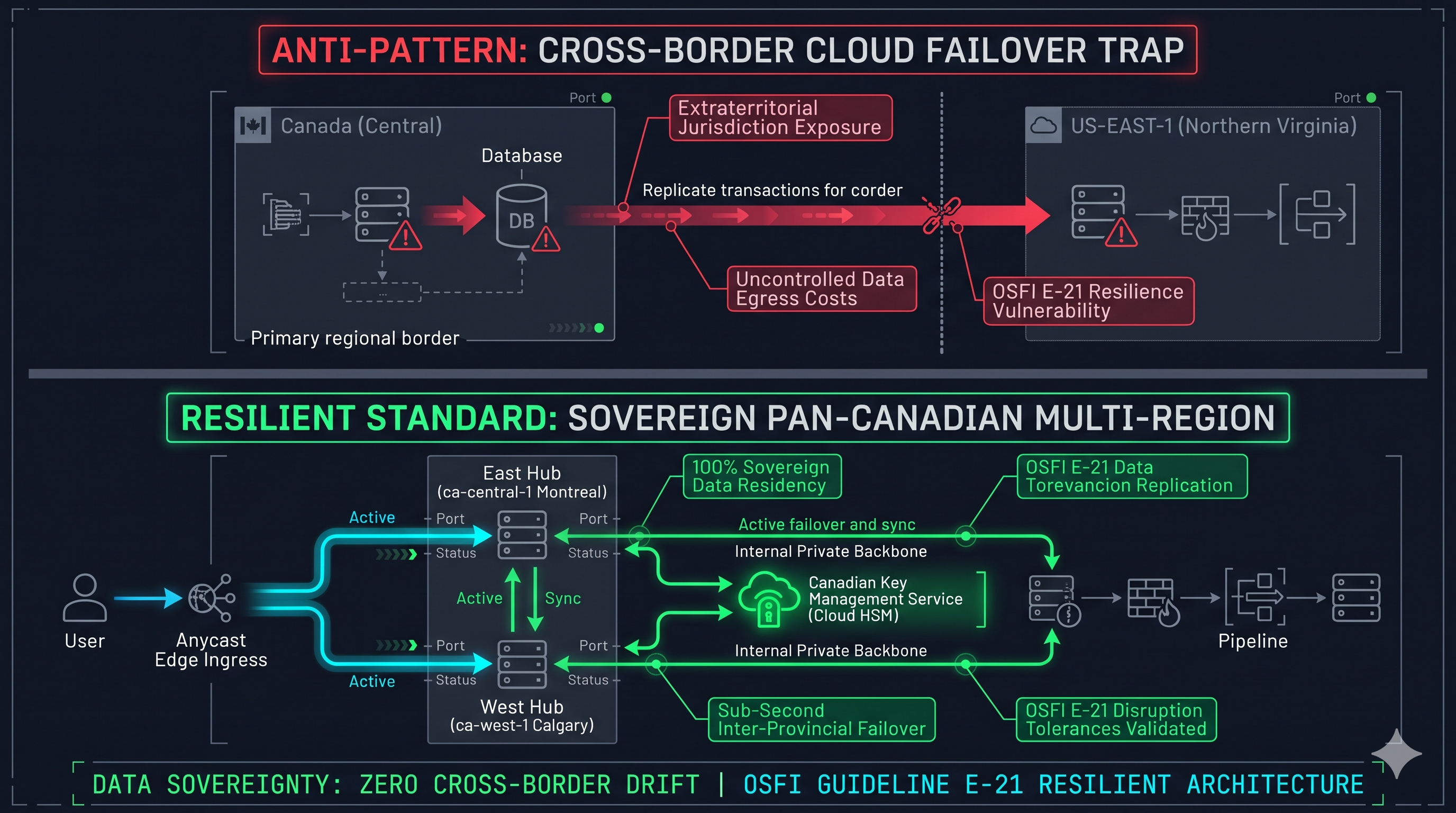
    A recurring anti-pattern is Cross-Border Multi-Region Coupling: hosting primary workloads in ca-central-1 (Central Canada) while configuring disaster recovery (DR) or asynchronous pipeline failovers into US availability zones (such as us-east-1).


    Under the Office of the Superintendent of Financial Institutions (OSFI Guideline E-21 on Operational Resilience) and federal privacy frameworks (PIPEDA / Quebec Law 25), this architecture introduces severe compliance and operational blind spots:


    Extraterritorial Jurisdiction Exposure: Replicating unencrypted or transient customer payloads across the border exposes Canadian user data to foreign legal discovery requests without explicit customer disclosure.


    Fragile Cross-Border Network Partitions: Routing active-passive database failover through international WAN trunks creates latency spikes and synchronization bottlenecks during severe transit disruptions.


    [❌ The Anti-Pattern: Cross-Border Cloud Failover Trap]
    Canadian User ──> Primary Ingress (ca-central-1: Montreal)
    │ (Cross-Border Replication Trunk)
    ▼
    Secondary DR (us-east-1: Virginia)
    Result: Foreign regulatory discovery exposure; cross-border WAN egress fees; E-21 resilience breach.


    [✅ The Sovereign Pan-Canadian Dual-Region Architecture]
    Canadian User ──> Anycast Edge Ingress (Canadian POPs)
    │
    ┌───────────────┴───────────────┐
    ▼ ▼
    [Primary Zone: ca-central-1] [Secondary Zone: ca-west-1]
    (Eastern Canada: Montreal) (Western Canada: Calgary)
    │ │
    └───────────────┬───────────────┘
    ▼
    [Envelope-Encrypted KMS: Sovereign Canadian HSM (AES-256)]
    [Automated OSFI E-21 Disruption Tolerance Telemetry Engine]
    To engineer resilient, sovereign cloud architectures in Canada, implement this 3-tier production pattern:


    1. Architect Inter-Provincial Sovereign Geo-Redundancy
    Stop relying on US border regions for disaster recovery.


    Establish dual-region topologies anchored entirely within domestic borders by pairing Eastern Canadian regions (ca-central-1 / Montreal) with Western Canadian regions (ca-west-1 / Calgary).


    Enforce VPC Service Endpoints and private interconnection backbones (Direct Connect / ExpressRoute) to ensure replication traffic never traverses public transit routes or international exchange points.


    2. Enforce Customer-Managed Keys (CMK) via In-Country Hardware Security Modules
    To satisfy statutory accountability principles under PIPEDA and Quebec Law 25:


    Isolate all cryptographic root keys within sovereign, dedicated Cloud HSMs provisioned exclusively within Canadian borders.


    3. Instrument Continuous Scenario Testing for Critical Operations (OSFI E-21)
    Operational resilience is no longer evaluated through static DR audit checklists:


    Under OSFI E-21, map every Information and Communication Technology (ICT) dependency directly to your organization’s named Critical Operations.


    Define concrete Tolerances for Disruption (e.g., maximum acceptable customer transaction disruption window).


    Run automated chaos injections: simulate the complete partition of trans-Canadian fiber routes and prove that application state fails over between Calgary and Montreal without exceeding your documented impact limits.


    Building modern software in Canada means recognizing that data sovereignty and operational resilience are inseparable architectural requirements.


    Discussion Question
    For Canadian platform teams: have you migrated your disaster recovery configurations to domestic inter-provincial regions (Montreal/Calgary), or does your infrastructure still depend on cross-border US regions for secondary failover?


    CTA
    Join Techawks Canada to discuss cloud infrastructure patterns, Canadian regulatory engineering, and distributed systems architecture with developers and technology leaders nationwide.
    Beyond Cross-Border Latency: How Canadian Engineering Teams Must Architect Sovereign Data Boundaries and Failover Under PIPEDA and OSFI E-21 Across the Canadian enterprise tech landscape—from financial hubs in Toronto to AI clusters in Montreal and Vancouver—engineering teams routinely manage hybrid cloud footprints. A recurring anti-pattern is Cross-Border Multi-Region Coupling: hosting primary workloads in ca-central-1 (Central Canada) while configuring disaster recovery (DR) or asynchronous pipeline failovers into US availability zones (such as us-east-1). Under the Office of the Superintendent of Financial Institutions (OSFI Guideline E-21 on Operational Resilience) and federal privacy frameworks (PIPEDA / Quebec Law 25), this architecture introduces severe compliance and operational blind spots: Extraterritorial Jurisdiction Exposure: Replicating unencrypted or transient customer payloads across the border exposes Canadian user data to foreign legal discovery requests without explicit customer disclosure. Fragile Cross-Border Network Partitions: Routing active-passive database failover through international WAN trunks creates latency spikes and synchronization bottlenecks during severe transit disruptions. [❌ The Anti-Pattern: Cross-Border Cloud Failover Trap] Canadian User ──> Primary Ingress (ca-central-1: Montreal) │ (Cross-Border Replication Trunk) ▼ Secondary DR (us-east-1: Virginia) Result: Foreign regulatory discovery exposure; cross-border WAN egress fees; E-21 resilience breach. [✅ The Sovereign Pan-Canadian Dual-Region Architecture] Canadian User ──> Anycast Edge Ingress (Canadian POPs) │ ┌───────────────┴───────────────┐ ▼ ▼ [Primary Zone: ca-central-1] [Secondary Zone: ca-west-1] (Eastern Canada: Montreal) (Western Canada: Calgary) │ │ └───────────────┬───────────────┘ ▼ [Envelope-Encrypted KMS: Sovereign Canadian HSM (AES-256)] [Automated OSFI E-21 Disruption Tolerance Telemetry Engine] To engineer resilient, sovereign cloud architectures in Canada, implement this 3-tier production pattern: 1. Architect Inter-Provincial Sovereign Geo-Redundancy Stop relying on US border regions for disaster recovery. Establish dual-region topologies anchored entirely within domestic borders by pairing Eastern Canadian regions (ca-central-1 / Montreal) with Western Canadian regions (ca-west-1 / Calgary). Enforce VPC Service Endpoints and private interconnection backbones (Direct Connect / ExpressRoute) to ensure replication traffic never traverses public transit routes or international exchange points. 2. Enforce Customer-Managed Keys (CMK) via In-Country Hardware Security Modules To satisfy statutory accountability principles under PIPEDA and Quebec Law 25: Isolate all cryptographic root keys within sovereign, dedicated Cloud HSMs provisioned exclusively within Canadian borders. 3. Instrument Continuous Scenario Testing for Critical Operations (OSFI E-21) Operational resilience is no longer evaluated through static DR audit checklists: Under OSFI E-21, map every Information and Communication Technology (ICT) dependency directly to your organization’s named Critical Operations. Define concrete Tolerances for Disruption (e.g., maximum acceptable customer transaction disruption window). Run automated chaos injections: simulate the complete partition of trans-Canadian fiber routes and prove that application state fails over between Calgary and Montreal without exceeding your documented impact limits. Building modern software in Canada means recognizing that data sovereignty and operational resilience are inseparable architectural requirements. Discussion Question For Canadian platform teams: have you migrated your disaster recovery configurations to domestic inter-provincial regions (Montreal/Calgary), or does your infrastructure still depend on cross-border US regions for secondary failover? CTA Join Techawks Canada to discuss cloud infrastructure patterns, Canadian regulatory engineering, and distributed systems architecture with developers and technology leaders nationwide.
    0 Comments 0 Shares 252 Views 0 Reviews
  • Architecting Sovereign AI in the UAE: How to Enforce In-Country Data Residency Across LLM Inference Pipelines
    As the UAE cements its position as a global capital for artificial intelligence, regulatory frameworks—specifically Federal Decree-Law No. 45 of 2021 on Personal Data Protection (PDPL) and the UAE Cyber Security Council National Cloud Security Policy—strictly enforce sovereign data residency and cross-border transfer controls.


    The critical engineering failure in AI adoption is treating foundational models as geographically agnostic APIs.


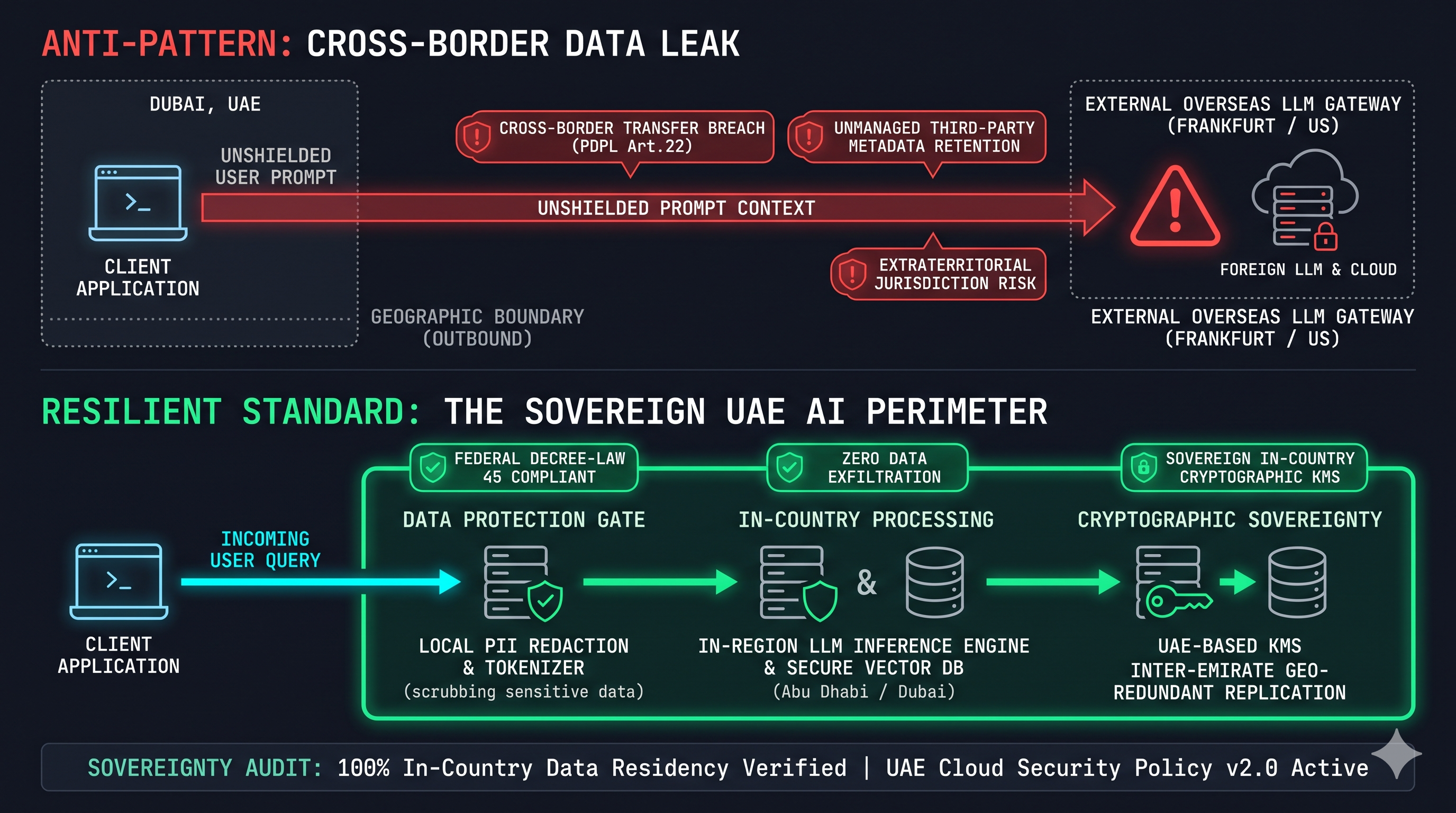
    When building Retrieval-Augmented Generation (RAG) or agentic loops, developers frequently send unstructured user context across international borders for external embedding generation and token completion. In regulated sectors (banking, government entities, critical infrastructure, and healthcare), this architecture breaches statutory compliance and risks heavy regulatory penalties.


    [❌ The Non-Compliant Cross-Border Anti-Pattern]
    UAE Client (Dubai/AD) ──> Web App ──(Unsanitized Prompt)──> External LLM Gateway (Frankfurt/US)
    │
    (Exfiltrates PII & Metadata)
    ▼
    Result: Direct violation of UAE PDPL Art. 22/23 & Sovereign Cloud Policy.


    [✅ The Sovereign UAE In-Country AI Architecture]
    UAE Client ──> In-Country API Gateway (Dubai / Abu Dhabi Cloud Region)
    │
    ▼
    [PII Redaction & Tokenization Guardrail]
    │
    ┌─────────────┴─────────────┐
    ▼ ▼
    [In-Country Vector DB] [Locally Hosted / Sovereign LLM]
    (AES-256 with UAE KMS) (In-Region Inference: UAE VPC)
    │ │
    └─────────────┬─────────────┘
    ▼
    [Encrypted In-Country Storage & Inter-Emirate Replica]
    To build compliant, enterprise-grade AI systems in the UAE, implement this 3-tier sovereign architecture:


    1. Pin Model Inference and Storage to Domestic Cloud Infrastructure
    Under the National Cloud Security Policy and PDPL, data and associated consumer metadata must remain under domestic UAE jurisdiction.


    Deploy model weights and vector indexes strictly within domestic cloud regions (e.g., UAE hyperscaler availability zones in Dubai and Abu Dhabi or sovereign infrastructure partners).


    Ensure all disaster recovery replication is configured as Inter-Emirate Geo-Redundancy (e.g., primary cluster in Dubai with hot/warm standby in Abu Dhabi), avoiding failovers that silently replicate customer databases outside sovereign borders.


    2. Implement Client-Side PII Masking and Deterministic Redaction
    Before any user input reaches downstream reasoning pipelines, route payloads through an automated preprocessing guardrail:


    Detect and tokenize sensitive national identifiers (Emirates ID numbers, passport strings, biometric tokens, contact records) using regex patterns and local named-entity recognition (NER) models.


    Replace sensitive fields with synthetic surrogate tokens (<EID_TOKEN_UUID>), maintaining an encrypted local vault to map variables back on the response path.


    3. Enforce In-Country Key Management (KMS Bring Your Own Key)
    Cloud security standards mandate that foreign entities cannot be compelled to expose data via extraterritorial access requests.


    Encrypt all persistent data at rest (database volumes, prompt logs, Parquet historical stores) using AES-256 with Customer-Managed Keys (CMK) managed inside UAE-resident Hardware Security Modules (HSMs).


    Enforce strict IAM policies ensuring encryption keys never leave UAE borders and foreign cloud operators cannot decrypt stored context payloads.


    Achieving enterprise AI scale in the UAE requires pairing frontier reasoning capabilities with strict sovereign isolation, ensuring your infrastructure is fully compliant with federal data protection laws.


    Discussion Question
    How is your engineering team solving the trade-off between accessing bleeding-edge frontier models and maintaining strict in-country data residency for regulated UAE workloads?


    CTA
    Join Techawks UAE to explore sovereign cloud engineering, regional AI architectures, and enterprise compliance patterns with builders and technology leaders across the UAE.
    Architecting Sovereign AI in the UAE: How to Enforce In-Country Data Residency Across LLM Inference Pipelines As the UAE cements its position as a global capital for artificial intelligence, regulatory frameworks—specifically Federal Decree-Law No. 45 of 2021 on Personal Data Protection (PDPL) and the UAE Cyber Security Council National Cloud Security Policy—strictly enforce sovereign data residency and cross-border transfer controls. The critical engineering failure in AI adoption is treating foundational models as geographically agnostic APIs. When building Retrieval-Augmented Generation (RAG) or agentic loops, developers frequently send unstructured user context across international borders for external embedding generation and token completion. In regulated sectors (banking, government entities, critical infrastructure, and healthcare), this architecture breaches statutory compliance and risks heavy regulatory penalties. [❌ The Non-Compliant Cross-Border Anti-Pattern] UAE Client (Dubai/AD) ──> Web App ──(Unsanitized Prompt)──> External LLM Gateway (Frankfurt/US) │ (Exfiltrates PII & Metadata) ▼ Result: Direct violation of UAE PDPL Art. 22/23 & Sovereign Cloud Policy. [✅ The Sovereign UAE In-Country AI Architecture] UAE Client ──> In-Country API Gateway (Dubai / Abu Dhabi Cloud Region) │ ▼ [PII Redaction & Tokenization Guardrail] │ ┌─────────────┴─────────────┐ ▼ ▼ [In-Country Vector DB] [Locally Hosted / Sovereign LLM] (AES-256 with UAE KMS) (In-Region Inference: UAE VPC) │ │ └─────────────┬─────────────┘ ▼ [Encrypted In-Country Storage & Inter-Emirate Replica] To build compliant, enterprise-grade AI systems in the UAE, implement this 3-tier sovereign architecture: 1. Pin Model Inference and Storage to Domestic Cloud Infrastructure Under the National Cloud Security Policy and PDPL, data and associated consumer metadata must remain under domestic UAE jurisdiction. Deploy model weights and vector indexes strictly within domestic cloud regions (e.g., UAE hyperscaler availability zones in Dubai and Abu Dhabi or sovereign infrastructure partners). Ensure all disaster recovery replication is configured as Inter-Emirate Geo-Redundancy (e.g., primary cluster in Dubai with hot/warm standby in Abu Dhabi), avoiding failovers that silently replicate customer databases outside sovereign borders. 2. Implement Client-Side PII Masking and Deterministic Redaction Before any user input reaches downstream reasoning pipelines, route payloads through an automated preprocessing guardrail: Detect and tokenize sensitive national identifiers (Emirates ID numbers, passport strings, biometric tokens, contact records) using regex patterns and local named-entity recognition (NER) models. Replace sensitive fields with synthetic surrogate tokens (<EID_TOKEN_UUID>), maintaining an encrypted local vault to map variables back on the response path. 3. Enforce In-Country Key Management (KMS Bring Your Own Key) Cloud security standards mandate that foreign entities cannot be compelled to expose data via extraterritorial access requests. Encrypt all persistent data at rest (database volumes, prompt logs, Parquet historical stores) using AES-256 with Customer-Managed Keys (CMK) managed inside UAE-resident Hardware Security Modules (HSMs). Enforce strict IAM policies ensuring encryption keys never leave UAE borders and foreign cloud operators cannot decrypt stored context payloads. Achieving enterprise AI scale in the UAE requires pairing frontier reasoning capabilities with strict sovereign isolation, ensuring your infrastructure is fully compliant with federal data protection laws. Discussion Question How is your engineering team solving the trade-off between accessing bleeding-edge frontier models and maintaining strict in-country data residency for regulated UAE workloads? CTA Join Techawks UAE to explore sovereign cloud engineering, regional AI architectures, and enterprise compliance patterns with builders and technology leaders across the UAE.
    0 Comments 0 Shares 239 Views 0 Reviews
  • Beyond Static Uptime: How UK Engineering Teams Must Architect Impact Tolerances for FCA & PRA Operational Resilience
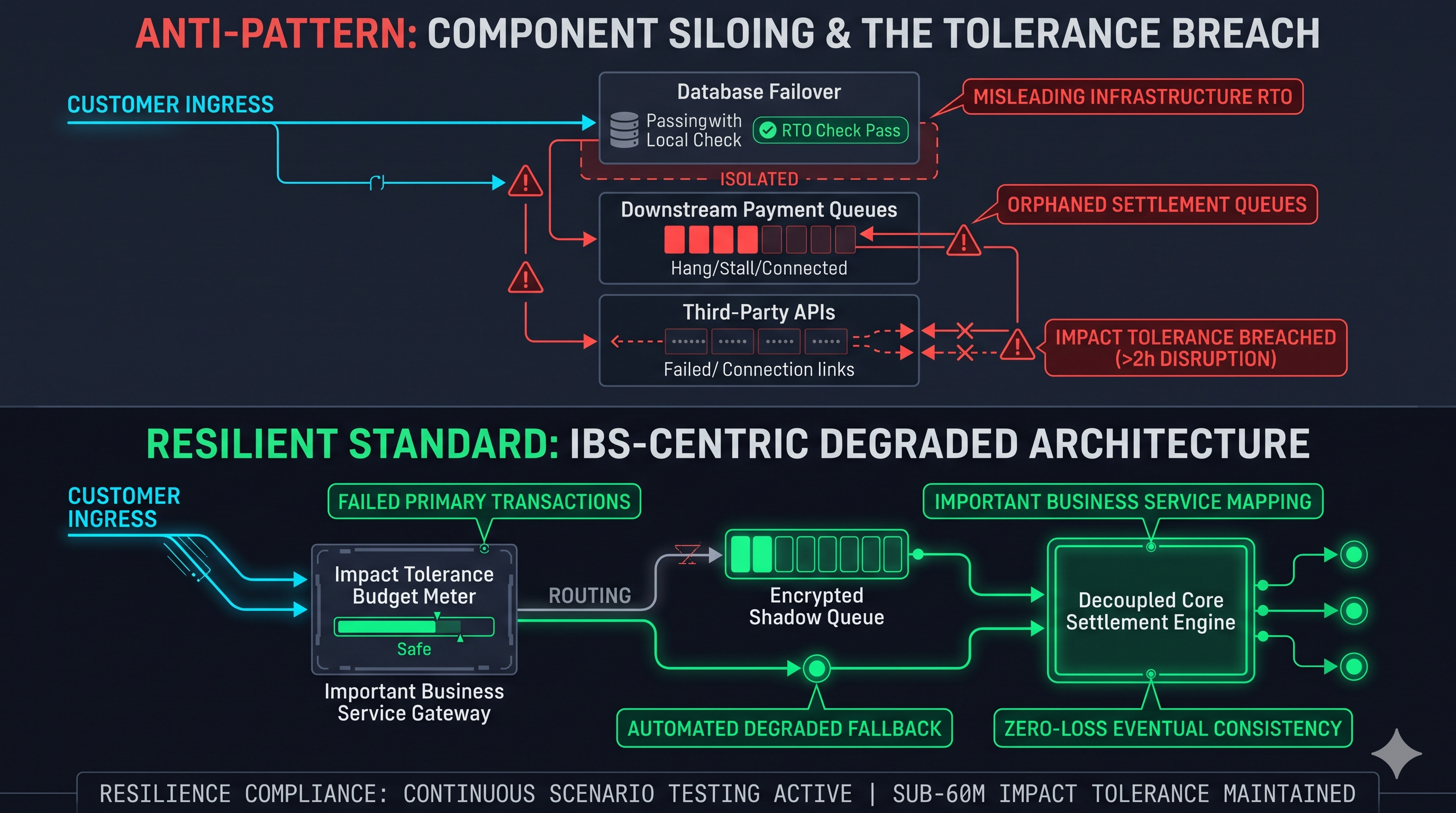
    Under supervisory oversight across UK financial services and digital infrastructure (governed by the Bank of England, PRA, and FCA operational resilience supervisory regimes), engineering teams are audited not on theoretical uptime, but on whether critical services can remain within strict Impact Tolerances during severe, plausible disruptions.


    Traditional disaster recovery focuses on infrastructure-level Recovery Point Objective (RPO) and Recovery Time Objective (RTO).


    The systemic flaw in this approach is Component Siloing: an engineering team might restore an Amazon RDS cluster in 15 minutes, but downstream third-party identity providers, clearing house webhooks, and asynchronous reconciliation queues can remain broken for hours, causing intolerable harm to end consumers.


    [❌ The Legacy Disaster Recovery Anti-Pattern: Component Siloing]
    Failure: Primary AWS eu-west-2 Database Outage
    DevOps Action: Restore DB snapshot in isolation (RTO met: 15m).
    Hidden Reality: Payment settlement queue hung; Open Banking API rate-limited; IBS remains down.
    Audit Finding: Impact Tolerance breached (Customer funds locked > 2h).


    [✅ The Production UK Operational Resilience Architecture: IBS Mapping & Circuit Breakers]
    Customer Ingress (Faster Payments / Open Banking)
    │
    ▼
    [IBS Gateway: Active Impact Tolerance Budget Meter]
    │
    ┌───────────────┴───────────────┐
    ▼ ▼
    [Primary Rails (eu-west-2)] [Warm Fallback / Degraded Mode]
    │ (Partition / Lag) │
    ▼ ▼
    [Circuit Breaker Trips] ──> [Deterministic Shadow Ledger (In-Memory)]
    │
    (Syncs within 45m Impact Cap)
    ▼
    [Asynchronous Core Settlement]
    To structure your UK cloud architectures around resilient service delivery rather than component uptime, implement this 3-tier engineering blueprint:


    1. Map Dependencies Directly to Important Business Services (IBS)
    Stop building dependency graphs grouped arbitrarily by microservice repositories.


    Group systems around discrete, customer-facing business outcomes (e.g., "Same-Day Faster Payment Initiation" or "Mortgage Decisioning").


    Tag every supporting asset: infrastructure, data stores, internal microservices, and external third-party SaaS vendors (BaaS providers, identity verification APIs).


    Identify single points of failure (SPOFs) where an unannounced cloud region degradation or upstream vendor rate limit cascades across the entire customer journey.


    2. Implement Automated Degradation Modes with Synthetic Shadow Queues
    When a core clearing switch or database cluster fails, avoid returning generic HTTP 500 errors to customers.


    Configure your edge gateways to trip into a Degraded Execution State the moment latency threatens the defined impact tolerance window (e.g., maximum allowable disruption of 60 minutes).


    Once primary backing services recover, an automated reconciliation worker drains the buffer sequentially with zero data loss.


    3. Transition from Passive DR Drills to Chaos Scenario Testing
    Static runbooks and annual DR PDF reports are dead documents. Supervisory guidelines expect firms to run automated chaos experiments simulating severe but plausible events:


    Simulate the complete sudden loss of an entire UK cloud availability zone alongside a concurrent third-party authentication API outage.


    Validate that your distributed state machines automatically reconcile data without exceeding your end-to-end tolerance threshold.


    Designing for operational resilience in the UK means accepting that individual microservices will experience outages—and engineering decoupled failover pathways that preserve customer outcomes under severe stress.


    Discussion Question
    How does your team define the technical boundary between an acceptable degraded mode and an official impact tolerance breach during third-party dependency outages?


    CTA
    Join Techawks UK to explore resilient systems engineering, cloud architecture patterns, and technical governance strategies with developers and platform leaders across the UK.
    Beyond Static Uptime: How UK Engineering Teams Must Architect Impact Tolerances for FCA & PRA Operational Resilience Under supervisory oversight across UK financial services and digital infrastructure (governed by the Bank of England, PRA, and FCA operational resilience supervisory regimes), engineering teams are audited not on theoretical uptime, but on whether critical services can remain within strict Impact Tolerances during severe, plausible disruptions. Traditional disaster recovery focuses on infrastructure-level Recovery Point Objective (RPO) and Recovery Time Objective (RTO). The systemic flaw in this approach is Component Siloing: an engineering team might restore an Amazon RDS cluster in 15 minutes, but downstream third-party identity providers, clearing house webhooks, and asynchronous reconciliation queues can remain broken for hours, causing intolerable harm to end consumers. [❌ The Legacy Disaster Recovery Anti-Pattern: Component Siloing] Failure: Primary AWS eu-west-2 Database Outage DevOps Action: Restore DB snapshot in isolation (RTO met: 15m). Hidden Reality: Payment settlement queue hung; Open Banking API rate-limited; IBS remains down. Audit Finding: Impact Tolerance breached (Customer funds locked > 2h). [✅ The Production UK Operational Resilience Architecture: IBS Mapping & Circuit Breakers] Customer Ingress (Faster Payments / Open Banking) │ ▼ [IBS Gateway: Active Impact Tolerance Budget Meter] │ ┌───────────────┴───────────────┐ ▼ ▼ [Primary Rails (eu-west-2)] [Warm Fallback / Degraded Mode] │ (Partition / Lag) │ ▼ ▼ [Circuit Breaker Trips] ──> [Deterministic Shadow Ledger (In-Memory)] │ (Syncs within 45m Impact Cap) ▼ [Asynchronous Core Settlement] To structure your UK cloud architectures around resilient service delivery rather than component uptime, implement this 3-tier engineering blueprint: 1. Map Dependencies Directly to Important Business Services (IBS) Stop building dependency graphs grouped arbitrarily by microservice repositories. Group systems around discrete, customer-facing business outcomes (e.g., "Same-Day Faster Payment Initiation" or "Mortgage Decisioning"). Tag every supporting asset: infrastructure, data stores, internal microservices, and external third-party SaaS vendors (BaaS providers, identity verification APIs). Identify single points of failure (SPOFs) where an unannounced cloud region degradation or upstream vendor rate limit cascades across the entire customer journey. 2. Implement Automated Degradation Modes with Synthetic Shadow Queues When a core clearing switch or database cluster fails, avoid returning generic HTTP 500 errors to customers. Configure your edge gateways to trip into a Degraded Execution State the moment latency threatens the defined impact tolerance window (e.g., maximum allowable disruption of 60 minutes). Once primary backing services recover, an automated reconciliation worker drains the buffer sequentially with zero data loss. 3. Transition from Passive DR Drills to Chaos Scenario Testing Static runbooks and annual DR PDF reports are dead documents. Supervisory guidelines expect firms to run automated chaos experiments simulating severe but plausible events: Simulate the complete sudden loss of an entire UK cloud availability zone alongside a concurrent third-party authentication API outage. Validate that your distributed state machines automatically reconcile data without exceeding your end-to-end tolerance threshold. Designing for operational resilience in the UK means accepting that individual microservices will experience outages—and engineering decoupled failover pathways that preserve customer outcomes under severe stress. Discussion Question How does your team define the technical boundary between an acceptable degraded mode and an official impact tolerance breach during third-party dependency outages? CTA Join Techawks UK to explore resilient systems engineering, cloud architecture patterns, and technical governance strategies with developers and platform leaders across the UK.
    0 Comments 0 Shares 170 Views 0 Reviews
  • Defeating "Harvest Now, Decrypt Later": How US Engineering Teams Must Architect Hybrid Post-Quantum TLS 1.3
    Across the US tech landscape—from federal contractors and defense tech to health tech and cloud infrastructure—compliance and security baselines are shifting toward quantum resilience.


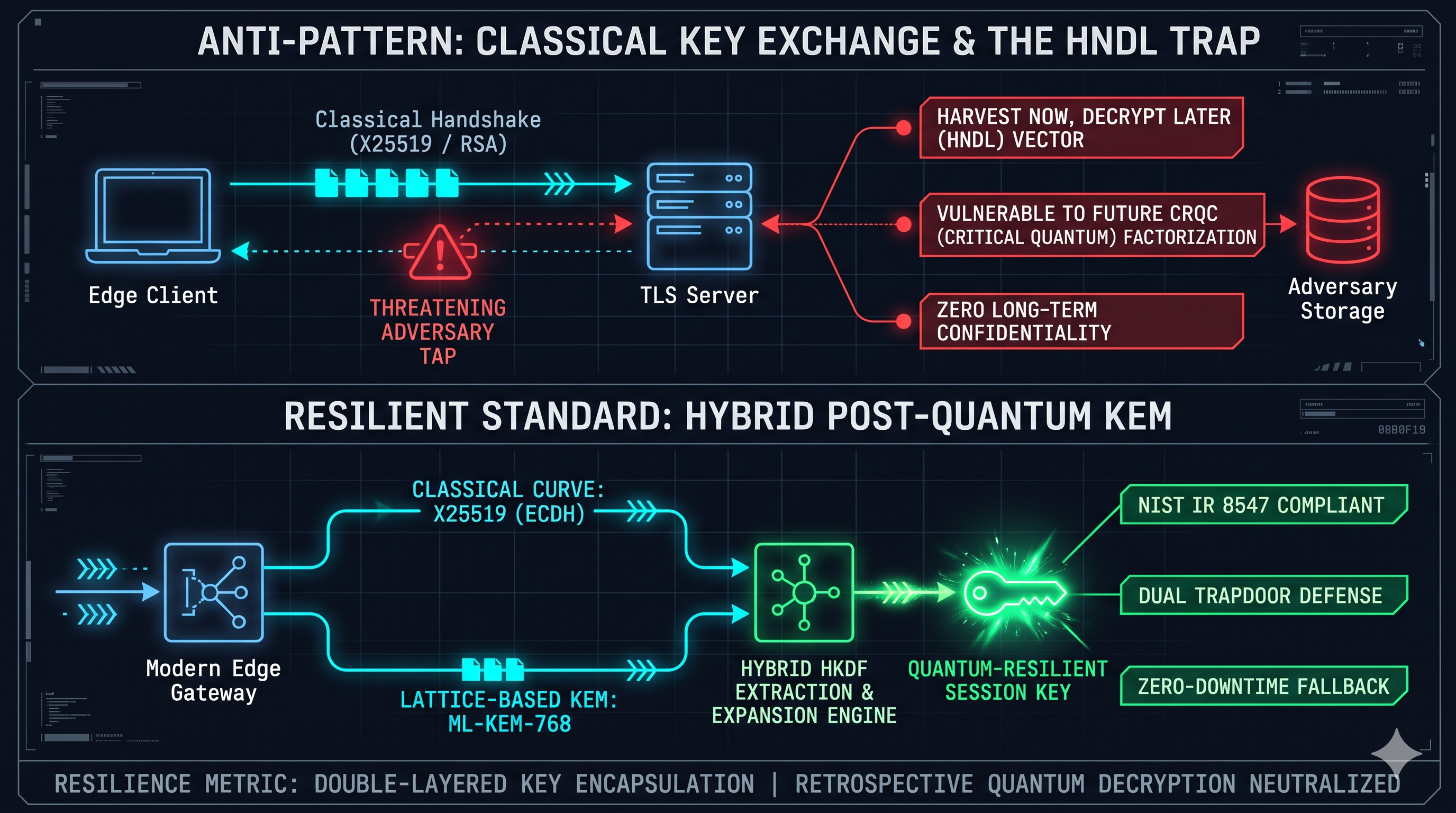
    The primary vector is not an immediate quantum compromise of live systems today, but Harvest Now, Decrypt Later (HNDL): state-sponsored adversaries passively capturing encrypted transit traffic to decrypt once fault-tolerant cryptanalytically relevant quantum computers (CRQCs) come online.


    Following the release of NIST IR 8547 (Transition to Post-Quantum Cryptography Standards), US technology providers and enterprise systems are transitioning from legacy key-exchange primitives toward hybrid post-quantum schemes.


    The core architectural failure is assuming migration requires a complete rip-and-replace of your cryptographic stack:


    [❌ Legacy Classical Ingress: Vulnerable to HNDL]
    Client ──(Standard X25519 / P-256 Key Exchange)──> Edge Load Balancer
    Adversary Action: Passive tap archives payload bytes.
    Future State: Cryptanalytic quantum computer cracks discrete log -> Full retrospective plaintext.


    [✅ Production Standard: Hybrid Post-Quantum Key Exchange (X25519 + ML-KEM)]
    Client ──(Combined Key Exchange: X25519 + ML-KEM-768)──> Edge Gateway
    │
    ┌───────────────┴───────────────┐
    ▼ ▼
    Classical Secret (X25519) Quantum-Resistant Secret (ML-KEM)
    │ │
    └───────────────┬───────────────┘
    ▼
    HKDF Extract-and-Expand (Hybrid Master Secret)
    Result: Breaking the session requires breaking BOTH classical and quantum-safe algorithms.
    To align your US cloud architectures with zero-trust quantum baselines without incurring operational downtime or breaking legacy clients, implement this 3-tier protocol:


    1. Deploy Dual-Mechanism Hybrid Key Exchanges at the Edge
    Do not abandon classical mathematics entirely. NIST and the Internet Engineering Task Force (IETF) recommend hybrid key encapsulation mechanisms (KEMs):


    Pair standard X25519 with ML-KEM-768 (standardized from CRYSTALS-Kyber).


    The shared master secret is derived via HKDF from both key agreements. If an unforeseen vulnerability is found in either algorithm, the complementary mathematical trapdoor preserves confidentiality.


    Modern ingress proxies (Envoy, NGINX, Cloudflare edge workers, AWS ALB) support hybrid post-quantum cipher suites natively.


    2. Mitigate Client Hello MTU Fragmentation
    ML-KEM public keys and ciphertexts are substantially larger than classical elliptic curve keys (e.g., ~1,184 bytes for ML-KEM-768 vs. 32 bytes for X25519).


    When the TLS ClientHello message exceeds the standard Network Maximum Transmission Unit (typically 1,500 bytes), intermediate network middleboxes or brittle corporate firewalls may drop fragmented packets.


    Tune your ingress buffer pools and monitor TCP retransmissions during the initial TLS handshake to ensure downstream middleboxes do not penalize hybrid handshakes.


    3. Establish Cryptographic Bill of Materials (CBOM) Observability
    You cannot migrate what you cannot locate.


    Instrument automated software composition analysis (SCA) to identify hard-coded cryptographic algorithms (RSA-2048, ECDSA P-256) across internal microservice communication and JWT signing routines.


    Decouple cryptographic algorithms from business logic using crypto-agile wrapper libraries, enabling dynamic algorithm reconfiguration without redeploying microservice binaries.


    Modern infrastructure engineering in the US demands recognizing that data with a 10-year confidentiality lifecycle is already insecure if protected solely by classical asymmetric keys.


    Discussion Question
    Has your platform or DevOps team started testing hybrid ML-KEM cipher suites on external load balancers, and did you run into any packet fragmentation issues with legacy corporate middleboxes?


    CTA
    Join Techawks USA to dissect federal cloud compliance, enterprise systems engineering, and frontier architecture patterns with builders across the United States.
    Defeating "Harvest Now, Decrypt Later": How US Engineering Teams Must Architect Hybrid Post-Quantum TLS 1.3 Across the US tech landscape—from federal contractors and defense tech to health tech and cloud infrastructure—compliance and security baselines are shifting toward quantum resilience. The primary vector is not an immediate quantum compromise of live systems today, but Harvest Now, Decrypt Later (HNDL): state-sponsored adversaries passively capturing encrypted transit traffic to decrypt once fault-tolerant cryptanalytically relevant quantum computers (CRQCs) come online. Following the release of NIST IR 8547 (Transition to Post-Quantum Cryptography Standards), US technology providers and enterprise systems are transitioning from legacy key-exchange primitives toward hybrid post-quantum schemes. The core architectural failure is assuming migration requires a complete rip-and-replace of your cryptographic stack: [❌ Legacy Classical Ingress: Vulnerable to HNDL] Client ──(Standard X25519 / P-256 Key Exchange)──> Edge Load Balancer Adversary Action: Passive tap archives payload bytes. Future State: Cryptanalytic quantum computer cracks discrete log -> Full retrospective plaintext. [✅ Production Standard: Hybrid Post-Quantum Key Exchange (X25519 + ML-KEM)] Client ──(Combined Key Exchange: X25519 + ML-KEM-768)──> Edge Gateway │ ┌───────────────┴───────────────┐ ▼ ▼ Classical Secret (X25519) Quantum-Resistant Secret (ML-KEM) │ │ └───────────────┬───────────────┘ ▼ HKDF Extract-and-Expand (Hybrid Master Secret) Result: Breaking the session requires breaking BOTH classical and quantum-safe algorithms. To align your US cloud architectures with zero-trust quantum baselines without incurring operational downtime or breaking legacy clients, implement this 3-tier protocol: 1. Deploy Dual-Mechanism Hybrid Key Exchanges at the Edge Do not abandon classical mathematics entirely. NIST and the Internet Engineering Task Force (IETF) recommend hybrid key encapsulation mechanisms (KEMs): Pair standard X25519 with ML-KEM-768 (standardized from CRYSTALS-Kyber). The shared master secret is derived via HKDF from both key agreements. If an unforeseen vulnerability is found in either algorithm, the complementary mathematical trapdoor preserves confidentiality. Modern ingress proxies (Envoy, NGINX, Cloudflare edge workers, AWS ALB) support hybrid post-quantum cipher suites natively. 2. Mitigate Client Hello MTU Fragmentation ML-KEM public keys and ciphertexts are substantially larger than classical elliptic curve keys (e.g., ~1,184 bytes for ML-KEM-768 vs. 32 bytes for X25519). When the TLS ClientHello message exceeds the standard Network Maximum Transmission Unit (typically 1,500 bytes), intermediate network middleboxes or brittle corporate firewalls may drop fragmented packets. Tune your ingress buffer pools and monitor TCP retransmissions during the initial TLS handshake to ensure downstream middleboxes do not penalize hybrid handshakes. 3. Establish Cryptographic Bill of Materials (CBOM) Observability You cannot migrate what you cannot locate. Instrument automated software composition analysis (SCA) to identify hard-coded cryptographic algorithms (RSA-2048, ECDSA P-256) across internal microservice communication and JWT signing routines. Decouple cryptographic algorithms from business logic using crypto-agile wrapper libraries, enabling dynamic algorithm reconfiguration without redeploying microservice binaries. Modern infrastructure engineering in the US demands recognizing that data with a 10-year confidentiality lifecycle is already insecure if protected solely by classical asymmetric keys. Discussion Question Has your platform or DevOps team started testing hybrid ML-KEM cipher suites on external load balancers, and did you run into any packet fragmentation issues with legacy corporate middleboxes? CTA Join Techawks USA to dissect federal cloud compliance, enterprise systems engineering, and frontier architecture patterns with builders across the United States.
    0 Comments 0 Shares 144 Views 0 Reviews
  • Architecting for India Stack: How to Build Resilient SAGA Choreography for Population-Scale UPI Pipelines
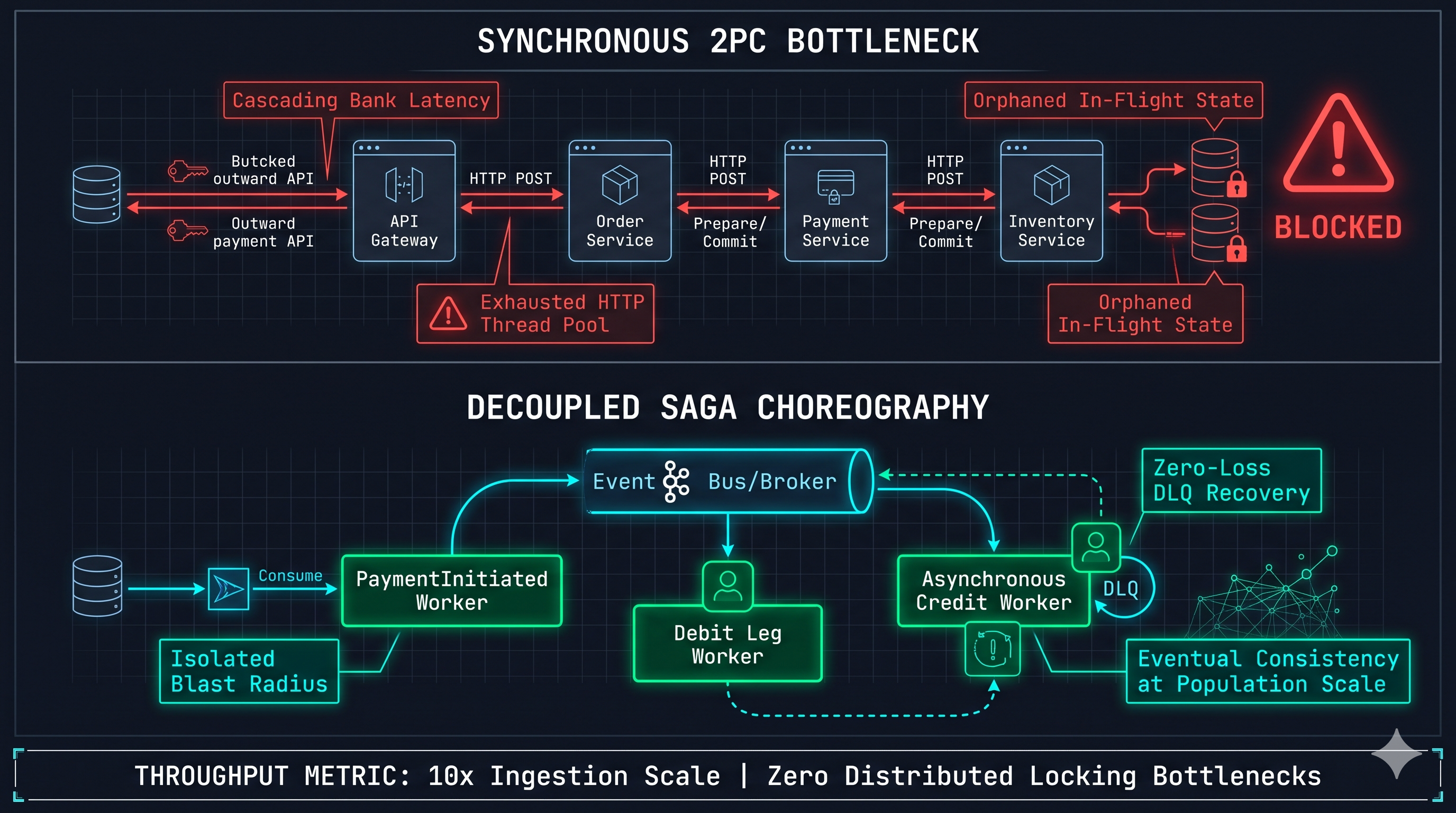
    India's Unified Payments Interface (UPI) handles billions of monthly transactions across hundreds of disparate banking partners. At this volume, banking endpoints exhibit unpredictable latency: an issuer debit call might take 80ms during standard hours and suddenly spike to 12 seconds during festive flash sales.Traditional distributed transaction systems attempt Two-Phase Commit (2PC), locking database rows across both the debiting bank and the crediting bank until both confirm.In a distributed, multi-entity ecosystem like the India Stack, holding global locks across independent banking networks is an operational failure mode. Instead, resilient payment architectures implement an Event-Driven SAGA Choreography with Compensating Reversals.[❌ The Synchronous HTTP / 2PC Anti-Pattern]
    User App ──(HTTP)──> Gateway ──(Sync)──> Issuer Bank (Debit) ──(Sync)──> Beneficiary Bank (Credit)
    │ (Timeout / 10s hang)
    ▼
    Outcome: Connection pools max out; upstream services crash; locks stay held indefinitely.


    [✅ The Production SAGA Choreography Architecture]
    Client Request ──> API Gateway ──> Orchestrator (Emits: 'PaymentInitiated')
    │
    ┌───────────────────────┴───────────────────────┐
    ▼ ▼
    [Debit Leg Worker] [Credit Leg Worker]
    (Calls Issuer via NPCI Switch) (Listens for 'DebitConfirmed' Event)
    │ │
    (Timeout / Failure?) (Credit Timeout?)
    ▼ ▼
    Emit 'DebitFailed' Event Trigger Auto-Reversal / Re-query
    (Immediate User Response) (Zero-Loss Settlement Worker)
    To engineer high-throughput payment rails that handle Indian peak load without transaction corruption, implement this 3-tier resilient pattern:
    1. Split Debits and Credits into Independent Asynchronous LegsNever bundle the customer debit and merchant/beneficiary credit into a single atomic blocking step.Debit Leg: Deduct funds from the payer’s account and transition state to DEBITED. Emit a signed internal Kafka/event-broker message.Credit Leg: Consume the event and execute credit against the payee’s institution.If the debit succeeds but the credit fails, do not fail the entire transaction synchronously. Instead, route the credit task to an internal dead-letter queue (DLQ) with scheduled polling or initiate an automated refund compensation saga.
    2. Implement Client-Side Idempotency and State MachinesBecause Indian networks face transient edge drops, consumers frequently mash retry buttons.Require every incoming payment request to carry a deterministic Transaction Reference ID (generated via UUIDv5 hashing the device binding, merchant order ID, and timestamp window).Enforce a strict Finite State Machine (FSM): INITIATED $\rightarrow$ PENDING_DEBIT $\rightarrow$ DEBITED $\rightarrow$ SETTLED (or REVERSED).Ensure state transitions are strictly monotonic so duplicate network webhooks cannot overwrite a terminal status.
    3. Decouple Polling via Bank Status Re-Query QueuesWhen an NPCI or bank switch returns a PENDING or TIMEOUT response code, do not keep the user's mobile screen waiting on a blocking thread.Immediately return a PENDING receipt to the client.Dispatch an out-of-band asynchronous worker with exponential backoff (e.g., polling intervals at $T+5\text{s}$, $T+30\text{s}$, $T+2\text{m}$, $T+15\text{m}$) to query the transaction status API directly.This frees up application gateway threads to ingest new requests while long-tail bank delays resolve asynchronously in the background.Architecting for population scale in India requires accepting that network delays and banking timeouts are inevitable—and building decoupled, eventually consistent workflows that guarantee zero ledger drift.
    Discussion Question
    When handling delayed payment states during peak traffic events, how does your engineering team manage the threshold between running automated status re-queries versus triggering immediate user refund sagas?
    CTA
    Join Techawks India to dissect national-scale software architectures, fintech systems engineering, and distributed design patterns with developers across India.
    Architecting for India Stack: How to Build Resilient SAGA Choreography for Population-Scale UPI Pipelines India's Unified Payments Interface (UPI) handles billions of monthly transactions across hundreds of disparate banking partners. At this volume, banking endpoints exhibit unpredictable latency: an issuer debit call might take 80ms during standard hours and suddenly spike to 12 seconds during festive flash sales.Traditional distributed transaction systems attempt Two-Phase Commit (2PC), locking database rows across both the debiting bank and the crediting bank until both confirm.In a distributed, multi-entity ecosystem like the India Stack, holding global locks across independent banking networks is an operational failure mode. Instead, resilient payment architectures implement an Event-Driven SAGA Choreography with Compensating Reversals.[❌ The Synchronous HTTP / 2PC Anti-Pattern] User App ──(HTTP)──> Gateway ──(Sync)──> Issuer Bank (Debit) ──(Sync)──> Beneficiary Bank (Credit) │ (Timeout / 10s hang) ▼ Outcome: Connection pools max out; upstream services crash; locks stay held indefinitely. [✅ The Production SAGA Choreography Architecture] Client Request ──> API Gateway ──> Orchestrator (Emits: 'PaymentInitiated') │ ┌───────────────────────┴───────────────────────┐ ▼ ▼ [Debit Leg Worker] [Credit Leg Worker] (Calls Issuer via NPCI Switch) (Listens for 'DebitConfirmed' Event) │ │ (Timeout / Failure?) (Credit Timeout?) ▼ ▼ Emit 'DebitFailed' Event Trigger Auto-Reversal / Re-query (Immediate User Response) (Zero-Loss Settlement Worker) To engineer high-throughput payment rails that handle Indian peak load without transaction corruption, implement this 3-tier resilient pattern: 1. Split Debits and Credits into Independent Asynchronous LegsNever bundle the customer debit and merchant/beneficiary credit into a single atomic blocking step.Debit Leg: Deduct funds from the payer’s account and transition state to DEBITED. Emit a signed internal Kafka/event-broker message.Credit Leg: Consume the event and execute credit against the payee’s institution.If the debit succeeds but the credit fails, do not fail the entire transaction synchronously. Instead, route the credit task to an internal dead-letter queue (DLQ) with scheduled polling or initiate an automated refund compensation saga. 2. Implement Client-Side Idempotency and State MachinesBecause Indian networks face transient edge drops, consumers frequently mash retry buttons.Require every incoming payment request to carry a deterministic Transaction Reference ID (generated via UUIDv5 hashing the device binding, merchant order ID, and timestamp window).Enforce a strict Finite State Machine (FSM): INITIATED $\rightarrow$ PENDING_DEBIT $\rightarrow$ DEBITED $\rightarrow$ SETTLED (or REVERSED).Ensure state transitions are strictly monotonic so duplicate network webhooks cannot overwrite a terminal status. 3. Decouple Polling via Bank Status Re-Query QueuesWhen an NPCI or bank switch returns a PENDING or TIMEOUT response code, do not keep the user's mobile screen waiting on a blocking thread.Immediately return a PENDING receipt to the client.Dispatch an out-of-band asynchronous worker with exponential backoff (e.g., polling intervals at $T+5\text{s}$, $T+30\text{s}$, $T+2\text{m}$, $T+15\text{m}$) to query the transaction status API directly.This frees up application gateway threads to ingest new requests while long-tail bank delays resolve asynchronously in the background.Architecting for population scale in India requires accepting that network delays and banking timeouts are inevitable—and building decoupled, eventually consistent workflows that guarantee zero ledger drift. Discussion Question When handling delayed payment states during peak traffic events, how does your engineering team manage the threshold between running automated status re-queries versus triggering immediate user refund sagas? CTA Join Techawks India to dissect national-scale software architectures, fintech systems engineering, and distributed design patterns with developers across India.
    0 Comments 0 Shares 142 Views 0 Reviews
  • Beyond Annotation Spaghetti: How to Architect Multi-Tenant Traffic with the Kubernetes Gateway API
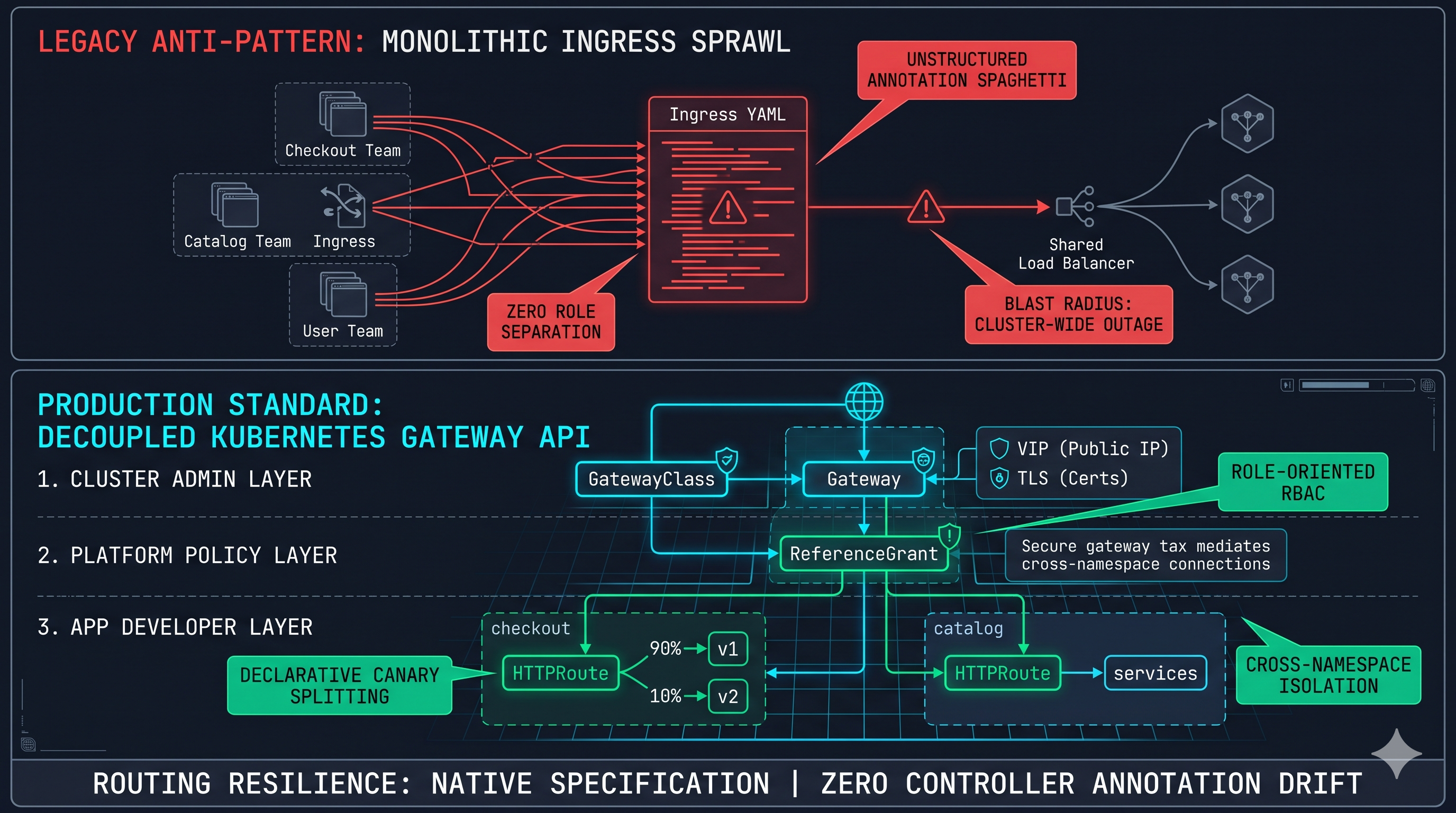
    The legacy Kubernetes Ingress resource attempted to force three distinct organizational personas into a single monolithic API object:


    Cluster/Infra Operators: Managing public IPs, TLS certificates, firewall rules, and cloud load balancers.


    Platform Engineers: Enforcing routing policies, rate limits, and authentication guards.


    Application Developers: Directing URI paths to specific internal service ports.


    Because Ingress lacked expressive native primitives for advanced routing (like canary splits, header rewriting, or multi-namespace attachment), platforms became dependent on custom controller annotations.


    The Gateway API decomposes monolithic ingress into a role-oriented, decoupled resource hierarchy:


    [❌ Monolithic Ingress Anti-Pattern]
    Single 'Ingress' Manifest (Annotated to death)
    ├── Infra Config (TLS, LoadBalancer IP)
    ├── Routing Rules (/api, /auth)
    └── App Secrets
    Result: No RBAC isolation; single namespace leak affects cluster-wide gateway.


    [✅ Production Gateway API Architecture]
    [Cluster Admin] --> GatewayClass (Defines controller: Cilium, Envoy, Cloud ALB)
    │
    [Platform / DevOps] --> Gateway (Manages listeners, VIP, TLS certs, allowed namespaces)
    │
    ┌───────────────┴───────────────┐
    ▼ ▼
    [App Team A / HTTPRoute] [App Team B / HTTPRoute]
    Namespace: 'checkout' Namespace: 'catalog'
    Path: /api/v1/checkout Path: /api/v1/products
    Canary: 90% v1 / 10% v2 Direct Service Forwarding
    To migrate production traffic cleanly without downtime, follow this 3-step transition pattern:


    1. Decouple Infrastructure from Application Routing
    Define the Gateway in an administrative namespace (e.g., infra-gateways) and declare explicit listener constraints:


    YAML
    apiVersion: gateway.networking.k8s.io/v1
    kind: Gateway
    metadata:
    name: external-edge-gateway
    namespace: infra-gateways
    spec:
    gatewayClassName: envoy-gateway
    listeners:
    - name: https-prod
    protocol: HTTPS
    port: 443
    tls:
    mode: Terminate
    certificateRefs:
    - kind: Secret
    name: wildcard-production-tls
    allowedRoutes:
    namespaces:
    from: Selector
    selector:
    matchLabels:
    gateway-access: "true"


    2. Delegate Routing Authority via Scoped HTTPRoute
    Application teams define their own routing inside their application namespaces by attaching to the parent gateway:


    YAML
    apiVersion: gateway.networking.k8s.io/v1
    kind: HTTPRoute
    metadata:
    name: checkout-route
    namespace: checkout-workloads
    spec:
    parentRefs:
    - name: external-edge-gateway
    namespace: infra-gateways
    rules:
    - matches:
    - path:
    type: PathPrefix
    value: /api/v1/checkout
    backendRefs:
    - name: checkout-svc-v1
    port: 8080
    weight: 90
    - name: checkout-svc-v2
    port: 8080
    weight: 10
    Canary traffic splitting is now an expressive, first-class native specification with weighted backend references—no brittle custom controller annotations required.


    3. Control Cross-Namespace References with ReferenceGrant
    By default, the Gateway API blocks cross-namespace routing to enforce multi-tenant security. If an HTTPRoute in namespace A needs to forward traffic to a backend Service in namespace B, namespace B must explicitly issue a ReferenceGrant. This eliminates cross-tenant privilege escalation and unauthorized service snooping.


    Discussion Question
    Has your platform team started migrating production workloads from legacy Ingress controllers to Gateway API implementations (Envoy Gateway, Cilium, or Cloud-managed Gateways), and what was your primary blocker during DNS cutover?


    CTA
    Join Cloud, DevOps & Open Source to explore hands-on Kubernetes architecture patterns, GitOps workflows, and production infrastructure design with engineers worldwide.
    Beyond Annotation Spaghetti: How to Architect Multi-Tenant Traffic with the Kubernetes Gateway API The legacy Kubernetes Ingress resource attempted to force three distinct organizational personas into a single monolithic API object: Cluster/Infra Operators: Managing public IPs, TLS certificates, firewall rules, and cloud load balancers. Platform Engineers: Enforcing routing policies, rate limits, and authentication guards. Application Developers: Directing URI paths to specific internal service ports. Because Ingress lacked expressive native primitives for advanced routing (like canary splits, header rewriting, or multi-namespace attachment), platforms became dependent on custom controller annotations. The Gateway API decomposes monolithic ingress into a role-oriented, decoupled resource hierarchy: [❌ Monolithic Ingress Anti-Pattern] Single 'Ingress' Manifest (Annotated to death) ├── Infra Config (TLS, LoadBalancer IP) ├── Routing Rules (/api, /auth) └── App Secrets Result: No RBAC isolation; single namespace leak affects cluster-wide gateway. [✅ Production Gateway API Architecture] [Cluster Admin] --> GatewayClass (Defines controller: Cilium, Envoy, Cloud ALB) │ [Platform / DevOps] --> Gateway (Manages listeners, VIP, TLS certs, allowed namespaces) │ ┌───────────────┴───────────────┐ ▼ ▼ [App Team A / HTTPRoute] [App Team B / HTTPRoute] Namespace: 'checkout' Namespace: 'catalog' Path: /api/v1/checkout Path: /api/v1/products Canary: 90% v1 / 10% v2 Direct Service Forwarding To migrate production traffic cleanly without downtime, follow this 3-step transition pattern: 1. Decouple Infrastructure from Application Routing Define the Gateway in an administrative namespace (e.g., infra-gateways) and declare explicit listener constraints: YAML apiVersion: gateway.networking.k8s.io/v1 kind: Gateway metadata: name: external-edge-gateway namespace: infra-gateways spec: gatewayClassName: envoy-gateway listeners: - name: https-prod protocol: HTTPS port: 443 tls: mode: Terminate certificateRefs: - kind: Secret name: wildcard-production-tls allowedRoutes: namespaces: from: Selector selector: matchLabels: gateway-access: "true" 2. Delegate Routing Authority via Scoped HTTPRoute Application teams define their own routing inside their application namespaces by attaching to the parent gateway: YAML apiVersion: gateway.networking.k8s.io/v1 kind: HTTPRoute metadata: name: checkout-route namespace: checkout-workloads spec: parentRefs: - name: external-edge-gateway namespace: infra-gateways rules: - matches: - path: type: PathPrefix value: /api/v1/checkout backendRefs: - name: checkout-svc-v1 port: 8080 weight: 90 - name: checkout-svc-v2 port: 8080 weight: 10 Canary traffic splitting is now an expressive, first-class native specification with weighted backend references—no brittle custom controller annotations required. 3. Control Cross-Namespace References with ReferenceGrant By default, the Gateway API blocks cross-namespace routing to enforce multi-tenant security. If an HTTPRoute in namespace A needs to forward traffic to a backend Service in namespace B, namespace B must explicitly issue a ReferenceGrant. This eliminates cross-tenant privilege escalation and unauthorized service snooping. Discussion Question Has your platform team started migrating production workloads from legacy Ingress controllers to Gateway API implementations (Envoy Gateway, Cilium, or Cloud-managed Gateways), and what was your primary blocker during DNS cutover? CTA Join Cloud, DevOps & Open Source to explore hands-on Kubernetes architecture patterns, GitOps workflows, and production infrastructure design with engineers worldwide.
    0 Comments 0 Shares 123 Views 0 Reviews
  • The Death of the Chat Box: Designing Reversible Affordances for Agentic AI Workflows
    Traditional UX assumes deterministic interaction: clicking a button always triggers an identical, predictable state mutation.


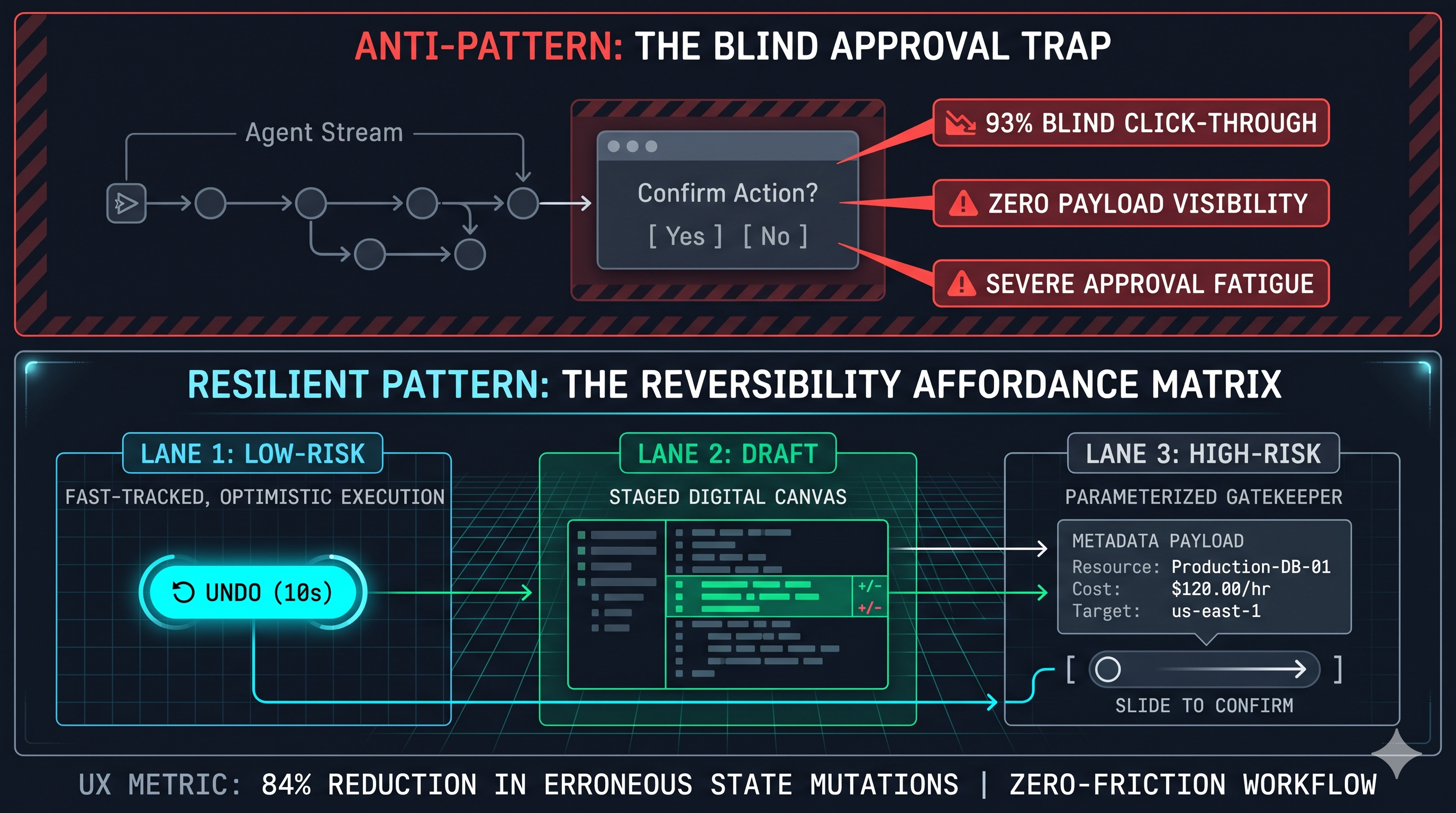
    Agentic AI breaks this paradigm. Because multi-step agents are non-deterministic, open-ended, and act directly on external environments (executing API calls, sending communications, modifying database records), applying conventional form validations or linear dialog boxes creates dangerous UX failure modes:


    The Interruption Bottleneck: Forcing users to approve every tiny autonomous step completely ruins the agent's core value proposition.


    The Blind-Approval Anti-Pattern: Generic modal dialogues ("Agent wants to proceed: OK / Cancel") obscure the underlying payload, training users to skim and accept without verifying.


    Product managers and product designers must transition from "Chat Interfaces" to Tiered Autonomy and Reversibility Affordances.


    [❌ The Broken Interaction: Generic Confirmation Modal]
    Agent Action ──> [Modal: "Are you sure you want to proceed? [Yes/No]"]
    Outcome: 93% blind approval rate; user fatigue; high disaster blast radius.


    [✅ Modern Agentic UX: The Reversibility Matrix]
    Action Type Interaction Pattern UX Affordance
    ────────────────────────────────────────────────────────────────────────────────────────
    Low-Risk / Reversible │ Optimistic Execution + Undo │ Temporary Toast (5-10s) + Rollback
    Draft / Staged Artifact │ Inline Diff & Direct Canvas Edit │ Shaded Canvas + Single-Key Accept
    High-Risk / Irreversible │ Parameterized Gatekeeper │ Explicit Payload Diff + Dual Approver
    To build agentic products users can genuinely rely on, apply this 3-step UX framework:


    1. Categorize Every Tool Action by Blast Radius and Reversibility
    Never treat all agent tool invocations equally:


    Low Blast Radius / High Reversibility: Tagging tickets, reordering lists, generating draft summaries. Pattern: Execute optimistically without blocking the user, while surfacing a persistent 10-second undo toast.


    High Blast Radius / Irreversible: Transacting payments, altering production infrastructure, deleting customer datasets. Pattern: Full execution freeze with explicit payload inspections.


    2. Design Structured Staging Canvases, Not Conversational Transcripts
    Users cannot parse complex structural changes inside a narrow scrolling chat transcript.


    When an agent drafts a workflow, document, or architecture, render it inside a dedicated Staging Canvas using inline diffing (visual green/red delta highlighting).


    Provide Inline Tweak Affordances: allow the user to click and edit specific hallucinated parameters directly on the canvas without reprompting the agent from scratch.


    3. Transform "Confirmation Modals" into "Parameterized Gatekeepers"
    Eliminate generic alert dialogues. An enterprise approval checkpoint must clearly display:


    The explicit external target (e.g., "Deploying branch 'staging-v2' to AWS us-east-1").


    The exact financial or state delta (e.g., "Estimated monthly compute: +$340/mo").


    A granular fallback toggle allowing the user to approve a subset of actions while rejecting risky tool parameters.


    Designing for autonomous systems is not about getting out of the user's way completely; it is about calibrating load-bearing friction so human oversight feels empowering rather than bureaucratic.


    Discussion Question
    In your product, what criteria separates an action executed autonomously with an "Undo" affordance from one that mandates a blocking Human-in-the-Loop approval gate?


    CTA
    Join Product, UX & Design to unpack real-world design systems, agentic interaction patterns, and product frameworks with designers and product leaders building next-generation interfaces.
    The Death of the Chat Box: Designing Reversible Affordances for Agentic AI Workflows Traditional UX assumes deterministic interaction: clicking a button always triggers an identical, predictable state mutation. Agentic AI breaks this paradigm. Because multi-step agents are non-deterministic, open-ended, and act directly on external environments (executing API calls, sending communications, modifying database records), applying conventional form validations or linear dialog boxes creates dangerous UX failure modes: The Interruption Bottleneck: Forcing users to approve every tiny autonomous step completely ruins the agent's core value proposition. The Blind-Approval Anti-Pattern: Generic modal dialogues ("Agent wants to proceed: OK / Cancel") obscure the underlying payload, training users to skim and accept without verifying. Product managers and product designers must transition from "Chat Interfaces" to Tiered Autonomy and Reversibility Affordances. [❌ The Broken Interaction: Generic Confirmation Modal] Agent Action ──> [Modal: "Are you sure you want to proceed? [Yes/No]"] Outcome: 93% blind approval rate; user fatigue; high disaster blast radius. [✅ Modern Agentic UX: The Reversibility Matrix] Action Type Interaction Pattern UX Affordance ──────────────────────────────────────────────────────────────────────────────────────── Low-Risk / Reversible │ Optimistic Execution + Undo │ Temporary Toast (5-10s) + Rollback Draft / Staged Artifact │ Inline Diff & Direct Canvas Edit │ Shaded Canvas + Single-Key Accept High-Risk / Irreversible │ Parameterized Gatekeeper │ Explicit Payload Diff + Dual Approver To build agentic products users can genuinely rely on, apply this 3-step UX framework: 1. Categorize Every Tool Action by Blast Radius and Reversibility Never treat all agent tool invocations equally: Low Blast Radius / High Reversibility: Tagging tickets, reordering lists, generating draft summaries. Pattern: Execute optimistically without blocking the user, while surfacing a persistent 10-second undo toast. High Blast Radius / Irreversible: Transacting payments, altering production infrastructure, deleting customer datasets. Pattern: Full execution freeze with explicit payload inspections. 2. Design Structured Staging Canvases, Not Conversational Transcripts Users cannot parse complex structural changes inside a narrow scrolling chat transcript. When an agent drafts a workflow, document, or architecture, render it inside a dedicated Staging Canvas using inline diffing (visual green/red delta highlighting). Provide Inline Tweak Affordances: allow the user to click and edit specific hallucinated parameters directly on the canvas without reprompting the agent from scratch. 3. Transform "Confirmation Modals" into "Parameterized Gatekeepers" Eliminate generic alert dialogues. An enterprise approval checkpoint must clearly display: The explicit external target (e.g., "Deploying branch 'staging-v2' to AWS us-east-1"). The exact financial or state delta (e.g., "Estimated monthly compute: +$340/mo"). A granular fallback toggle allowing the user to approve a subset of actions while rejecting risky tool parameters. Designing for autonomous systems is not about getting out of the user's way completely; it is about calibrating load-bearing friction so human oversight feels empowering rather than bureaucratic. Discussion Question In your product, what criteria separates an action executed autonomously with an "Undo" affordance from one that mandates a blocking Human-in-the-Loop approval gate? CTA Join Product, UX & Design to unpack real-world design systems, agentic interaction patterns, and product frameworks with designers and product leaders building next-generation interfaces.
    0 Comments 0 Shares 126 Views 0 Reviews
  • Beyond Directory-Based Hive Partitions: How to Architect Hidden Partitioning and Manifest Pruning in Modern Lakehouses
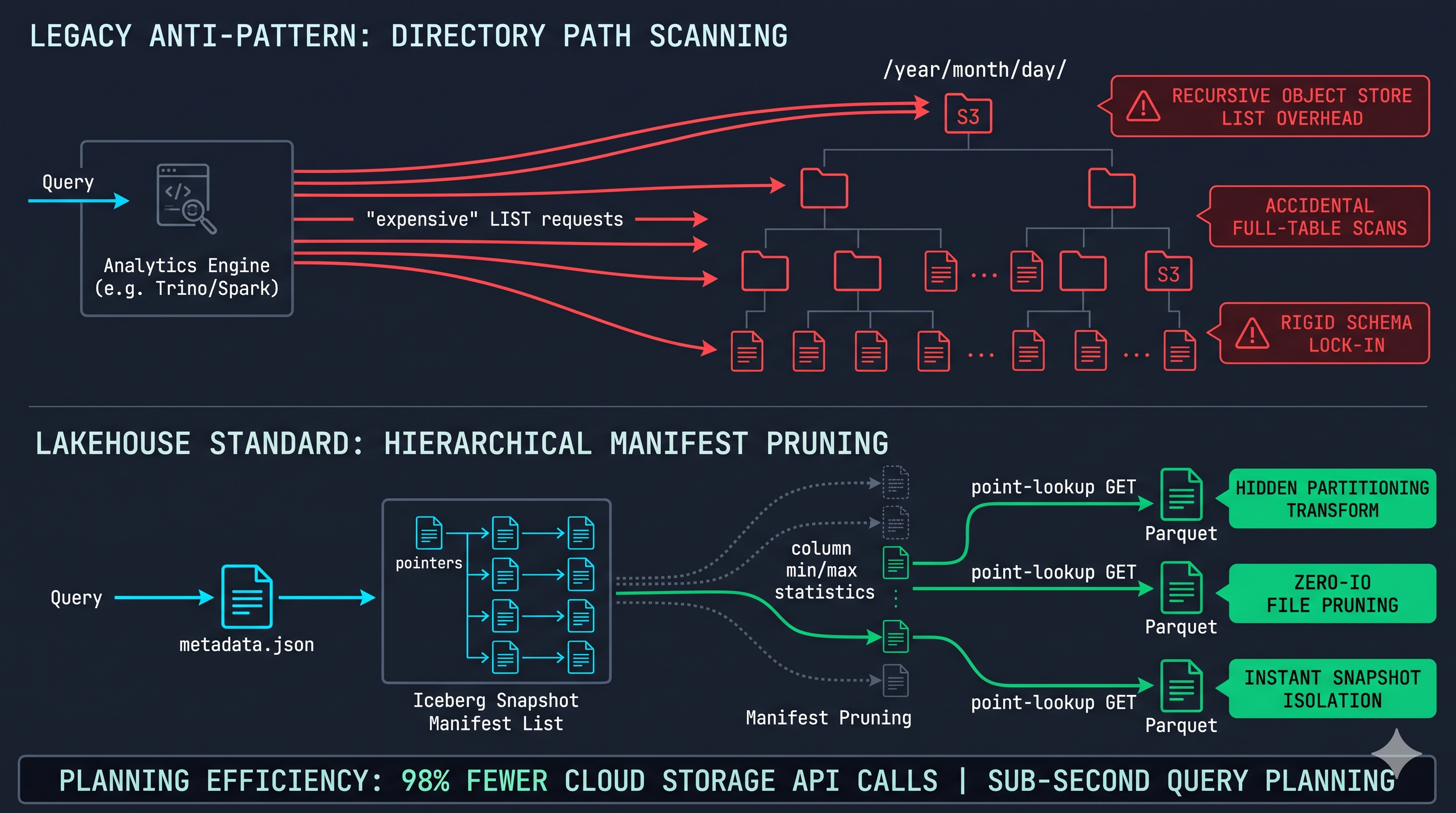
    In legacy Hive-style data lakes, partition values were embedded directly into physical cloud object storage paths.


    This creates two critical production failure modes:


    Physical Coupling & Query Misalignment: When users write SQL filters against timestamps (WHERE event_time >= '2026-10-01'), but the storage engine is partitioned strictly by string date columns (WHERE date_str = '2026-10-01'), the query planner cannot deduce directory paths and is forced to perform a full-table scan across thousands of storage prefixes.


    Catalog Metadata Bottlenecks: Query planning requires sending recursive filesystem LIST requests to cloud object storage (e.g., S3, ADLS, GCS), which are rate-limited, high-latency, and lack column-level statistical bounds.


    Modern open table formats (such as Apache Iceberg and Delta Lake) replace physical directory scanning with Hierarchical Metadata Trees and Hidden Partitioning.


    [❌ Legacy Hive Partitioning: Path-Bound Full Scan Trap]
    SQL Query: SELECT * FROM telemetry WHERE timestamp >= '2026-10-31 00:00:00'
    Path: s3://lakehouse/telemetry/year=2026/month=10/day=31/
    Planner: Must issue S3:LIST objects on thousands of prefixes.
    Result: 45-second metadata discovery overhead; failed partition pruning on timestamp transforms.


    [✅ Lakehouse Manifest Pruning: Hierarchical Snapshot Tree]
    Catalog Pointer ──> metadata.json ──> Manifest List (Snapshot)
    │
    ┌────────────────────────────┴────────────────────────────┐
    ▼ ▼
    Manifest File A (Partitions: Oct 20-25) Manifest File B (Partitions: Oct 26-31)
    [Evaluates Min/Max Stats: PRUNED] [Column Stats Match: SCANNED]
    │ │
    (0 Data Files Read) Data Files (Direct GET by path)
    To optimize analytics queries across multi-engine lakehouses (Trino, Spark, DuckDB, Snowflake), implement this 3-tier table management architecture:


    1. Leverage Hidden Partitioning via Transform Functions
    Stop forcing data engineers to materialize redundant synthetic columns (date, month, hour) alongside canonical ISO timestamps.


    Use partition transforms directly on source timestamp fields (e.g., days(event_time) or hours(event_time)).


    The query engine automatically converts predicates on event_time into manifest filter operations. Analysts query the business column naturally without knowing the underlying storage partitioning scheme.


    2. Eliminate Directory Rewrites with Partition Evolution
    Business data volumes scale unpredictably. A table partitioned by day may grow to gigabytes per hour, while an over-partitioned table creates the dreaded "small-file crisis."


    The table format assigns partition spec IDs per manifest. Old data queries use Spec 0, while new data routes through Spec 1, enabling zero-downtime schema and layout evolution.


    3. Enforce Manifest Compaction and Snapshot Expiration
    As streaming pipelines (Kafka/Flink) commit records every few minutes, small manifest files proliferate, degrading query planning time.


    Schedule asynchronous metadata compaction routines:


    SQL
    -- Iceberg rewrite manifests to cluster data files by partition bounds
    CALL system.rewrite_manifests('analytics.production_telemetry');


    -- Expire obsolete historical snapshots older than 7 days to clean storage bloat
    CALL system.expire_snapshots('analytics.production_telemetry', older_than => TIMESTAMP '2026-10-24 00:00:00');


    Moving your lakehouse from primitive directory structures to snapshot-based metadata architectures decouples business query logic from physical file layouts, slashing time-to-first-byte across enterprise analytics workloads.


    Discussion Question
    How frequently does your data engineering team run manifest compaction and file bin-packing routines on streaming lakehouse tables to prevent query-planning degradation?


    CTA
    Join Data Science & Analytics to learn advanced data engineering architectures, lakehouse performance tuning, and scalable query optimization techniques with practitioners globally.
    Beyond Directory-Based Hive Partitions: How to Architect Hidden Partitioning and Manifest Pruning in Modern Lakehouses In legacy Hive-style data lakes, partition values were embedded directly into physical cloud object storage paths. This creates two critical production failure modes: Physical Coupling & Query Misalignment: When users write SQL filters against timestamps (WHERE event_time >= '2026-10-01'), but the storage engine is partitioned strictly by string date columns (WHERE date_str = '2026-10-01'), the query planner cannot deduce directory paths and is forced to perform a full-table scan across thousands of storage prefixes. Catalog Metadata Bottlenecks: Query planning requires sending recursive filesystem LIST requests to cloud object storage (e.g., S3, ADLS, GCS), which are rate-limited, high-latency, and lack column-level statistical bounds. Modern open table formats (such as Apache Iceberg and Delta Lake) replace physical directory scanning with Hierarchical Metadata Trees and Hidden Partitioning. [❌ Legacy Hive Partitioning: Path-Bound Full Scan Trap] SQL Query: SELECT * FROM telemetry WHERE timestamp >= '2026-10-31 00:00:00' Path: s3://lakehouse/telemetry/year=2026/month=10/day=31/ Planner: Must issue S3:LIST objects on thousands of prefixes. Result: 45-second metadata discovery overhead; failed partition pruning on timestamp transforms. [✅ Lakehouse Manifest Pruning: Hierarchical Snapshot Tree] Catalog Pointer ──> metadata.json ──> Manifest List (Snapshot) │ ┌────────────────────────────┴────────────────────────────┐ ▼ ▼ Manifest File A (Partitions: Oct 20-25) Manifest File B (Partitions: Oct 26-31) [Evaluates Min/Max Stats: PRUNED] [Column Stats Match: SCANNED] │ │ (0 Data Files Read) Data Files (Direct GET by path) To optimize analytics queries across multi-engine lakehouses (Trino, Spark, DuckDB, Snowflake), implement this 3-tier table management architecture: 1. Leverage Hidden Partitioning via Transform Functions Stop forcing data engineers to materialize redundant synthetic columns (date, month, hour) alongside canonical ISO timestamps. Use partition transforms directly on source timestamp fields (e.g., days(event_time) or hours(event_time)). The query engine automatically converts predicates on event_time into manifest filter operations. Analysts query the business column naturally without knowing the underlying storage partitioning scheme. 2. Eliminate Directory Rewrites with Partition Evolution Business data volumes scale unpredictably. A table partitioned by day may grow to gigabytes per hour, while an over-partitioned table creates the dreaded "small-file crisis." The table format assigns partition spec IDs per manifest. Old data queries use Spec 0, while new data routes through Spec 1, enabling zero-downtime schema and layout evolution. 3. Enforce Manifest Compaction and Snapshot Expiration As streaming pipelines (Kafka/Flink) commit records every few minutes, small manifest files proliferate, degrading query planning time. Schedule asynchronous metadata compaction routines: SQL -- Iceberg rewrite manifests to cluster data files by partition bounds CALL system.rewrite_manifests('analytics.production_telemetry'); -- Expire obsolete historical snapshots older than 7 days to clean storage bloat CALL system.expire_snapshots('analytics.production_telemetry', older_than => TIMESTAMP '2026-10-24 00:00:00'); Moving your lakehouse from primitive directory structures to snapshot-based metadata architectures decouples business query logic from physical file layouts, slashing time-to-first-byte across enterprise analytics workloads. Discussion Question How frequently does your data engineering team run manifest compaction and file bin-packing routines on streaming lakehouse tables to prevent query-planning degradation? CTA Join Data Science & Analytics to learn advanced data engineering architectures, lakehouse performance tuning, and scalable query optimization techniques with practitioners globally.
    0 Comments 0 Shares 99 Views 0 Reviews
  • Stop Securing Just Passwords: How to Defend Against Non-Human Identity (NHI) Privilege Escalation in Cloud Workloads
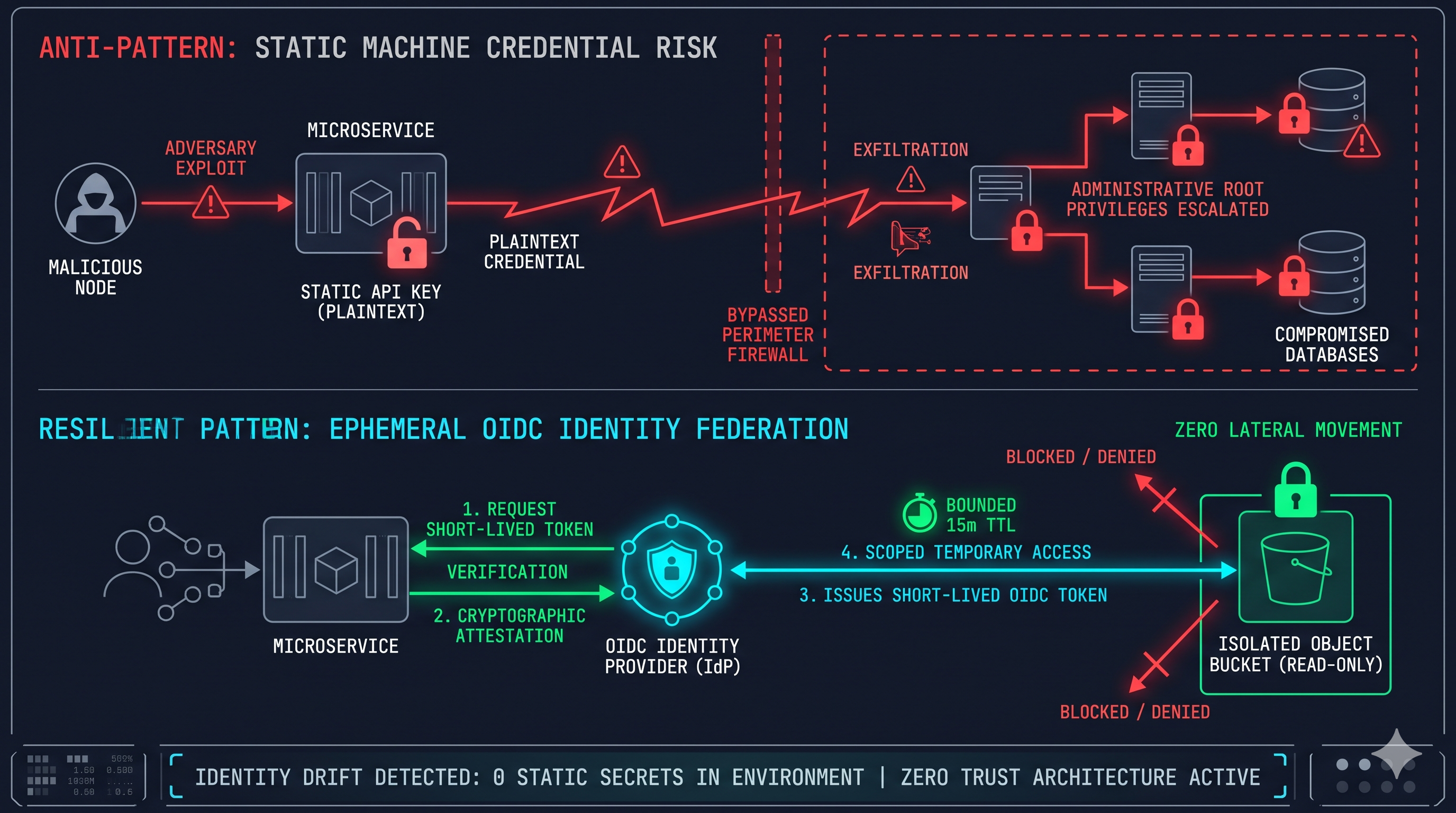
    Traditional perimeter and endpoint security models assume the threat actor is trying to bypass network boundaries from the outside. In modern cloud-native infrastructures, the primary threat surface has migrated to Non-Human Identities (NHIs): long-lived OAuth tokens, machine-to-machine service principals, pipeline secrets, and automated agent keys.When a build runner, microservice, or automated agent is granted wildcard IAM policies (*), a single leaked credential in a staging environment allows an adversary to execute seamless lateral movement and privilege escalation across your production cloud cluster.[❌ The NHI Anti-Pattern: Over-Privileged Static Credentials]
    Service Pod / CI Runner ──(Static API Key stored in .env)──> IAM Role: AdministratorAccess (*)
    Adversary Action: Extract key from memory/log ──> Instant Root Escalation ──> Lateral DB Exfiltration


    [✅ Zero-Trust NHI Architecture: Ephemeral OIDC Federation]
    Workload / Agent ──(Requests OIDC Token)──> Cloud Identity Provider (AWS STS / Azure Managed ID)
    │
    (Cryptographic Attestation & Bound TTL)
    ▼
    Least-Privilege Ephemeral Token (TTL: 15 mins) ──> Scoped Down Target Resource (Read-Only)
    To eliminate machine-identity blind spots, implement this 3-tier hardening framework across your architecture:
    1. Deprecate Long-Lived Static Machine SecretsNever store static cloud access keys (AKIA... or static service account JSON keys) inside container images, repo variables, or environment config files.Migrate CI/CD runners (GitHub Actions, GitLab CI, ArgoCD) to OpenID Connect (OIDC) identity federation.Workloads authenticate via cryptographically signed JWTs, exchanging claims for short-lived credentials (TTL $\le 1$ hour) that expire automatically without requiring manual key rotation.
    2. Enforce Non-Human Identity Least Privilege via Activity AuditingDevelopers routinely assign broad roles (like AmazonS3FullAccess or Cloud Storage Admin) "just to get the microservice running."Deploy automated cloud security posture tools to compare assigned IAM permissions against actual runtime API calls.Strip unused mutation actions (Create*, Delete*, Update*) to prevent an exploited read service from turning into a destructive ransomware vector.
    3. Establish Behavioral Anomaly Baselines for Machine AccountsHuman users log in during working hours from predictable geographical regions. Non-human identities run deterministic tasks from explicit VPC CIDR blocks:Alert immediately on geo-velocity anomalies (e.g., a backend service account suddenly calling an API from an external consumer IP).Flag out-of-band API calls (e.g., an invoice microservice attempting to call iam:CreateAccessKey or query cloud metadata endpoints).Securing the enterprise in modern environments requires recognizing that every machine identity is a full security principal—and unattended machine keys with infinite lifetimes are an open invitation for lateral compromise.
    Discussion Question
    How does your team currently audit and rotate machine identities, service principals, and CI/CD access tokens compared to human employee accounts?
    CTA
    Join Cybersecurity & Ethical Hacking to dissect live threat modeling scenarios, master cloud defense architectures, and level up your enterprise security engineering skills.
    Stop Securing Just Passwords: How to Defend Against Non-Human Identity (NHI) Privilege Escalation in Cloud Workloads Traditional perimeter and endpoint security models assume the threat actor is trying to bypass network boundaries from the outside. In modern cloud-native infrastructures, the primary threat surface has migrated to Non-Human Identities (NHIs): long-lived OAuth tokens, machine-to-machine service principals, pipeline secrets, and automated agent keys.When a build runner, microservice, or automated agent is granted wildcard IAM policies (*), a single leaked credential in a staging environment allows an adversary to execute seamless lateral movement and privilege escalation across your production cloud cluster.[❌ The NHI Anti-Pattern: Over-Privileged Static Credentials] Service Pod / CI Runner ──(Static API Key stored in .env)──> IAM Role: AdministratorAccess (*) Adversary Action: Extract key from memory/log ──> Instant Root Escalation ──> Lateral DB Exfiltration [✅ Zero-Trust NHI Architecture: Ephemeral OIDC Federation] Workload / Agent ──(Requests OIDC Token)──> Cloud Identity Provider (AWS STS / Azure Managed ID) │ (Cryptographic Attestation & Bound TTL) ▼ Least-Privilege Ephemeral Token (TTL: 15 mins) ──> Scoped Down Target Resource (Read-Only) To eliminate machine-identity blind spots, implement this 3-tier hardening framework across your architecture: 1. Deprecate Long-Lived Static Machine SecretsNever store static cloud access keys (AKIA... or static service account JSON keys) inside container images, repo variables, or environment config files.Migrate CI/CD runners (GitHub Actions, GitLab CI, ArgoCD) to OpenID Connect (OIDC) identity federation.Workloads authenticate via cryptographically signed JWTs, exchanging claims for short-lived credentials (TTL $\le 1$ hour) that expire automatically without requiring manual key rotation. 2. Enforce Non-Human Identity Least Privilege via Activity AuditingDevelopers routinely assign broad roles (like AmazonS3FullAccess or Cloud Storage Admin) "just to get the microservice running."Deploy automated cloud security posture tools to compare assigned IAM permissions against actual runtime API calls.Strip unused mutation actions (Create*, Delete*, Update*) to prevent an exploited read service from turning into a destructive ransomware vector. 3. Establish Behavioral Anomaly Baselines for Machine AccountsHuman users log in during working hours from predictable geographical regions. Non-human identities run deterministic tasks from explicit VPC CIDR blocks:Alert immediately on geo-velocity anomalies (e.g., a backend service account suddenly calling an API from an external consumer IP).Flag out-of-band API calls (e.g., an invoice microservice attempting to call iam:CreateAccessKey or query cloud metadata endpoints).Securing the enterprise in modern environments requires recognizing that every machine identity is a full security principal—and unattended machine keys with infinite lifetimes are an open invitation for lateral compromise. Discussion Question How does your team currently audit and rotate machine identities, service principals, and CI/CD access tokens compared to human employee accounts? CTA Join Cybersecurity & Ethical Hacking to dissect live threat modeling scenarios, master cloud defense architectures, and level up your enterprise security engineering skills.
    0 Comments 0 Shares 95 Views 0 Reviews
  • Breaking Free from Localhost: The 4 Distributed Systems Realities Every CS Student Must Learn
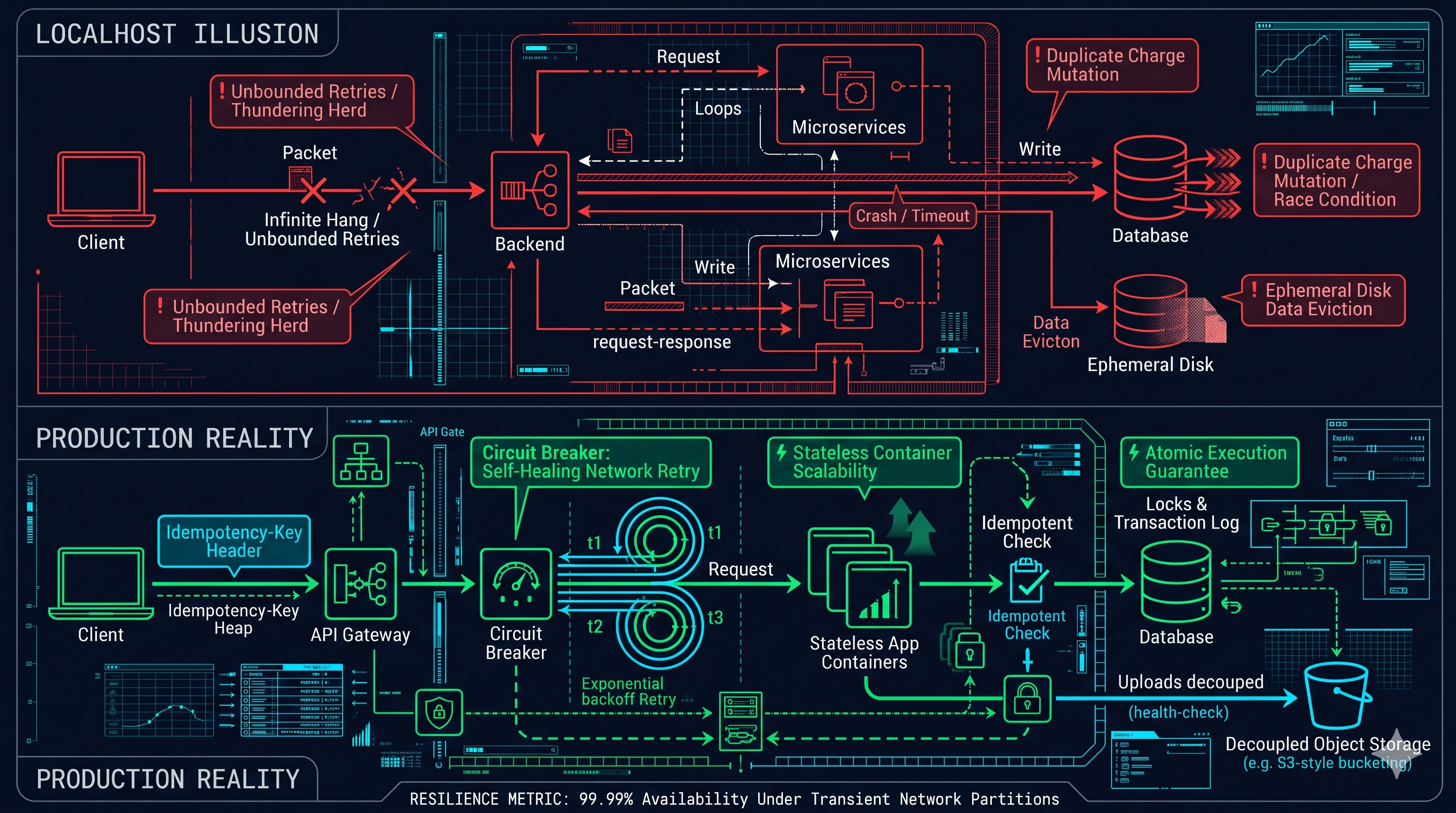
    Computer science curriculums excel at teaching algorithmic complexity, compiler internals, and data structures. However, student side projects often hit a wall during production deployments or technical systems interviews because students treat remote cloud services like local function calls.On localhost, loopback traffic (127.0.0.1) has zero latency, boundless developer RAM, and guaranteed delivery. In production, the eight fallacies of distributed computing take over: packets drop, third-party APIs experience transient timeouts, and serverless runtimes wipe ephemeral disk storage clean between invocations.[❌ The Localhost Student Assumption]
    Client Request ──(Guaranteed 0ms)──> Server ──(Instant)──> In-Memory State
    Result: Any packet loss or crash corrupts session data and triggers duplicate writes.


    [✅ The Production Distributed Architecture]
    Client Request
    │ (Idempotency Key: UUIDv4)
    ▼
    [API Gateway] ──> [Circuit Breaker & Retry with Exponential Backoff]
    │
    ├──> Idempotent Worker ──> Transactional DB (ACID / Rollback Guarantee)
    └──> Ephemeral Storage Isolated ──> S3 / Object Store for Persistent Assets
    Result: Transient network drops self-heal with zero double-execution risk.
    To bridge the gap between academic programming and production software engineering, build these four distributed patterns into your next portfolio project:
    1. Implement Idempotency Keys on Mutating EndpointsWhen an HTTP POST request times out, a browser or mobile client will automatically retry. If your endpoint charges a credit card, increments an inventory count, or provisions a resource, blind retries cause duplicate state mutations.Require an Idempotency-Key: <UUID> header on non-idempotent operations.Check a distributed key-value store (like Redis) before executing: if the key exists, return the cached result instead of executing the side-effect twice.
    2. Replace Blind Retries with Exponential Backoff and JitterIf an external API is struggling under load, hammering it with instant while (!success) retry() loops will trigger a thundering herd problem that completely takes down downstream services.Use exponential backoff ($T_{\text{wait}} = 2^{\text{attempt}} \times \text{base\_delay}$) paired with random jitter (randomized entropy added to wait intervals) to desynchronize retrying clients.
    3. Treat the Local Filesystem as Stateless and EphemeralOn your personal laptop, running fs.writeFileSync('/uploads/avatar.png') writes cleanly to your hard drive. In production environments (like AWS Lambda, Cloud Run, or Kubernetes pods), containers dynamically spin down, auto-scale, and migrate across hosts.Any file written to the local container disk is destroyed on pod recycling.Always stream static assets and file uploads directly to dedicated object storage (such as AWS S3 or Cloudflare R2) using pre-signed upload URLs.
    4. Design for Partial FailureA function call on a single machine either returns a value or throws an exception. A network call can succeed, fail, or—most dangerously—time out after the remote server already executed the write. Always define explicit timeout thresholds and fallback degradations so a slow non-critical microservice does not lock your entire application thread pool.
    Transitioning your portfolio from toy apps to production-grade services shows interviewers that you understand systems resilience, operational boundaries, and real-world failure modes.
    Discussion Question
    What was the first unexpected error or architectural bottleneck you encountered when you moved your first student project from localhost to a live cloud host?
    CTA
    Join Students in Tech to access system design roadmaps, project review clinics, and distributed engineering mentorship to prepare for high-impact software careers.
    Breaking Free from Localhost: The 4 Distributed Systems Realities Every CS Student Must Learn Computer science curriculums excel at teaching algorithmic complexity, compiler internals, and data structures. However, student side projects often hit a wall during production deployments or technical systems interviews because students treat remote cloud services like local function calls.On localhost, loopback traffic (127.0.0.1) has zero latency, boundless developer RAM, and guaranteed delivery. In production, the eight fallacies of distributed computing take over: packets drop, third-party APIs experience transient timeouts, and serverless runtimes wipe ephemeral disk storage clean between invocations.[❌ The Localhost Student Assumption] Client Request ──(Guaranteed 0ms)──> Server ──(Instant)──> In-Memory State Result: Any packet loss or crash corrupts session data and triggers duplicate writes. [✅ The Production Distributed Architecture] Client Request │ (Idempotency Key: UUIDv4) ▼ [API Gateway] ──> [Circuit Breaker & Retry with Exponential Backoff] │ ├──> Idempotent Worker ──> Transactional DB (ACID / Rollback Guarantee) └──> Ephemeral Storage Isolated ──> S3 / Object Store for Persistent Assets Result: Transient network drops self-heal with zero double-execution risk. To bridge the gap between academic programming and production software engineering, build these four distributed patterns into your next portfolio project: 1. Implement Idempotency Keys on Mutating EndpointsWhen an HTTP POST request times out, a browser or mobile client will automatically retry. If your endpoint charges a credit card, increments an inventory count, or provisions a resource, blind retries cause duplicate state mutations.Require an Idempotency-Key: <UUID> header on non-idempotent operations.Check a distributed key-value store (like Redis) before executing: if the key exists, return the cached result instead of executing the side-effect twice. 2. Replace Blind Retries with Exponential Backoff and JitterIf an external API is struggling under load, hammering it with instant while (!success) retry() loops will trigger a thundering herd problem that completely takes down downstream services.Use exponential backoff ($T_{\text{wait}} = 2^{\text{attempt}} \times \text{base\_delay}$) paired with random jitter (randomized entropy added to wait intervals) to desynchronize retrying clients. 3. Treat the Local Filesystem as Stateless and EphemeralOn your personal laptop, running fs.writeFileSync('/uploads/avatar.png') writes cleanly to your hard drive. In production environments (like AWS Lambda, Cloud Run, or Kubernetes pods), containers dynamically spin down, auto-scale, and migrate across hosts.Any file written to the local container disk is destroyed on pod recycling.Always stream static assets and file uploads directly to dedicated object storage (such as AWS S3 or Cloudflare R2) using pre-signed upload URLs. 4. Design for Partial FailureA function call on a single machine either returns a value or throws an exception. A network call can succeed, fail, or—most dangerously—time out after the remote server already executed the write. Always define explicit timeout thresholds and fallback degradations so a slow non-critical microservice does not lock your entire application thread pool. Transitioning your portfolio from toy apps to production-grade services shows interviewers that you understand systems resilience, operational boundaries, and real-world failure modes. Discussion Question What was the first unexpected error or architectural bottleneck you encountered when you moved your first student project from localhost to a live cloud host? CTA Join Students in Tech to access system design roadmaps, project review clinics, and distributed engineering mentorship to prepare for high-impact software careers.
    0 Comments 0 Shares 87 Views 0 Reviews
  • Beyond Algorithmic Grinding: How to Pass the Modern 2026 Code Review & Debugging Interview
    The highest-signal technical screening format across tech companies today is no longer generating algorithmic puzzles from an empty canvas. It is the Live Code Review and Architectural Refactoring Interview.Interviewers drop you into an existing codebase—often featuring code generated by an AI assistant or written by an offsite engineer—and ask you to identify structural flaws, memory leaks, and concurrency bottlenecks.Candidates who fail this round typically fall into the same trap: they focus purely on micro-syntax styling instead of reasoning through systemic failure modes.[❌ The Flawed Junior Approach: Syntax Nitpicking]
    Candidate scans line-by-line: "Variable name should be camelCase. Missing semicolon here."
    Outcome: ZERO signal on architectural judgment, concurrency, or cost awareness.


    [✅ The Production Engineer Framework: Structural Diagnostics]
    1. Blast Radius & State --> Is this mutate-in-place? Are there unhandled exceptions?
    2. Resource Lifecycle --> Are DB connections, event listeners, or streams leaking?
    3. Concurrency & Locking --> Can two concurrent promises access this shared state simultaneously?
    4. Observability & Cost --> Is this triggering an N+1 query or unbounded memory growth?
    Here is the exact 4-step diagnostic protocol to use when handed a broken PR or unfamiliar service during an interview:
    1. Audit the Asynchronous Lifecycles and Shared StateLook immediately for race conditions and leaked event listeners. When reading Node.js, Go, or Python async blocks, ask:Can this promise/goroutine remain dangling if an upstream timeout fires?Is state mutation isolated, or can concurrent workers overwrite shared cache slots?
    2. Trace the Worst-Case Memory & I/O BoundSenior candidates immediately evaluate memory footprints rather than average-case runtime:Does an array accumulator hold references indefinitely in memory instead of flushing to a stream?Does a database call run inside a loop ($N+1$ query pattern) rather than executing as a batched read?
    3. Propose Incremental Refactoring, Not a Total RewriteJunior engineers often suggest trashing the code and starting over. Staff-level candidates say:"To keep production stable, we should first isolate the mutation inside a transaction boundary. Once that is safe, we can refactor this monolithic handler into an event-driven worker."Demonstrating that you think about downtime, rollback strategies, and operational risk tells the hiring committee you can be trusted with production systems on Day 1.
    Discussion Question
    What is the most subtle production bug or anti-pattern you have ever encountered in a live interview or a peer's pull request?
    CTA
    Join Tech Jobs & Opportunities to master real-world interview formats, access curated technical career playbooks, and land senior roles in modern engineering teams.
    Beyond Algorithmic Grinding: How to Pass the Modern 2026 Code Review & Debugging Interview The highest-signal technical screening format across tech companies today is no longer generating algorithmic puzzles from an empty canvas. It is the Live Code Review and Architectural Refactoring Interview.Interviewers drop you into an existing codebase—often featuring code generated by an AI assistant or written by an offsite engineer—and ask you to identify structural flaws, memory leaks, and concurrency bottlenecks.Candidates who fail this round typically fall into the same trap: they focus purely on micro-syntax styling instead of reasoning through systemic failure modes.[❌ The Flawed Junior Approach: Syntax Nitpicking] Candidate scans line-by-line: "Variable name should be camelCase. Missing semicolon here." Outcome: ZERO signal on architectural judgment, concurrency, or cost awareness. [✅ The Production Engineer Framework: Structural Diagnostics] 1. Blast Radius & State --> Is this mutate-in-place? Are there unhandled exceptions? 2. Resource Lifecycle --> Are DB connections, event listeners, or streams leaking? 3. Concurrency & Locking --> Can two concurrent promises access this shared state simultaneously? 4. Observability & Cost --> Is this triggering an N+1 query or unbounded memory growth? Here is the exact 4-step diagnostic protocol to use when handed a broken PR or unfamiliar service during an interview: 1. Audit the Asynchronous Lifecycles and Shared StateLook immediately for race conditions and leaked event listeners. When reading Node.js, Go, or Python async blocks, ask:Can this promise/goroutine remain dangling if an upstream timeout fires?Is state mutation isolated, or can concurrent workers overwrite shared cache slots? 2. Trace the Worst-Case Memory & I/O BoundSenior candidates immediately evaluate memory footprints rather than average-case runtime:Does an array accumulator hold references indefinitely in memory instead of flushing to a stream?Does a database call run inside a loop ($N+1$ query pattern) rather than executing as a batched read? 3. Propose Incremental Refactoring, Not a Total RewriteJunior engineers often suggest trashing the code and starting over. Staff-level candidates say:"To keep production stable, we should first isolate the mutation inside a transaction boundary. Once that is safe, we can refactor this monolithic handler into an event-driven worker."Demonstrating that you think about downtime, rollback strategies, and operational risk tells the hiring committee you can be trusted with production systems on Day 1. Discussion Question What is the most subtle production bug or anti-pattern you have ever encountered in a live interview or a peer's pull request? CTA Join Tech Jobs & Opportunities to master real-world interview formats, access curated technical career playbooks, and land senior roles in modern engineering teams.
    0 Comments 0 Shares 32 Views 0 Reviews
  • Taming Autonomous AI Agents: How to Build Resilient Human-in-the-Loop Safeguards for Production Workflows
    As major cloud providers roll out consumption- and token-based billing for autonomous multi-step agents, running agentic loops without explicit execution boundaries is an expensive architectural hazard.


    When an autonomous agent attempts multi-step problem solving, it often enters non-deterministic recursion: continuously querying vector stores, reprompting LLM endpoints, and calling external APIs until a context window overflows or an API rate limit trips.


    Here is a practical architecture pattern to establish deterministic control over autonomous agents:


    1. Implement a Dual-Token Circuit Breaker
    Never allow an agent to call tools in an open-ended while(true) loop. Wrap your orchestration runtime with strict hard caps:


    Max Tool Hops: Hard limit of 4–6 tool invocations per user task before mandatory state suspension.


    Token Budget Threshold: Track cumulative input/output token usage per session. If cumulative token consumption breaches 75% of your target threshold, freeze execution and downscale context.


    Python
    class AgentExecutionGuard:
    def __init__(self, max_hops=5, max_tokens=15000):
    self.max_hops = max_hops
    self.max_tokens = max_tokens
    self.hops_taken = 0
    self.tokens_used = 0


    def validate_step(self, step_tokens: int):
    self.hops_taken += 1
    self.tokens_used += step_tokens


    if self.hops_taken > self.max_hops or self.tokens_used > self.max_tokens:
    raise CircuitBreakerException("Budget ceiling exceeded. Suspended for human review.")
    2. Classify Tool Operations by Mutability
    Segment agent tools into two discrete permission tiers:


    Read-Only / Idempotent Tools: Search, document retrieval, database reads, code analysis. These run autonomously.


    Mutating Tools: DB writes, transactional API calls, production deployments, user-facing email dispatch.


    Whenever the planner attempts to execute a Mutating Tool, serialize the execution context to a Redis/Postgres state store, generate an approval token, and notify an engineer via webhook.


    3. Enforce Schema-Strict Validation on Structured Outputs
    Do not parse free-form model reasoning to execute backend commands. Enforce strict JSON Schema / Pydantic validation on the agent’s function-calling outputs:


    Validate parameter bounds (e.g., preventing unbounded LIMIT clauses or dangerous shell arguments).


    Reject and log any hallucinated or polymorphic arguments before dispatching them to downstream microservices.


    Moving from brittle demo scripts to production systems requires treating agentic intelligence not as an all-powerful black box, but as an untrusted microservice bounded by deterministic observability, rate limiting, and permission gates.


    Discussion Question
    How does your team currently guard against infinite loops and unauthorized state changes when deploying agentic workflows into production?


    CTA
    Join the Techawks General Community to discuss production-grade software engineering, AI architecture patterns, and resilient cloud systems with builders worldwide.
    Taming Autonomous AI Agents: How to Build Resilient Human-in-the-Loop Safeguards for Production Workflows As major cloud providers roll out consumption- and token-based billing for autonomous multi-step agents, running agentic loops without explicit execution boundaries is an expensive architectural hazard. When an autonomous agent attempts multi-step problem solving, it often enters non-deterministic recursion: continuously querying vector stores, reprompting LLM endpoints, and calling external APIs until a context window overflows or an API rate limit trips. Here is a practical architecture pattern to establish deterministic control over autonomous agents: 1. Implement a Dual-Token Circuit Breaker Never allow an agent to call tools in an open-ended while(true) loop. Wrap your orchestration runtime with strict hard caps: Max Tool Hops: Hard limit of 4–6 tool invocations per user task before mandatory state suspension. Token Budget Threshold: Track cumulative input/output token usage per session. If cumulative token consumption breaches 75% of your target threshold, freeze execution and downscale context. Python class AgentExecutionGuard: def __init__(self, max_hops=5, max_tokens=15000): self.max_hops = max_hops self.max_tokens = max_tokens self.hops_taken = 0 self.tokens_used = 0 def validate_step(self, step_tokens: int): self.hops_taken += 1 self.tokens_used += step_tokens if self.hops_taken > self.max_hops or self.tokens_used > self.max_tokens: raise CircuitBreakerException("Budget ceiling exceeded. Suspended for human review.") 2. Classify Tool Operations by Mutability Segment agent tools into two discrete permission tiers: Read-Only / Idempotent Tools: Search, document retrieval, database reads, code analysis. These run autonomously. Mutating Tools: DB writes, transactional API calls, production deployments, user-facing email dispatch. Whenever the planner attempts to execute a Mutating Tool, serialize the execution context to a Redis/Postgres state store, generate an approval token, and notify an engineer via webhook. 3. Enforce Schema-Strict Validation on Structured Outputs Do not parse free-form model reasoning to execute backend commands. Enforce strict JSON Schema / Pydantic validation on the agent’s function-calling outputs: Validate parameter bounds (e.g., preventing unbounded LIMIT clauses or dangerous shell arguments). Reject and log any hallucinated or polymorphic arguments before dispatching them to downstream microservices. Moving from brittle demo scripts to production systems requires treating agentic intelligence not as an all-powerful black box, but as an untrusted microservice bounded by deterministic observability, rate limiting, and permission gates. Discussion Question How does your team currently guard against infinite loops and unauthorized state changes when deploying agentic workflows into production? CTA Join the Techawks General Community to discuss production-grade software engineering, AI architecture patterns, and resilient cloud systems with builders worldwide.
    0 Comments 0 Shares 19 Views 0 Reviews
More Results