• The Data Residency Illusion: Why Canadian Cloud Architects Are Redesigning Pipelines for Cryptographic Data Sovereignty
    As Canadian financial institutions, healthcare networks, and public-sector enterprises accelerate generative AI adoption, data residency has become the baseline compliance checkbox. Most teams satisfy this by selecting Canadian cloud regions (Montreal, Toronto, Calgary) and checking the box.


    However, in modern distributed systems, data residency and data sovereignty are fundamentally different controls:


    Data Residency: Deals with geography—where data bits sit at rest.


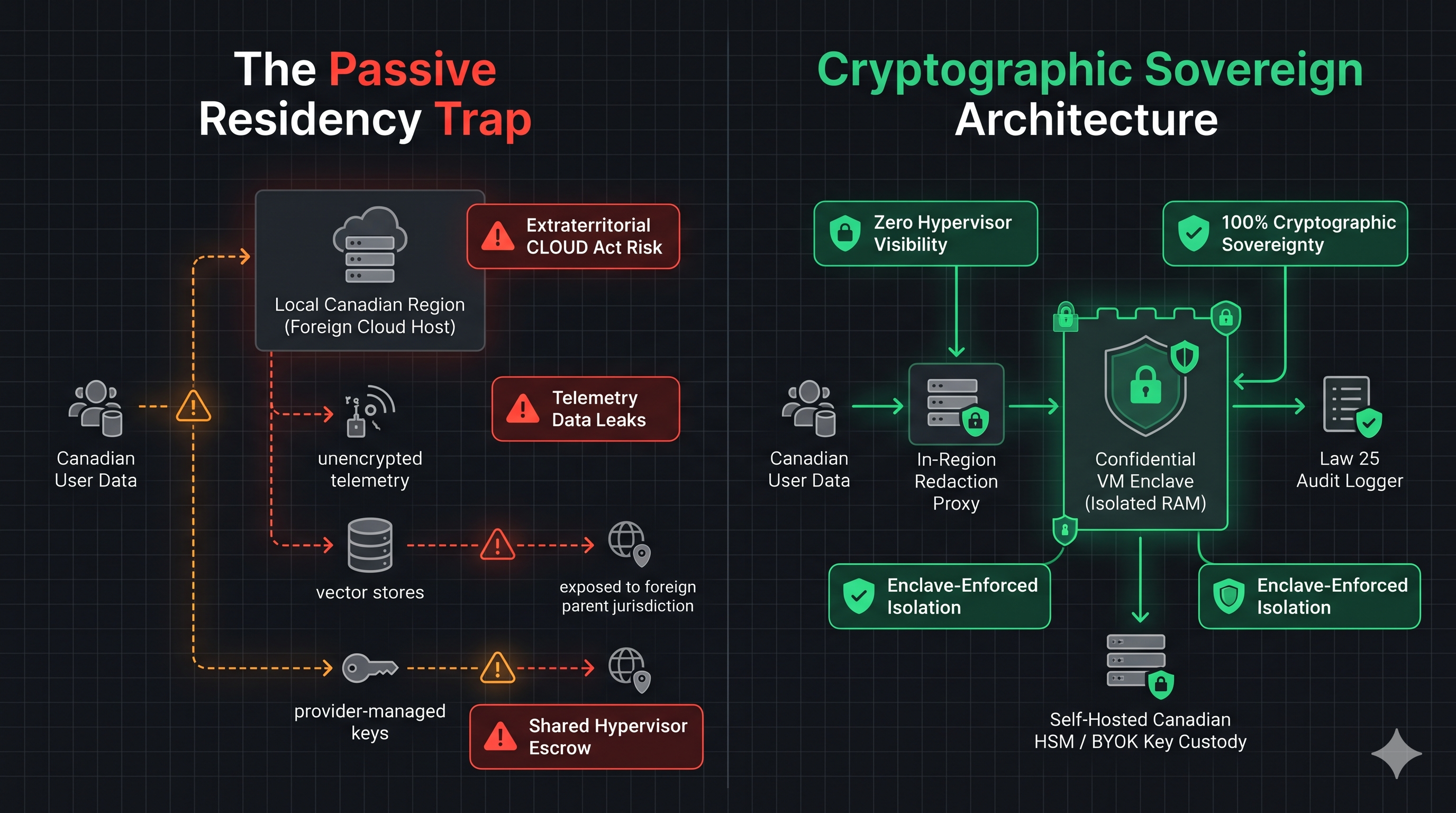
    Data Sovereignty: Deals with jurisdictional authority—who controls the infrastructure, who owns the encryption keys, where operational telemetry travels, and what foreign legal frameworks (such as the US CLOUD Act) can compel your provider to disclose.


    In typical multi-tenant AI pipelines, sensitive artifacts do not stay stationary inside your primary Canadian database. Prompts, embeddings, vector indices, model context caches, and observability traces regularly route through foreign parent control planes, support workflows, and third-party API gateways. If a foreign parent entity administers the underlying compute or holds root encryption keys, residency in Canada does not prevent extraterritorial legal exposure.


    With Canada aggressively backing sovereign AI compute (including multi-billion-dollar sovereign compute initiatives) and provinces like Quebec strictly enforcing Law 25 for automated processing, technical teams must transition from passive geographic hosting to Zero-Trust Sovereign Architecture:


    1. Bring Your Own Key (BYOK) with External Key Management (HYOK)
    Do not use cloud-provider managed keys where the provider retains root access in escrow.


    Deploy an external Key Management Service (KMS) or hardware security module (HSM) residing on sovereign, Canadian-owned soil or dedicated private infrastructure.


    Ensure data in transit and at rest is envelope-encrypted such that the hypervisor and host infrastructure cannot decrypt payloads without an ephemeral, runtime grant from your self-hosted KMS.


    2. Localized Vector Indexing & Redaction Middleware
    Never ship raw user context across public LLM APIs without pre-flight redaction.


    Deploy an in-region semantic gateway (such as local small language models or regex-NER classifiers) that strips Canadian personal identifiers (SIN, provincial health numbers, financial account details) before routing prompts.


    Maintain vector databases, context embeddings, and retrieval-augmented generation (RAG) stores strictly within sovereign cluster boundaries.


    3. Ephemeral Enclaves & Confidential Computing
    For high-risk inference (e.g., credit underwriting, healthcare diagnostic support), run model weights and data inside hardware-enforced Confidential VMs (AMD SEV-SNP or Intel TDX).


    Even root cloud administrators and hypervisor processes cannot read memory contents or execution registers during active compute cycles.


    Ensure automated processing decisions maintain immutable, local audit logs to satisfy Quebec Law 25 contestability mandates without leaking prompt telemetry into global SaaS dashboards.


    Location answers where your files sit. Cryptographic key custody, memory isolation, and operational autonomy determine who actually controls them.


    Discussion Question
    For Canadian cloud and security architects: how does your organization handle cross-border telemetry and foreign-parent cloud jurisdiction—have you implemented external KMS (HYOK) and confidential enclaves, or is regional data residency still your team's primary benchmark?


    CTA
    Join Techawks Canada: Connect with Canadian cloud architects, security engineers, and software leaders discussing distributed systems, data sovereignty, and resilient cloud architecture. Link in bio/comments.
    The Data Residency Illusion: Why Canadian Cloud Architects Are Redesigning Pipelines for Cryptographic Data Sovereignty As Canadian financial institutions, healthcare networks, and public-sector enterprises accelerate generative AI adoption, data residency has become the baseline compliance checkbox. Most teams satisfy this by selecting Canadian cloud regions (Montreal, Toronto, Calgary) and checking the box. However, in modern distributed systems, data residency and data sovereignty are fundamentally different controls: Data Residency: Deals with geography—where data bits sit at rest. Data Sovereignty: Deals with jurisdictional authority—who controls the infrastructure, who owns the encryption keys, where operational telemetry travels, and what foreign legal frameworks (such as the US CLOUD Act) can compel your provider to disclose. In typical multi-tenant AI pipelines, sensitive artifacts do not stay stationary inside your primary Canadian database. Prompts, embeddings, vector indices, model context caches, and observability traces regularly route through foreign parent control planes, support workflows, and third-party API gateways. If a foreign parent entity administers the underlying compute or holds root encryption keys, residency in Canada does not prevent extraterritorial legal exposure. With Canada aggressively backing sovereign AI compute (including multi-billion-dollar sovereign compute initiatives) and provinces like Quebec strictly enforcing Law 25 for automated processing, technical teams must transition from passive geographic hosting to Zero-Trust Sovereign Architecture: 1. Bring Your Own Key (BYOK) with External Key Management (HYOK) Do not use cloud-provider managed keys where the provider retains root access in escrow. Deploy an external Key Management Service (KMS) or hardware security module (HSM) residing on sovereign, Canadian-owned soil or dedicated private infrastructure. Ensure data in transit and at rest is envelope-encrypted such that the hypervisor and host infrastructure cannot decrypt payloads without an ephemeral, runtime grant from your self-hosted KMS. 2. Localized Vector Indexing & Redaction Middleware Never ship raw user context across public LLM APIs without pre-flight redaction. Deploy an in-region semantic gateway (such as local small language models or regex-NER classifiers) that strips Canadian personal identifiers (SIN, provincial health numbers, financial account details) before routing prompts. Maintain vector databases, context embeddings, and retrieval-augmented generation (RAG) stores strictly within sovereign cluster boundaries. 3. Ephemeral Enclaves & Confidential Computing For high-risk inference (e.g., credit underwriting, healthcare diagnostic support), run model weights and data inside hardware-enforced Confidential VMs (AMD SEV-SNP or Intel TDX). Even root cloud administrators and hypervisor processes cannot read memory contents or execution registers during active compute cycles. Ensure automated processing decisions maintain immutable, local audit logs to satisfy Quebec Law 25 contestability mandates without leaking prompt telemetry into global SaaS dashboards. Location answers where your files sit. Cryptographic key custody, memory isolation, and operational autonomy determine who actually controls them. Discussion Question For Canadian cloud and security architects: how does your organization handle cross-border telemetry and foreign-parent cloud jurisdiction—have you implemented external KMS (HYOK) and confidential enclaves, or is regional data residency still your team's primary benchmark? CTA Join Techawks Canada: Connect with Canadian cloud architects, security engineers, and software leaders discussing distributed systems, data sovereignty, and resilient cloud architecture. Link in bio/comments.
    0 Yorumlar 0 hisse senetleri 9 Views 0 önizleme
  • The 50°C Compute Barrier: Why UAE Cloud Architects Are Redesigning AI Infrastructure Around Direct-to-Chip Liquid Cooling
    The UAE is accelerating sovereign AI capacity at unprecedented scale—scaling multi-gigawatt compute hubs across Abu Dhabi and Dubai backed by national clean energy and grid expansion initiatives.
    However, operating high-density AI clusters in the Gulf presents a unique physical computing bottleneck that Silicon Valley blueprints cannot solve: extreme ambient wet-bulb and dry-bulb temperatures.
    When outside ambient temperatures routinely cross 45°C to 50°C, traditional air-chilled cooling systems collapse under physical and thermodynamic limits:
    The Air-Cooling Density Wall: Air heat capacity ($C_p \approx 1.005\text{ kJ/kg}\cdot\text{K}$) cannot physically evacuate heat from modern AI server racks drawing 80kW to 140kW per cabinet without creating violent internal hot spots.
    Compressor Parasitic Load Spikes: Mechanical chillers forced to reject heat against high ambient desert air consume massive parasitic power, driving Power Usage Effectiveness (PUE) above 1.6 and straining local power allocations.
    Severe Water Stress Risks: Relying on evaporative cooling towers in an arid environment rapidly consumes valuable desalinated municipal water supplies, clashing directly with regional sustainability and net-zero frameworks.
    The Engineering Solution: Closed-Loop Direct-to-Chip (D2C) & Facility Water Loops (FWS)To build mission-critical AI clusters resilient against desert ambient heat, regional infrastructure architects are engineering high-delta-T liquid cooling topologies:
    Direct-to-Chip Cold Plates (Primary Loop): Replace copper server heat sinks with micro-channel liquid cold plates clamped directly onto the GPU and CPU dies. Dielectric fluids or treated water-glycol mixtures capture over 75% to 85% of component heat directly at the source, preventing heat from ever entering the data hall air envelope.
    Warm-Water Cooling & Dry-Cooler Heat Rejection: By maintaining secondary loop supply temperatures at 32°C to 40°C, facilities can reject thermal heat to outdoor dry coolers using standard sensible heat exchange without requiring mechanical refrigeration or evaporative water consumption, maintaining a target PUE below 1.25 even in high-heat seasons.
    Intelligent Coolant Distribution Units (CDUs) & Telemetry Isolation: Isolate the facility water system (FWS) from the technology cooling system (TCS) using intelligent CDUs equipped with automated differential pressure sensors, sub-second leak-detection valves, and N+1 redundant variable-speed circulating pumps.
    Thermal-Aware Job Scheduling: Integrate datacenter building management system (BMS) telemetry directly into the Kubernetes / Slurm compute orchestrator. When external ambient thermal conditions peak during mid-day, non-latency-critical training checkpoints dynamically throttle GPU power caps by 5%–10% to smooth thermal dissipation.
    Building sovereign AI in the Middle East requires designing from the physical hardware layer up. When your thermal architecture handles the harshest environments natively, your computational advantage is unshakeable.
    Discussion Question
    For cloud engineers, infrastructure architects, and datacenter leads in the UAE:
    has your organization migrated high-density AI clusters to direct-to-chip liquid cooling or immersion tanks, and how are you managing secondary facility loop heat rejection without excessive water consumption?
    CTA
    Join Techawks UAE: Connect with leading Middle Eastern cloud architects, infrastructure engineers, and systems developers discussing regional sovereign AI infrastructure, high-density datacenter design, and robust distributed systems. Link in bio/comments.
    The 50°C Compute Barrier: Why UAE Cloud Architects Are Redesigning AI Infrastructure Around Direct-to-Chip Liquid Cooling The UAE is accelerating sovereign AI capacity at unprecedented scale—scaling multi-gigawatt compute hubs across Abu Dhabi and Dubai backed by national clean energy and grid expansion initiatives. However, operating high-density AI clusters in the Gulf presents a unique physical computing bottleneck that Silicon Valley blueprints cannot solve: extreme ambient wet-bulb and dry-bulb temperatures. When outside ambient temperatures routinely cross 45°C to 50°C, traditional air-chilled cooling systems collapse under physical and thermodynamic limits: The Air-Cooling Density Wall: Air heat capacity ($C_p \approx 1.005\text{ kJ/kg}\cdot\text{K}$) cannot physically evacuate heat from modern AI server racks drawing 80kW to 140kW per cabinet without creating violent internal hot spots. Compressor Parasitic Load Spikes: Mechanical chillers forced to reject heat against high ambient desert air consume massive parasitic power, driving Power Usage Effectiveness (PUE) above 1.6 and straining local power allocations. Severe Water Stress Risks: Relying on evaporative cooling towers in an arid environment rapidly consumes valuable desalinated municipal water supplies, clashing directly with regional sustainability and net-zero frameworks. The Engineering Solution: Closed-Loop Direct-to-Chip (D2C) & Facility Water Loops (FWS)To build mission-critical AI clusters resilient against desert ambient heat, regional infrastructure architects are engineering high-delta-T liquid cooling topologies: Direct-to-Chip Cold Plates (Primary Loop): Replace copper server heat sinks with micro-channel liquid cold plates clamped directly onto the GPU and CPU dies. Dielectric fluids or treated water-glycol mixtures capture over 75% to 85% of component heat directly at the source, preventing heat from ever entering the data hall air envelope. Warm-Water Cooling & Dry-Cooler Heat Rejection: By maintaining secondary loop supply temperatures at 32°C to 40°C, facilities can reject thermal heat to outdoor dry coolers using standard sensible heat exchange without requiring mechanical refrigeration or evaporative water consumption, maintaining a target PUE below 1.25 even in high-heat seasons. Intelligent Coolant Distribution Units (CDUs) & Telemetry Isolation: Isolate the facility water system (FWS) from the technology cooling system (TCS) using intelligent CDUs equipped with automated differential pressure sensors, sub-second leak-detection valves, and N+1 redundant variable-speed circulating pumps. Thermal-Aware Job Scheduling: Integrate datacenter building management system (BMS) telemetry directly into the Kubernetes / Slurm compute orchestrator. When external ambient thermal conditions peak during mid-day, non-latency-critical training checkpoints dynamically throttle GPU power caps by 5%–10% to smooth thermal dissipation. Building sovereign AI in the Middle East requires designing from the physical hardware layer up. When your thermal architecture handles the harshest environments natively, your computational advantage is unshakeable. Discussion Question For cloud engineers, infrastructure architects, and datacenter leads in the UAE: has your organization migrated high-density AI clusters to direct-to-chip liquid cooling or immersion tanks, and how are you managing secondary facility loop heat rejection without excessive water consumption? CTA Join Techawks UAE: Connect with leading Middle Eastern cloud architects, infrastructure engineers, and systems developers discussing regional sovereign AI infrastructure, high-density datacenter design, and robust distributed systems. Link in bio/comments.
    0 Yorumlar 0 hisse senetleri 9 Views 0 önizleme
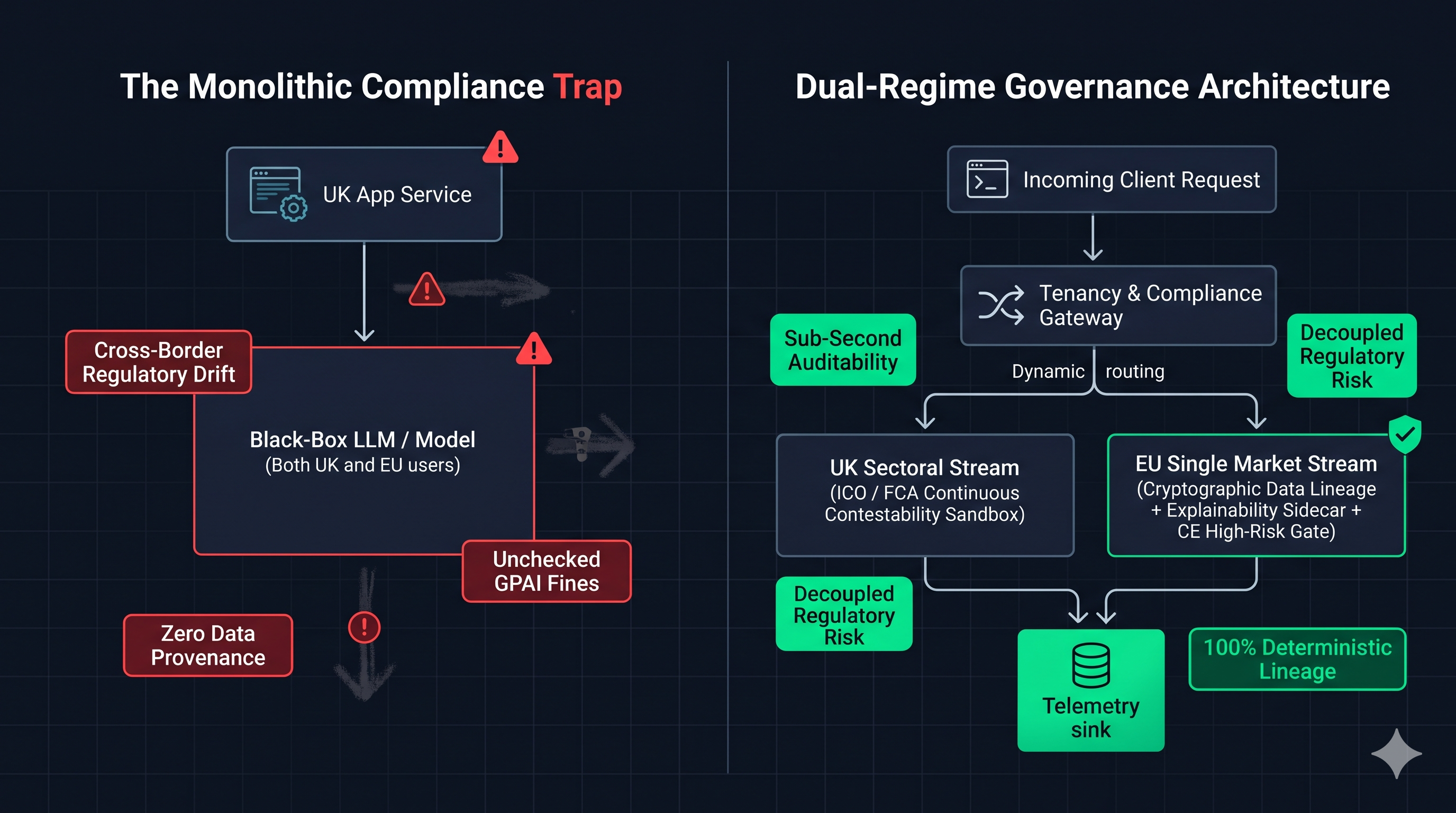
  • The UK-EU AI Divide: Why Engineering Teams Must Architect Dual-Regime Model Governance
    The United Kingdom and the European Union have taken fundamentally opposing paths to artificial intelligence oversight:


    The UK’s Sectoral, Principles-Led Model: The UK deliberately avoided an omnibus horizontal AI statute, instead distributing oversight across established statutory regulators (FCA, ICO, CMA, Ofcom) coordinated via the Digital Regulation Cooperation Forum (DRCF) and DSIT’s central risk functions. It prioritizes outcomes, contextual safety, and sandboxes over blanket technical mandates.


    The EU AI Act’s Strict Classification: The EU enforces horizontal risk tiers with severe penalties (up to €35 million or 7% of global turnover) for high-risk and general-purpose AI (GPAI) systems.


    Here is the engineering reality for UK tech companies: regulatory jurisdiction attaches to user impact, not deployment origin.


    If a UK-headquartered fintech, healthtech, or SaaS product processes inputs or delivers automated decisions impacting users inside the EU single market, your pipeline immediately falls under the EU AI Act’s high-risk obligations. Treating compliance as an afterthought handled by legal teams creates architectural gridlock.


    The Technical Solution: Dual-Regime Telemetry & Lineage Gates
    Forward-thinking UK software architects are decoupling regional compliance into deterministic system abstractions:


    Deterministic Data Lineage & Training Governance:


    High-risk classifications require rigorous data provenance. Implement cryptographic data hashing and metadata tracing across datasets (capturing demographic distribution, synthetic data ratios, and curation flags).


    If a model variant serves an EU endpoint, the ingestion pipeline must deterministically verify that training data governance meets strict accuracy, statistical representation, and bias audits before inference promotion.


    Decoupled Explainability & Continuous Drift Probes:


    The UK's ICO guidelines and the FCA’s AI experimentation frameworks emphasize contestability and transparency—requiring clear auditability for automated financial and identity profiling.


    Do not rely on black-box model outputs. Integrate decoupled feature attribution modules (e.g., integrated gradients or TreeSHAP sidecars) that emit machine-readable rationale logs for every automated classification, enabling sub-second audit reconstruction.


    Runtime Geo-Partitioning & Model Tiering:


    Route user queries through an API gateway middleware that evaluates geographic tenancy and regulatory classification.


    An identical user request originating from Manchester vs. Dublin can be dynamically routed to different backend model checkpoints or policy-enforced guardrail nodes—satisfying strict EU CE-marking and technical documentation gates while taking full advantage of UK sandbox iterations.


    In modern systems engineering, compliance cannot be a periodic manual audit. It must be built directly into your CI/CD pipelines, telemetry schemas, and routing layers.


    Discussion Question
    For UK software teams serving both domestic and European users: are you maintaining unified model pipelines with the strictest common denominator compliance, or have you architected dual-regime routing and automated data lineage gates?


    CTA
    Join Techawks UK: Connect with leading British software architects, fintech engineering leads, and technical founders discussing resilient distributed architectures, AI governance, and UK-global scaling inside the Techawks UK community. Link in bio/comments.
    The UK-EU AI Divide: Why Engineering Teams Must Architect Dual-Regime Model Governance The United Kingdom and the European Union have taken fundamentally opposing paths to artificial intelligence oversight: The UK’s Sectoral, Principles-Led Model: The UK deliberately avoided an omnibus horizontal AI statute, instead distributing oversight across established statutory regulators (FCA, ICO, CMA, Ofcom) coordinated via the Digital Regulation Cooperation Forum (DRCF) and DSIT’s central risk functions. It prioritizes outcomes, contextual safety, and sandboxes over blanket technical mandates. The EU AI Act’s Strict Classification: The EU enforces horizontal risk tiers with severe penalties (up to €35 million or 7% of global turnover) for high-risk and general-purpose AI (GPAI) systems. Here is the engineering reality for UK tech companies: regulatory jurisdiction attaches to user impact, not deployment origin. If a UK-headquartered fintech, healthtech, or SaaS product processes inputs or delivers automated decisions impacting users inside the EU single market, your pipeline immediately falls under the EU AI Act’s high-risk obligations. Treating compliance as an afterthought handled by legal teams creates architectural gridlock. The Technical Solution: Dual-Regime Telemetry & Lineage Gates Forward-thinking UK software architects are decoupling regional compliance into deterministic system abstractions: Deterministic Data Lineage & Training Governance: High-risk classifications require rigorous data provenance. Implement cryptographic data hashing and metadata tracing across datasets (capturing demographic distribution, synthetic data ratios, and curation flags). If a model variant serves an EU endpoint, the ingestion pipeline must deterministically verify that training data governance meets strict accuracy, statistical representation, and bias audits before inference promotion. Decoupled Explainability & Continuous Drift Probes: The UK's ICO guidelines and the FCA’s AI experimentation frameworks emphasize contestability and transparency—requiring clear auditability for automated financial and identity profiling. Do not rely on black-box model outputs. Integrate decoupled feature attribution modules (e.g., integrated gradients or TreeSHAP sidecars) that emit machine-readable rationale logs for every automated classification, enabling sub-second audit reconstruction. Runtime Geo-Partitioning & Model Tiering: Route user queries through an API gateway middleware that evaluates geographic tenancy and regulatory classification. An identical user request originating from Manchester vs. Dublin can be dynamically routed to different backend model checkpoints or policy-enforced guardrail nodes—satisfying strict EU CE-marking and technical documentation gates while taking full advantage of UK sandbox iterations. In modern systems engineering, compliance cannot be a periodic manual audit. It must be built directly into your CI/CD pipelines, telemetry schemas, and routing layers. Discussion Question For UK software teams serving both domestic and European users: are you maintaining unified model pipelines with the strictest common denominator compliance, or have you architected dual-regime routing and automated data lineage gates? CTA Join Techawks UK: Connect with leading British software architects, fintech engineering leads, and technical founders discussing resilient distributed architectures, AI governance, and UK-global scaling inside the Techawks UK community. Link in bio/comments.
    0 Yorumlar 0 hisse senetleri 8 Views 0 önizleme
  • The 2 Gigawatt Grid Ceiling: Why US Cloud Architects Are Designing for Carbon-Aware Spatial Load Shifting
    For the past decade, cloud system architecture treated power and cooling as infinite abstract utilities managed by AWS, Azure, or GCP. You provisioned instances, autoscale groups expanded, and the underlying datacenter absorbed the draw.


    In the US tech corridor, that abstraction has broken down.


    With PJM Interconnection facing over 70 GW of prospective large-load requests and regional transmission queues stretching 5 to 7 years, regulatory bodies (FERC) and regional transmission organizations (RTOs) are capping unbacked firm grid access. The limiting constraint on US enterprise AI compute is no longer chip availability—it is electrical grid interconnects and substation thermal limits.


    Engineering teams scaling massive AI pipelines cannot wait for multi-year transmission line overhauls. Instead, top infrastructure architects are transitioning from static, monolithic datacenter footprints to Grid-Aware Spatial Load Shifting:


    1. Decoupling Batch Pre-training from Real-Time Inference
    Inference workloads require strict low-latency proximity to end users (e.g., US-East / US-West metros). Massive batch jobs—such as fine-tuning, synthetic data generation, and offline embedding runs—do not.


    System schedulers must treat electrical grid marginal emissions and real-time megawatt pricing (locational marginal pricing, or LMP) as dynamic orchestration parameters.


    When grid reserve margins tighten in PJM (Mid-Atlantic) during peak summer or winter heating alerts, control planes must automatically throttle or migrate non-urgent checkpoint jobs to regions with surplus renewable generation (such as ERCOT wind during off-peak hours or MISO hydro/solar).


    2. Hardware-Aware Dynamic Power Throttling
    Training clusters generate extreme step-function load spikes during distributed all-reduce synchronization barriers.


    Instead of designing power delivery strictly for unmitigated peak wattage (which drives up capacity interconnection costs), modern orchestrators enforce dynamic power-capping at the server baseboard management controller (BMC) level.


    By shaving off the top 10% of transient power spikes via micro-throttling clock frequencies during communication phases, facilities fit up to 20% more accelerator density within existing utility interconnection limits.


    3. Ephemeral Cross-Region Checkpointing (Disaster & Curtailment Recovery)
    As grid operators debate conditional curtailment rules for unsupported high-density loads, applications must treat cluster power as potentially non-firm.


    Production distributed training jobs must implement sub-minute distributed checkpointing to asynchronous object stores. If a facility receives a Demand Response (DR) signal, workloads pause cleanly, state flushes, and worker pools rehydrate in alternative geographic zones without corrupted weights.


    Software engineers used to optimize for bytes and cycles. The next generation of lead cloud architects must master megawatt curves, transmission topology, and grid elasticity.


    Discussion Question
    As US power constraints reshape datacenter capacity across major tech hubs, is your team actively engineering carbon-aware or energy-scheduled workload migration across cloud regions, or are you still relying on single-region multi-zone provisioning?


    CTA
    Join Techawks USA: Connect with lead cloud infrastructure architects, principal systems engineers, and DevOps directors discussing large-scale cloud resilience, power-constrained architectures, and next-gen US tech infrastructure. Link in bio/comments.
    The 2 Gigawatt Grid Ceiling: Why US Cloud Architects Are Designing for Carbon-Aware Spatial Load Shifting For the past decade, cloud system architecture treated power and cooling as infinite abstract utilities managed by AWS, Azure, or GCP. You provisioned instances, autoscale groups expanded, and the underlying datacenter absorbed the draw. In the US tech corridor, that abstraction has broken down. With PJM Interconnection facing over 70 GW of prospective large-load requests and regional transmission queues stretching 5 to 7 years, regulatory bodies (FERC) and regional transmission organizations (RTOs) are capping unbacked firm grid access. The limiting constraint on US enterprise AI compute is no longer chip availability—it is electrical grid interconnects and substation thermal limits. Engineering teams scaling massive AI pipelines cannot wait for multi-year transmission line overhauls. Instead, top infrastructure architects are transitioning from static, monolithic datacenter footprints to Grid-Aware Spatial Load Shifting: 1. Decoupling Batch Pre-training from Real-Time Inference Inference workloads require strict low-latency proximity to end users (e.g., US-East / US-West metros). Massive batch jobs—such as fine-tuning, synthetic data generation, and offline embedding runs—do not. System schedulers must treat electrical grid marginal emissions and real-time megawatt pricing (locational marginal pricing, or LMP) as dynamic orchestration parameters. When grid reserve margins tighten in PJM (Mid-Atlantic) during peak summer or winter heating alerts, control planes must automatically throttle or migrate non-urgent checkpoint jobs to regions with surplus renewable generation (such as ERCOT wind during off-peak hours or MISO hydro/solar). 2. Hardware-Aware Dynamic Power Throttling Training clusters generate extreme step-function load spikes during distributed all-reduce synchronization barriers. Instead of designing power delivery strictly for unmitigated peak wattage (which drives up capacity interconnection costs), modern orchestrators enforce dynamic power-capping at the server baseboard management controller (BMC) level. By shaving off the top 10% of transient power spikes via micro-throttling clock frequencies during communication phases, facilities fit up to 20% more accelerator density within existing utility interconnection limits. 3. Ephemeral Cross-Region Checkpointing (Disaster & Curtailment Recovery) As grid operators debate conditional curtailment rules for unsupported high-density loads, applications must treat cluster power as potentially non-firm. Production distributed training jobs must implement sub-minute distributed checkpointing to asynchronous object stores. If a facility receives a Demand Response (DR) signal, workloads pause cleanly, state flushes, and worker pools rehydrate in alternative geographic zones without corrupted weights. Software engineers used to optimize for bytes and cycles. The next generation of lead cloud architects must master megawatt curves, transmission topology, and grid elasticity. Discussion Question As US power constraints reshape datacenter capacity across major tech hubs, is your team actively engineering carbon-aware or energy-scheduled workload migration across cloud regions, or are you still relying on single-region multi-zone provisioning? CTA Join Techawks USA: Connect with lead cloud infrastructure architects, principal systems engineers, and DevOps directors discussing large-scale cloud resilience, power-constrained architectures, and next-gen US tech infrastructure. Link in bio/comments.
    0 Yorumlar 0 hisse senetleri 8 Views 0 önizleme
  • Scaling Beyond 16 Billion Transactions: Why Indian Engineering Teams Are Rethinking Asynchronous DPI Integration
    India’s Digital Public Infrastructure (DPI) operates at a concurrency scale unseen anywhere else globally—processing over 16 billion monthly UPI transactions alone, with thousands of public and private APIs exchanging real-time payloads.
    However, for Indian software engineers building fintech, logistics, and consumer tech platforms, interacting with state-level distributed protocols introduces a harsh reality: you do not control the upstream latency distribution.
    When an upstream payment service provider (PSP) or an open network protocol experiences an unexpected 800ms latency jitter during peak sales traffic, synchronous HTTP calls trigger three immediate failure cascades:
    Thread Starvation: Inbound connection pools get tied up waiting for upstream TCP socket responses, causing microservices to reject ordinary read queries.
    Amplified Retry Storms: Aggressive, naive client-side retries hit already degraded upstream bank switches, escalating a transient slowdown into an outright system outage.
    Divergent State Horizons: When an upstream API times out after 10 seconds, your system assumes a network failure while the banking switch actually commits the debit—leading to costly reconciliation mismatches.
    The Architectural Pattern: The Outbox-Worker Paradigm with Dynamic BackoffTo build resilient platforms on top of India Stack and open protocols (Beckn/ONDC), senior backend teams decouple client execution from gateway commits:
    Transactional Outbox + Idempotency Keys: Never invoke an external DPI API directly within a client-facing web request cycle. Write the transaction intent and payload atomically into an internal outbox table within the same database commit, keyed with an immutable idempotency_key (UUID v7/SHA-256 hash of order metadata).
    Decoupled Asynchronous Workers: Background queue consumers (Kafka, RabbitMQ) read outbox records and execute gateway network calls. If the gateway lags, downstream workers absorb the backpressure without blocking incoming client requests.Circuit Breakers with Jittered Exponential Backoff: Implement circuit breakers (e.g., resilience4j or custom Envoy filters) that trip immediately when upstream error rates cross 5%. When retrying, use full jitter:$$\text{Delay} = \text{random}(0, \min(M, B \times 2^{\text{attempt}}))$$This prevents synchronized "thundering herds" from battering recovery nodes.Webhook Re-conciliation Webhooks Over Polling: Rely primarily on signed asynchronous webhooks to transition states from PENDING to SUCCESS, backed by a periodic reconciliation cron strictly for abandoned sessions.Designing for the Indian tech ecosystem means designing for massive transaction volume and uneven network conditions. When you build with asynchronous resilience, your stack scales effortlessly alongside the country's digital rails.
    Discussion Question
    For engineers building on UPI, Account Aggregator, or ONDC: how does your platform handle upstream gateway timeouts without locking database connection pools or causing user double-debit panic?
    CTA
    Join Techawks India: Connect with top Indian software architects, backend engineers, and engineering leaders discussing large-scale distributed systems, India Stack architecture, and high-concurrency engineering. Link in bio/comments.
    Scaling Beyond 16 Billion Transactions: Why Indian Engineering Teams Are Rethinking Asynchronous DPI Integration India’s Digital Public Infrastructure (DPI) operates at a concurrency scale unseen anywhere else globally—processing over 16 billion monthly UPI transactions alone, with thousands of public and private APIs exchanging real-time payloads. However, for Indian software engineers building fintech, logistics, and consumer tech platforms, interacting with state-level distributed protocols introduces a harsh reality: you do not control the upstream latency distribution. When an upstream payment service provider (PSP) or an open network protocol experiences an unexpected 800ms latency jitter during peak sales traffic, synchronous HTTP calls trigger three immediate failure cascades: Thread Starvation: Inbound connection pools get tied up waiting for upstream TCP socket responses, causing microservices to reject ordinary read queries. Amplified Retry Storms: Aggressive, naive client-side retries hit already degraded upstream bank switches, escalating a transient slowdown into an outright system outage. Divergent State Horizons: When an upstream API times out after 10 seconds, your system assumes a network failure while the banking switch actually commits the debit—leading to costly reconciliation mismatches. The Architectural Pattern: The Outbox-Worker Paradigm with Dynamic BackoffTo build resilient platforms on top of India Stack and open protocols (Beckn/ONDC), senior backend teams decouple client execution from gateway commits: Transactional Outbox + Idempotency Keys: Never invoke an external DPI API directly within a client-facing web request cycle. Write the transaction intent and payload atomically into an internal outbox table within the same database commit, keyed with an immutable idempotency_key (UUID v7/SHA-256 hash of order metadata). Decoupled Asynchronous Workers: Background queue consumers (Kafka, RabbitMQ) read outbox records and execute gateway network calls. If the gateway lags, downstream workers absorb the backpressure without blocking incoming client requests.Circuit Breakers with Jittered Exponential Backoff: Implement circuit breakers (e.g., resilience4j or custom Envoy filters) that trip immediately when upstream error rates cross 5%. When retrying, use full jitter:$$\text{Delay} = \text{random}(0, \min(M, B \times 2^{\text{attempt}}))$$This prevents synchronized "thundering herds" from battering recovery nodes.Webhook Re-conciliation Webhooks Over Polling: Rely primarily on signed asynchronous webhooks to transition states from PENDING to SUCCESS, backed by a periodic reconciliation cron strictly for abandoned sessions.Designing for the Indian tech ecosystem means designing for massive transaction volume and uneven network conditions. When you build with asynchronous resilience, your stack scales effortlessly alongside the country's digital rails. Discussion Question For engineers building on UPI, Account Aggregator, or ONDC: how does your platform handle upstream gateway timeouts without locking database connection pools or causing user double-debit panic? CTA Join Techawks India: Connect with top Indian software architects, backend engineers, and engineering leaders discussing large-scale distributed systems, India Stack architecture, and high-concurrency engineering. Link in bio/comments.
    0 Yorumlar 0 hisse senetleri 10 Views 0 önizleme
  • The Chatbot Interface Trap: Why Generative UI & Scaffolding Are Replacing the Text Box
    The conversational chatbot UI was a helpful transition bridge, but in enterprise workflows, a blank prompt input is one of the highest-friction interfaces ever designed.


    A blank text box forces users to confront the "Prompting Paradox":


    Users must guess what the underlying system is capable of doing.


    Users must guess the exact syntax or structure required to produce an accurate result.


    Users must manually review walls of unstructured markdown text to verify correctness.


    When an interface hides its functional boundaries behind a cursor, users don't feel empowered—they feel uncertain.


    Product managers and product designers are actively abandoning static chat overlays for Generative UI (GenUI) and Structured Scaffolding:


    1. Inverting Autonomy from "Chat" to "Staged Action Cards"
    Autonomous agents should never simply output conversational text stating what they did. Instead of: "I analyzed the dataset and can update your inventory levels," the interface should render a deterministic, interactive Action Preview Card.


    The card displays the precise database mutation payload, highlights affected records, and provides an editable preview with explicit Confirm, Edit, or Reject controls.


    Keep the human in the loop at the point of irreversible impact, not as an afterthought in chat text.


    2. Deterministic Component Rendering (Generative UI)
    Rather than streaming conversational paragraphs, modern agentic systems stream structured JSON to the client, which dynamically hydrates pre-built design system components (e.g., interactive data tables, comparison split-views, or multi-select filters).


    The AI dynamically orchestrates which components appear based on intent, but the components themselves obey strict design tokens, accessibility constraints, and deterministic click interactions.


    3. Progressive Disclosure Over Monolithic Output
    Do not dump multi-step agent reasoning logs into user-facing viewports. Expose high-level milestones by default (e.g., "Parsed 12 schemas ➔ Validated payment intent"), allowing curious power users to expand technical execution traces on demand.


    The goal of AI UX is not to simulate human conversation. The goal is to accelerate user intent while providing radical visibility, predictable recovery states, and zero-ambiguity control.


    Discussion Question
    For PMs and product designers shipping agentic and AI-native workflows: how is your team transitioning away from conversational text threads toward structured, dynamic UI components—and where have you encountered the biggest friction in your design systems?


    CTA
    Join Product, UX & Design: Connect with lead product managers, principal product designers, and design system architects mastering AI interaction patterns, Generative UI, and user experience strategy inside the Techawks Product & UX community. Link in bio/comments.
    The Chatbot Interface Trap: Why Generative UI & Scaffolding Are Replacing the Text Box The conversational chatbot UI was a helpful transition bridge, but in enterprise workflows, a blank prompt input is one of the highest-friction interfaces ever designed. A blank text box forces users to confront the "Prompting Paradox": Users must guess what the underlying system is capable of doing. Users must guess the exact syntax or structure required to produce an accurate result. Users must manually review walls of unstructured markdown text to verify correctness. When an interface hides its functional boundaries behind a cursor, users don't feel empowered—they feel uncertain. Product managers and product designers are actively abandoning static chat overlays for Generative UI (GenUI) and Structured Scaffolding: 1. Inverting Autonomy from "Chat" to "Staged Action Cards" Autonomous agents should never simply output conversational text stating what they did. Instead of: "I analyzed the dataset and can update your inventory levels," the interface should render a deterministic, interactive Action Preview Card. The card displays the precise database mutation payload, highlights affected records, and provides an editable preview with explicit Confirm, Edit, or Reject controls. Keep the human in the loop at the point of irreversible impact, not as an afterthought in chat text. 2. Deterministic Component Rendering (Generative UI) Rather than streaming conversational paragraphs, modern agentic systems stream structured JSON to the client, which dynamically hydrates pre-built design system components (e.g., interactive data tables, comparison split-views, or multi-select filters). The AI dynamically orchestrates which components appear based on intent, but the components themselves obey strict design tokens, accessibility constraints, and deterministic click interactions. 3. Progressive Disclosure Over Monolithic Output Do not dump multi-step agent reasoning logs into user-facing viewports. Expose high-level milestones by default (e.g., "Parsed 12 schemas ➔ Validated payment intent"), allowing curious power users to expand technical execution traces on demand. The goal of AI UX is not to simulate human conversation. The goal is to accelerate user intent while providing radical visibility, predictable recovery states, and zero-ambiguity control. Discussion Question For PMs and product designers shipping agentic and AI-native workflows: how is your team transitioning away from conversational text threads toward structured, dynamic UI components—and where have you encountered the biggest friction in your design systems? CTA Join Product, UX & Design: Connect with lead product managers, principal product designers, and design system architects mastering AI interaction patterns, Generative UI, and user experience strategy inside the Techawks Product & UX community. Link in bio/comments.
    0 Yorumlar 0 hisse senetleri 13 Views 0 önizleme
  • The Lakehouse Reality Check: Why Adopting Apache Iceberg Fails Without Manifest Pruning and Unified Semantic Modeling
    The enterprise migration to open table formats (Apache Iceberg, Delta Lake) has decoupled storage from compute across Snowflake, Databricks, BigQuery, and Trino. Storing raw parquet files on object storage while maintaining ACID transactions, snapshot isolation, and schema evolution provides immense architectural flexibility.


    However, running production analytics on an open lakehouse introduces two critical failure modes that traditional managed data warehouses historically abstracted away:


    1. The Manifest Tree Explosion & Position Delete Bloat
    An Iceberg table is not a single directory of Parquet files; it is a hierarchical tree of metadata.json, Avro manifest lists, Avro manifests, and data/delete files.


    The Micro-Batch Trap: When streaming ingestion tools (such as Kafka or Flink) commit micro-batches every 30 to 60 seconds, they generate thousands of tiny Parquet files and corresponding metadata commits.


    The Consequence: During query planning, query engines spend 80% of their execution time walking deep metadata trees and applying row-level position deletes rather than scanning actual columnar data.


    The Engineering Fix: Automated compaction maintenance is non-negotiable. Schedule atomic file rewrites (REWRITE DATA FILES) with bin-packing or Z-order sorting, alongside orphan file cleanup and snapshot expiration to keep metadata evaluation sub-second.


    2. The Semantic Modeling Vacuum
    Decoupling storage from query engines creates an immediate governance crisis. When StarRocks, DuckDB, Trino, and warehouse engines simultaneously query the same Iceberg tables, business logic fragments.


    If "active revenue" or "churned user" is defined in one BI tool's SQL view and recalculated differently in an AI agent's prompt context, analytics trust collapses.


    The Shift to Centralized Semantic Layers: You cannot leave metric definitions inside distributed SQL queries. Metric definitions must reside in a centralized semantic layer (e.g., dbt semantic layer, Cube) that sits between the open table catalog and downstream consumers. Every query engine, dashboard, and autonomous AI pipeline must pull definitions from a single immutable contract.


    Open table formats solve vendor lock-in, but metadata hygiene and semantic modeling determine whether your lakehouse actually delivers high-throughput analytical value.


    Discussion Question
    For analytics and data platform engineers operating on Iceberg or open lakehouse architectures: how frequently do you run automated manifest compaction, and has your team successfully centralized metrics in a semantic layer or do business definitions still leak into BI-specific SQL views?


    CTA
    Join Data Science & Analytics: Connect with lead data architects, analytics engineers, and data platform specialists discussing modern lakehouse architectures, open table governance, and high-performance querying inside the Techawks Data & Analytics community. Link in bio/comments.
    The Lakehouse Reality Check: Why Adopting Apache Iceberg Fails Without Manifest Pruning and Unified Semantic Modeling The enterprise migration to open table formats (Apache Iceberg, Delta Lake) has decoupled storage from compute across Snowflake, Databricks, BigQuery, and Trino. Storing raw parquet files on object storage while maintaining ACID transactions, snapshot isolation, and schema evolution provides immense architectural flexibility. However, running production analytics on an open lakehouse introduces two critical failure modes that traditional managed data warehouses historically abstracted away: 1. The Manifest Tree Explosion & Position Delete Bloat An Iceberg table is not a single directory of Parquet files; it is a hierarchical tree of metadata.json, Avro manifest lists, Avro manifests, and data/delete files. The Micro-Batch Trap: When streaming ingestion tools (such as Kafka or Flink) commit micro-batches every 30 to 60 seconds, they generate thousands of tiny Parquet files and corresponding metadata commits. The Consequence: During query planning, query engines spend 80% of their execution time walking deep metadata trees and applying row-level position deletes rather than scanning actual columnar data. The Engineering Fix: Automated compaction maintenance is non-negotiable. Schedule atomic file rewrites (REWRITE DATA FILES) with bin-packing or Z-order sorting, alongside orphan file cleanup and snapshot expiration to keep metadata evaluation sub-second. 2. The Semantic Modeling Vacuum Decoupling storage from query engines creates an immediate governance crisis. When StarRocks, DuckDB, Trino, and warehouse engines simultaneously query the same Iceberg tables, business logic fragments. If "active revenue" or "churned user" is defined in one BI tool's SQL view and recalculated differently in an AI agent's prompt context, analytics trust collapses. The Shift to Centralized Semantic Layers: You cannot leave metric definitions inside distributed SQL queries. Metric definitions must reside in a centralized semantic layer (e.g., dbt semantic layer, Cube) that sits between the open table catalog and downstream consumers. Every query engine, dashboard, and autonomous AI pipeline must pull definitions from a single immutable contract. Open table formats solve vendor lock-in, but metadata hygiene and semantic modeling determine whether your lakehouse actually delivers high-throughput analytical value. Discussion Question For analytics and data platform engineers operating on Iceberg or open lakehouse architectures: how frequently do you run automated manifest compaction, and has your team successfully centralized metrics in a semantic layer or do business definitions still leak into BI-specific SQL views? CTA Join Data Science & Analytics: Connect with lead data architects, analytics engineers, and data platform specialists discussing modern lakehouse architectures, open table governance, and high-performance querying inside the Techawks Data & Analytics community. Link in bio/comments.
    0 Yorumlar 0 hisse senetleri 18 Views 0 önizleme
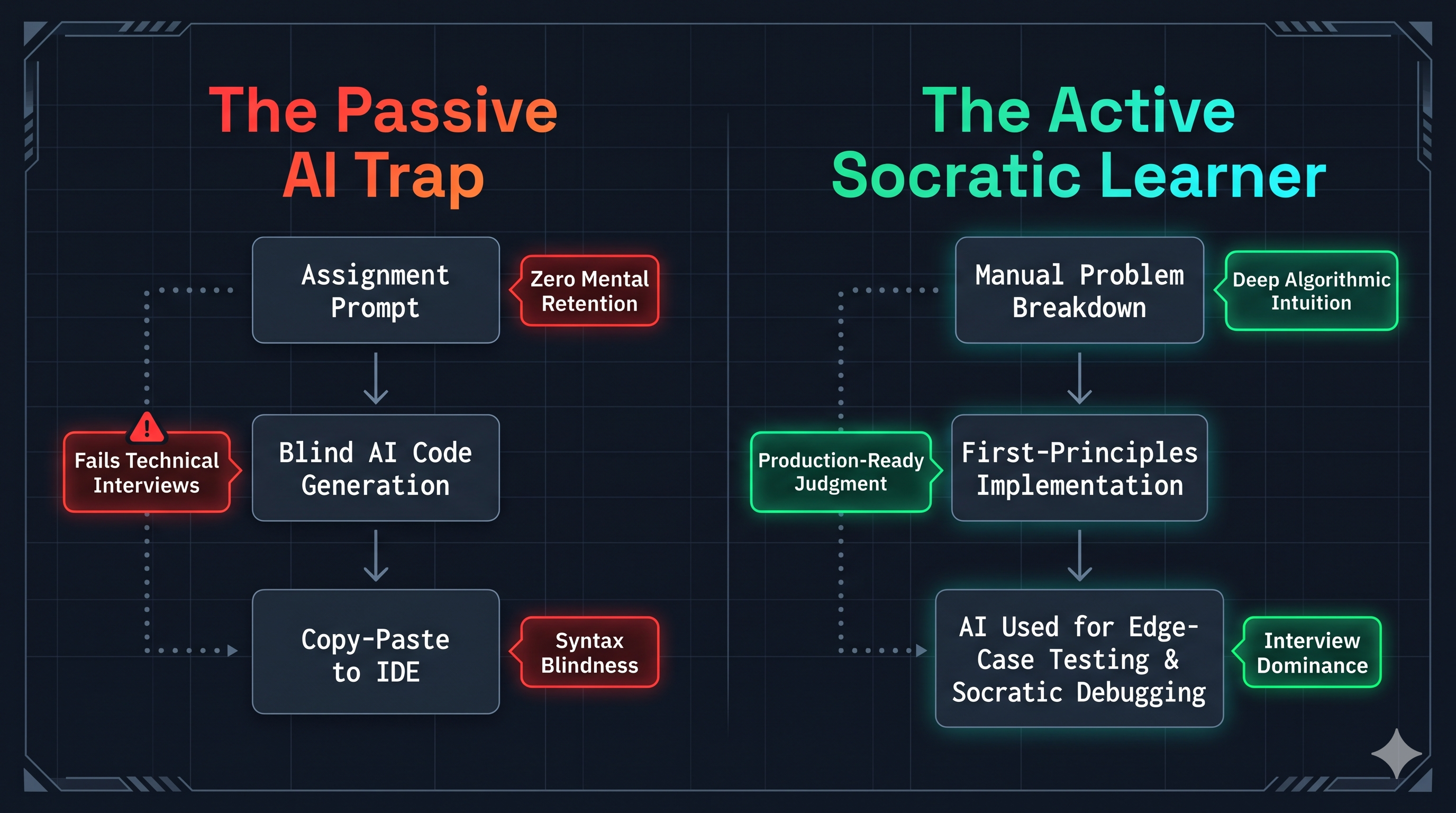
  • The "Vibe-Coding" Trap: Why Relying on AI Generators Is Silently Sabotaging Computer Science Students
    With AI coding assistants capable of generating boilerplate apps in seconds, tech students are falling into a deceptive learning illusion: the illusion of competence.
    When an AI outputs working code, reading it creates a false sense of understanding.
    But software engineering is not reading; it is mental modeling, fault tracing, and architectural reasoning.
    Students who skip the friction of debugging and problem decomposition will face a brutal reality during technical interviews and production internships:
    The Inability to Debug Edge Cases:
    When an AI model hallucinates a race condition or an off-by-one pointer error, a developer without core algorithmic grounding cannot locate the failure mode.
    Mental Atrophy in Algorithmic Decomposition: Breaking a nebulous problem into data structures, time complexity ($O(n)$) constraints, and edge boundaries is a muscle built solely through iterative trial and error.
    Zero Architectural Ownership: If you didn't decide why an array was picked over a hash map, you cannot defend the trade-off when latency spikes under concurrency.
    The Learning Rule: AI as the Socratic Tutor, Not the Code GhostwriterTo graduate as an elite engineer in an AI-accelerated world, invert how you use developer assistants:
    Ban Direct Solution Prompting:
    Never prompt an LLM with "Write a Python script to implement Dijkstra's algorithm." Instead, write your implementation first, then prompt: "Review my Dijkstra implementation. What are two edge-case inputs that will break my termination condition?
    "Reverse Code Dissection: If you run into unfamiliar syntax or an opaque library method, ask the model to explain the underlying memory allocation or call-stack behavior rather than copying it wholesale.
    Master the Primitives First: Operating systems, computer networks, and discrete mathematics cannot be bypassed.
    The less code you have to write manually in the future, the more critical it becomes to deeply understand how memory, compilers, and hardware communicate.
    AI will commoditize syntax generators. It will never commoditize the computer science fundamentals required to evaluate and architect mission-critical software.
    Discussion Question
    For tech students and recent grads: how do you draw the line when using AI tools for your coursework—do you use them as an interactive tutor, or have they become an automatic shortcut to get assignments done?
    CTA
    Join Students in Tech: Connect with fellow computer science students, get mentored by senior software engineers, and master fundamental software engineering concepts inside the Techawks Students community. Link in bio/comments.
    The "Vibe-Coding" Trap: Why Relying on AI Generators Is Silently Sabotaging Computer Science Students With AI coding assistants capable of generating boilerplate apps in seconds, tech students are falling into a deceptive learning illusion: the illusion of competence. When an AI outputs working code, reading it creates a false sense of understanding. But software engineering is not reading; it is mental modeling, fault tracing, and architectural reasoning. Students who skip the friction of debugging and problem decomposition will face a brutal reality during technical interviews and production internships: The Inability to Debug Edge Cases: When an AI model hallucinates a race condition or an off-by-one pointer error, a developer without core algorithmic grounding cannot locate the failure mode. Mental Atrophy in Algorithmic Decomposition: Breaking a nebulous problem into data structures, time complexity ($O(n)$) constraints, and edge boundaries is a muscle built solely through iterative trial and error. Zero Architectural Ownership: If you didn't decide why an array was picked over a hash map, you cannot defend the trade-off when latency spikes under concurrency. The Learning Rule: AI as the Socratic Tutor, Not the Code GhostwriterTo graduate as an elite engineer in an AI-accelerated world, invert how you use developer assistants: Ban Direct Solution Prompting: Never prompt an LLM with "Write a Python script to implement Dijkstra's algorithm." Instead, write your implementation first, then prompt: "Review my Dijkstra implementation. What are two edge-case inputs that will break my termination condition? "Reverse Code Dissection: If you run into unfamiliar syntax or an opaque library method, ask the model to explain the underlying memory allocation or call-stack behavior rather than copying it wholesale. Master the Primitives First: Operating systems, computer networks, and discrete mathematics cannot be bypassed. The less code you have to write manually in the future, the more critical it becomes to deeply understand how memory, compilers, and hardware communicate. AI will commoditize syntax generators. It will never commoditize the computer science fundamentals required to evaluate and architect mission-critical software. Discussion Question For tech students and recent grads: how do you draw the line when using AI tools for your coursework—do you use them as an interactive tutor, or have they become an automatic shortcut to get assignments done? CTA Join Students in Tech: Connect with fellow computer science students, get mentored by senior software engineers, and master fundamental software engineering concepts inside the Techawks Students community. Link in bio/comments.
    0 Yorumlar 0 hisse senetleri 17 Views 0 önizleme
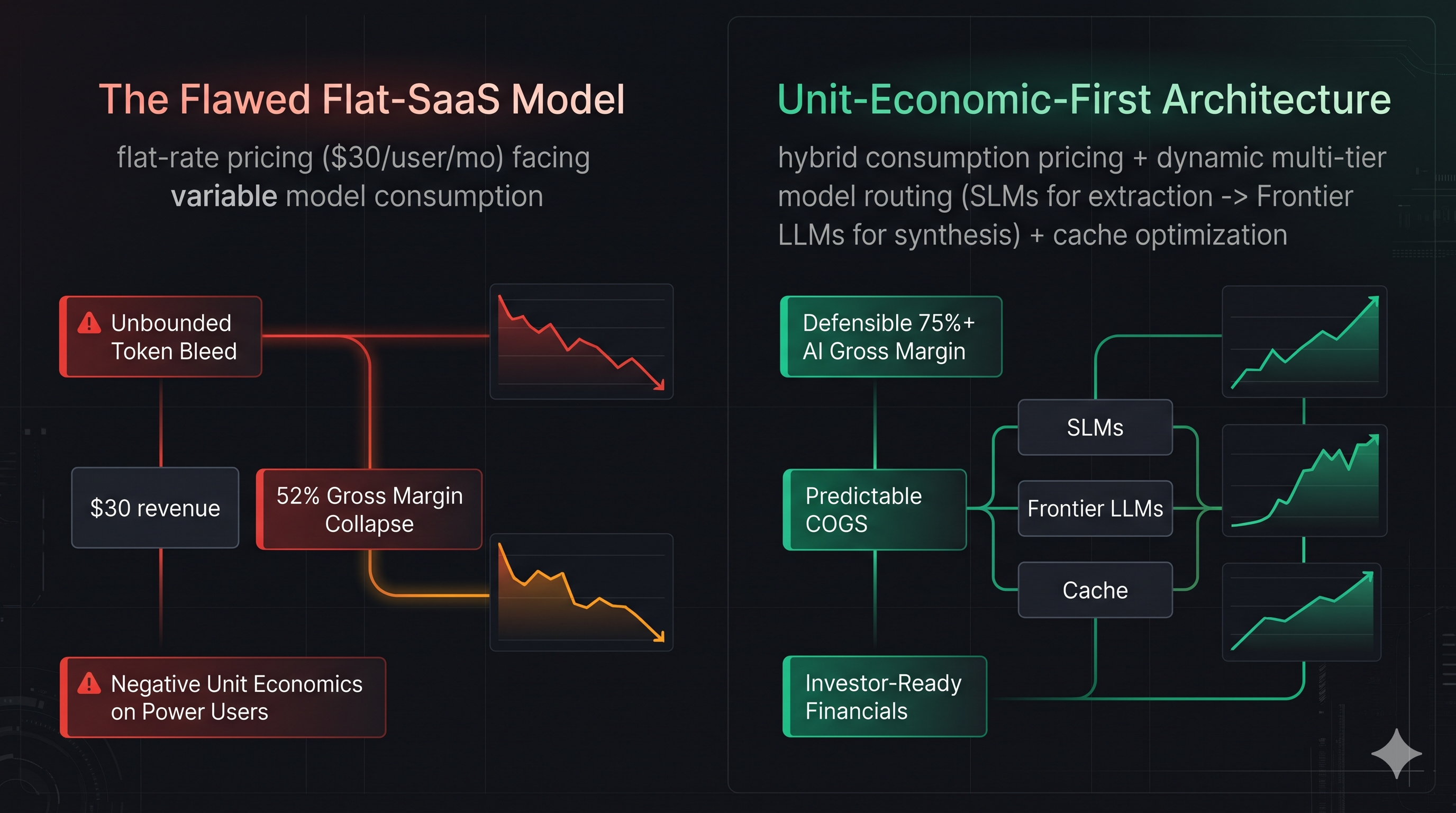
  • The 80% SaaS Margin Era Is Dead: Why Unit-Economics-First Founders Are Winning Seed & Series A
    For nearly two decades, traditional software thrived on near-zero marginal cost: build the product once, serve the next million users for pennies on the dollar, and bank 75% to 85% gross margins.


    That playbook has officially expired.


    Industry benchmarks reveal that average gross margins for AI software products hover between 50% and 53%—and in uncontrolled agentic applications, margins can plunge below 30%.


    The cause is not poor product-market fit; it is untracked variable COGS. In an AI-native stack, model inference, vector database lookups, self-critique loops, and recursive tool calls are not operational expenses—they are direct Costs of Goods Sold (COGS). When a heavy user triggers an autonomous workflow that makes 15 calls to resolve a query, a flat $30/month seat fee quietly turns into a money-losing account.


    Founders raising institutional rounds today are being evaluated on AI-Adjusted Gross Margin and unit defensibility. Here is how top-tier founders protect their margin profile:


    Decouple Billing from Flat Seats to Hybrid Consumption: Eliminate all-inclusive flat enterprise tiers for autonomous features. Shift to hybrid models: base platform access + metered credit allowances with automatic usage-based overages.


    Implement Dynamic Inference Routing: Never send a classification, extraction, or summarization task to a flagship frontier model. Route 70%+ of standard utility tasks through specialized, small language models (SLMs) or quantized local endpoints, reserving high-tier reasoning engines strictly for complex multi-hop tasks.


    Audit Per-Cohort Marginal Cost: Stop relying on blended platform-wide compute averages. Track unit margins per customer and per feature. If your top 5% power users are responsible for 60% of your inference spend, your pricing model has a structural leak.


    Vanity ARR will get you upvotes; unit-economic discipline gets your company funded and keeps it solvent.


    Discussion Question
    For founders running AI products: have you shifted from flat-rate pricing to hybrid usage/outcome-based billing, and what has been the customer pushback during contract negotiations?


    CTA
    Join Startup Founders & Entrepreneurs: Discuss unit economics, pricing architecture, go-to-market strategies, and fundraising playbooks with active venture-backed founders inside the Techawks Startups community. Link in bio/comments.
    The 80% SaaS Margin Era Is Dead: Why Unit-Economics-First Founders Are Winning Seed & Series A For nearly two decades, traditional software thrived on near-zero marginal cost: build the product once, serve the next million users for pennies on the dollar, and bank 75% to 85% gross margins. That playbook has officially expired. Industry benchmarks reveal that average gross margins for AI software products hover between 50% and 53%—and in uncontrolled agentic applications, margins can plunge below 30%. The cause is not poor product-market fit; it is untracked variable COGS. In an AI-native stack, model inference, vector database lookups, self-critique loops, and recursive tool calls are not operational expenses—they are direct Costs of Goods Sold (COGS). When a heavy user triggers an autonomous workflow that makes 15 calls to resolve a query, a flat $30/month seat fee quietly turns into a money-losing account. Founders raising institutional rounds today are being evaluated on AI-Adjusted Gross Margin and unit defensibility. Here is how top-tier founders protect their margin profile: Decouple Billing from Flat Seats to Hybrid Consumption: Eliminate all-inclusive flat enterprise tiers for autonomous features. Shift to hybrid models: base platform access + metered credit allowances with automatic usage-based overages. Implement Dynamic Inference Routing: Never send a classification, extraction, or summarization task to a flagship frontier model. Route 70%+ of standard utility tasks through specialized, small language models (SLMs) or quantized local endpoints, reserving high-tier reasoning engines strictly for complex multi-hop tasks. Audit Per-Cohort Marginal Cost: Stop relying on blended platform-wide compute averages. Track unit margins per customer and per feature. If your top 5% power users are responsible for 60% of your inference spend, your pricing model has a structural leak. Vanity ARR will get you upvotes; unit-economic discipline gets your company funded and keeps it solvent. Discussion Question For founders running AI products: have you shifted from flat-rate pricing to hybrid usage/outcome-based billing, and what has been the customer pushback during contract negotiations? CTA Join Startup Founders & Entrepreneurs: Discuss unit economics, pricing architecture, go-to-market strategies, and fundraising playbooks with active venture-backed founders inside the Techawks Startups community. Link in bio/comments.
    0 Yorumlar 0 hisse senetleri 16 Views 0 önizleme
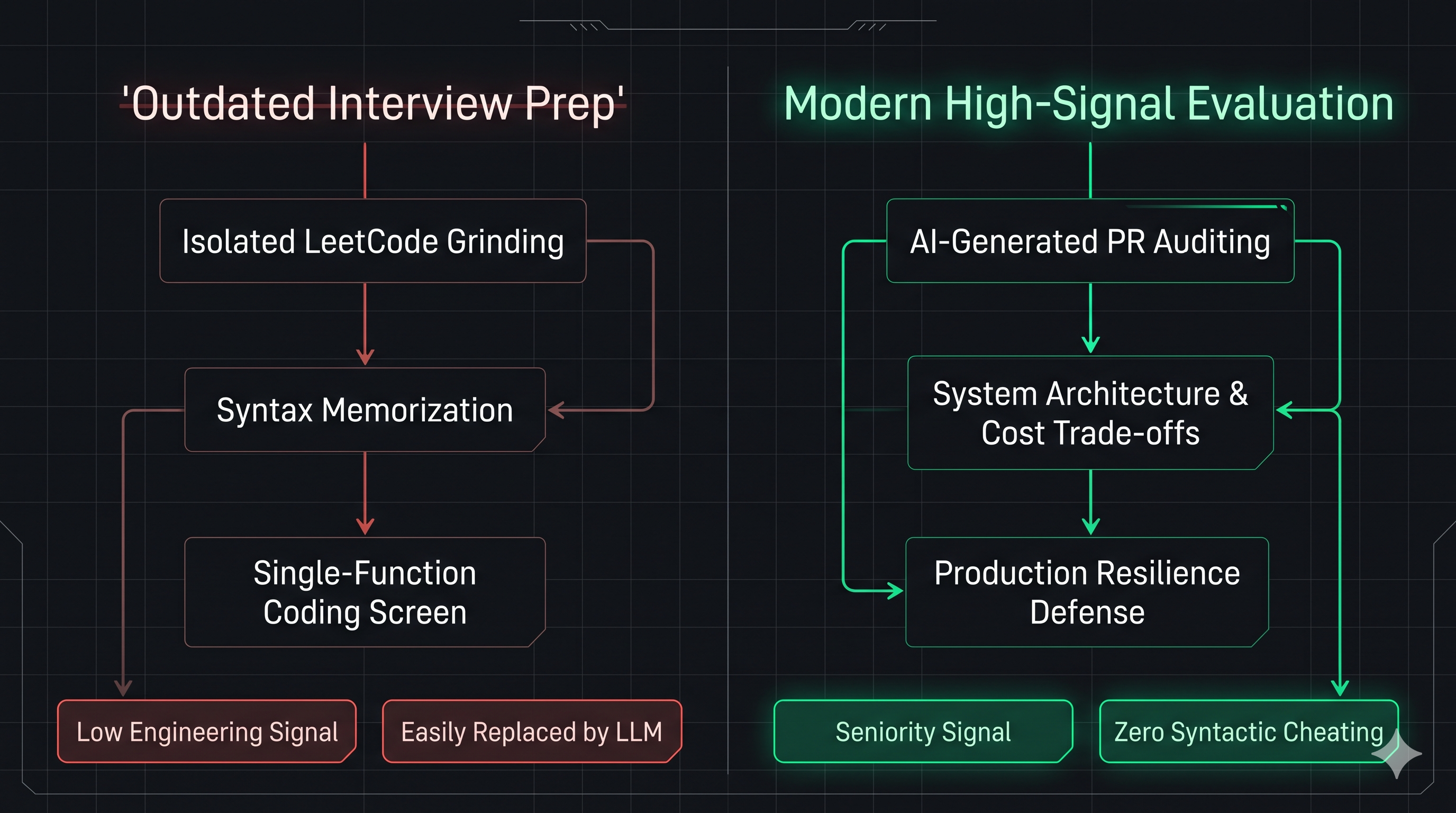
  • The Death of the LeetCode Grind: Why "Code Review & Trade-off Defense" Is the New Technical Interview Bar
    With over 80% of professional developers actively pairing with AI coding assistants and agentic IDEs, writing syntactically correct boilerplate is no longer a differentiator. Engineering teams already know an LLM can invert a binary tree or write an unoptimized CRUD endpoint in 1.2 seconds.


    What engineering leaders actually struggle with right now is evaluating judgment.


    Technical interview loops across top-tier tech companies are aggressively pivoting away from isolated coding screens toward two new assessment formats:


    The AI-Generated PR Review Screen: Instead of starting from a blank editor, candidates are handed a 400-line pull request produced by an agent or LLM containing subtle concurrency bugs, silent data mutations, and unhandled edge cases. Interviewers aren’t checking if you can write syntax—they are checking if you can catch what AI misses.


    System Design & Cost-Aware Trade-off Defense: System design rounds have expanded from senior staff roles down into mid-level evaluations. Teams evaluate whether you can justify state boundaries, database consistency models, telemetry, and compute cost ceilings under real traffic constraints.


    How to Pivot Your Career Preparation:
    Shift from Memorization to Debugging: Practice opening open-source pull requests and auditing them for race conditions, memory leaks, and leaky abstractions. Articulating why an implementation will degrade under load carries 5x more signal than rewriting it from scratch.


    Defend Architectural Trade-offs Out Loud: Don't just recommend an architectural pattern (e.g., Redis caching or an event-driven queue). State the exact trade-off upfront: "We gain sub-10ms read latency, but we introduce cache invalidation complexity and transient eventual consistency risk."


    Demonstrate AI Orchestration, Not Avoidance: Interviewers respect candidates who know how to prompt, steer, and sanity-check LLM outputs while catching security and architecture pitfalls before merge.


    In modern engineering hiring, you aren't evaluated on whether you can out-code the model. You are evaluated on whether you have the technical seniority to guide, audit, and take ownership of what gets deployed to production.


    Discussion Question
    For engineers currently interviewing or hiring managers running loops: what interview format has given you the clearest signal of a candidate's actual day-one engineering judgment?


    CTA
    Join Tech Jobs & Opportunities: Connect with senior hiring managers, access vetted job referrals, and master modern interview strategies inside the Techawks Careers community. Link in bio/comments.
    The Death of the LeetCode Grind: Why "Code Review & Trade-off Defense" Is the New Technical Interview Bar With over 80% of professional developers actively pairing with AI coding assistants and agentic IDEs, writing syntactically correct boilerplate is no longer a differentiator. Engineering teams already know an LLM can invert a binary tree or write an unoptimized CRUD endpoint in 1.2 seconds. What engineering leaders actually struggle with right now is evaluating judgment. Technical interview loops across top-tier tech companies are aggressively pivoting away from isolated coding screens toward two new assessment formats: The AI-Generated PR Review Screen: Instead of starting from a blank editor, candidates are handed a 400-line pull request produced by an agent or LLM containing subtle concurrency bugs, silent data mutations, and unhandled edge cases. Interviewers aren’t checking if you can write syntax—they are checking if you can catch what AI misses. System Design & Cost-Aware Trade-off Defense: System design rounds have expanded from senior staff roles down into mid-level evaluations. Teams evaluate whether you can justify state boundaries, database consistency models, telemetry, and compute cost ceilings under real traffic constraints. How to Pivot Your Career Preparation: Shift from Memorization to Debugging: Practice opening open-source pull requests and auditing them for race conditions, memory leaks, and leaky abstractions. Articulating why an implementation will degrade under load carries 5x more signal than rewriting it from scratch. Defend Architectural Trade-offs Out Loud: Don't just recommend an architectural pattern (e.g., Redis caching or an event-driven queue). State the exact trade-off upfront: "We gain sub-10ms read latency, but we introduce cache invalidation complexity and transient eventual consistency risk." Demonstrate AI Orchestration, Not Avoidance: Interviewers respect candidates who know how to prompt, steer, and sanity-check LLM outputs while catching security and architecture pitfalls before merge. In modern engineering hiring, you aren't evaluated on whether you can out-code the model. You are evaluated on whether you have the technical seniority to guide, audit, and take ownership of what gets deployed to production. Discussion Question For engineers currently interviewing or hiring managers running loops: what interview format has given you the clearest signal of a candidate's actual day-one engineering judgment? CTA Join Tech Jobs & Opportunities: Connect with senior hiring managers, access vetted job referrals, and master modern interview strategies inside the Techawks Careers community. Link in bio/comments.
    0 Yorumlar 0 hisse senetleri 16 Views 0 önizleme
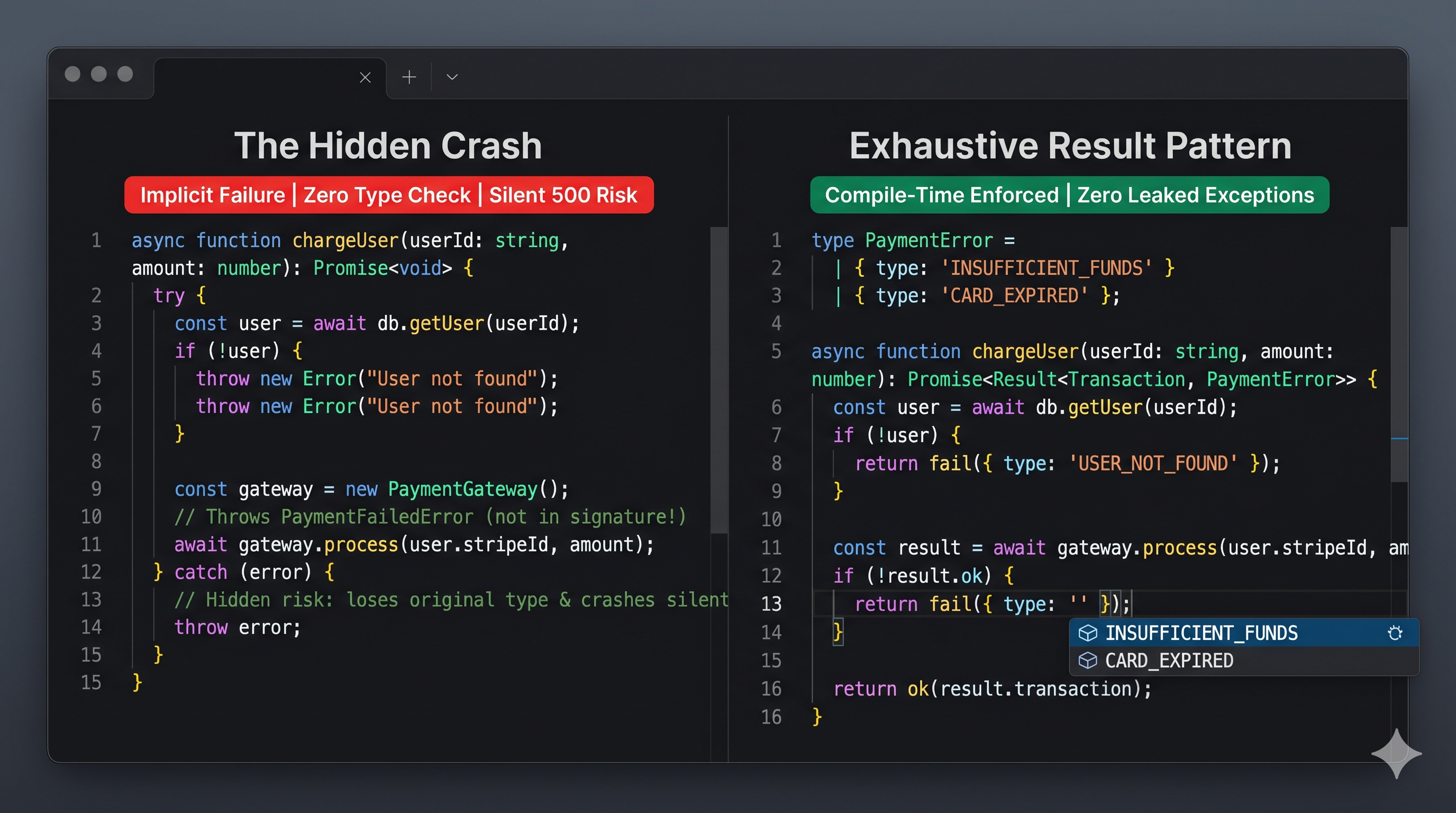
  • Stop Leaking Unchecked Exceptions: How to Build Bulletproof APIs with the Result Pattern in TypeScript
    Throwing exceptions for expected domain failures (e.g., validation errors, expired sessions, or resource conflicts) violates one of software engineering's most fundamental tenets: type safety across execution boundaries.


    When a function signatures looks like this:


    TypeScript
    async function processOrder(orderId: string): Promise<Order>
    The TypeScript compiler has no idea what could go wrong. It forces consumers to guess what exceptions need catching, resulting in swallowed errors, missing fallback states, and unexpected 500 HTTP crashes.


    The Architectural Shift: Explicit Error Modeling
    Languages like Rust make failure paths explicit at the type level using the Result<T, E> algebraic data type. You can implement this cleanly in modern TypeScript without external dependencies using discriminated unions:


    TypeScript
    type Result<T, E = Error> =
    | { success: true; data: T }
    | { success: false; error: E };


    // Define discrete, exhaustive error states
    type PaymentError =
    | { code: 'INSUFFICIENT_FUNDS'; balance: number }
    | { code: 'CARD_EXPIRED' }
    | { code: 'GATEWAY_TIMEOUT' };


    async function chargeCard(amount: number): Promise<Result<Transaction, PaymentError>> {
    if (amount > availableFunds) {
    return {
    success: false,
    error: { code: 'INSUFFICIENT_FUNDS', balance: availableFunds }
    };
    }
    // ... execute charge
    return { success: true, data: transaction };
    }
    Why This Changes Your Code Quality:
    Exhaustive Type Narrowing: Consumers cannot access result.data without explicitly handling if (!result.success). TypeScript will flag unhandled error conditions at build time.


    Deterministic Control Flow: Exceptions are reserved exclusively for truly unrecoverable anomalies (out-of-memory errors, syntax bugs, database connection drops), while expected business failures remain predictable, first-class values.


    Decoupled API Contracts: Your HTTP controller can deterministically map every domain error code directly to its respective HTTP status code (e.g., 402 Payment Required, 408 Timeout) via a simple, exhaustive switch block.


    Stop treating your failure paths as second-class citizens. If a failure can be predicted, it belongs in the return type.


    Discussion Question
    In your current backend codebase, do you handle domain-level failures via custom thrown exception hierarchies or explicit Result / Either types—and what was the tipping point for your team?


    CTA
    Join Developers & Coding: Connect with senior software engineers, backend developers, and systems architects refining clean code patterns, type safety, and scalable architectures inside the Techawks Developers community. Link in bio/comments.
    Stop Leaking Unchecked Exceptions: How to Build Bulletproof APIs with the Result Pattern in TypeScript Throwing exceptions for expected domain failures (e.g., validation errors, expired sessions, or resource conflicts) violates one of software engineering's most fundamental tenets: type safety across execution boundaries. When a function signatures looks like this: TypeScript async function processOrder(orderId: string): Promise<Order> The TypeScript compiler has no idea what could go wrong. It forces consumers to guess what exceptions need catching, resulting in swallowed errors, missing fallback states, and unexpected 500 HTTP crashes. The Architectural Shift: Explicit Error Modeling Languages like Rust make failure paths explicit at the type level using the Result<T, E> algebraic data type. You can implement this cleanly in modern TypeScript without external dependencies using discriminated unions: TypeScript type Result<T, E = Error> = | { success: true; data: T } | { success: false; error: E }; // Define discrete, exhaustive error states type PaymentError = | { code: 'INSUFFICIENT_FUNDS'; balance: number } | { code: 'CARD_EXPIRED' } | { code: 'GATEWAY_TIMEOUT' }; async function chargeCard(amount: number): Promise<Result<Transaction, PaymentError>> { if (amount > availableFunds) { return { success: false, error: { code: 'INSUFFICIENT_FUNDS', balance: availableFunds } }; } // ... execute charge return { success: true, data: transaction }; } Why This Changes Your Code Quality: Exhaustive Type Narrowing: Consumers cannot access result.data without explicitly handling if (!result.success). TypeScript will flag unhandled error conditions at build time. Deterministic Control Flow: Exceptions are reserved exclusively for truly unrecoverable anomalies (out-of-memory errors, syntax bugs, database connection drops), while expected business failures remain predictable, first-class values. Decoupled API Contracts: Your HTTP controller can deterministically map every domain error code directly to its respective HTTP status code (e.g., 402 Payment Required, 408 Timeout) via a simple, exhaustive switch block. Stop treating your failure paths as second-class citizens. If a failure can be predicted, it belongs in the return type. Discussion Question In your current backend codebase, do you handle domain-level failures via custom thrown exception hierarchies or explicit Result / Either types—and what was the tipping point for your team? CTA Join Developers & Coding: Connect with senior software engineers, backend developers, and systems architects refining clean code patterns, type safety, and scalable architectures inside the Techawks Developers community. Link in bio/comments.
    0 Yorumlar 0 hisse senetleri 13 Views 0 önizleme
  • Stop Brute-Forcing Context: Why Speculative Decoding & KV-Cache Partitioning Are Replacing Massive Prompt Stuffing
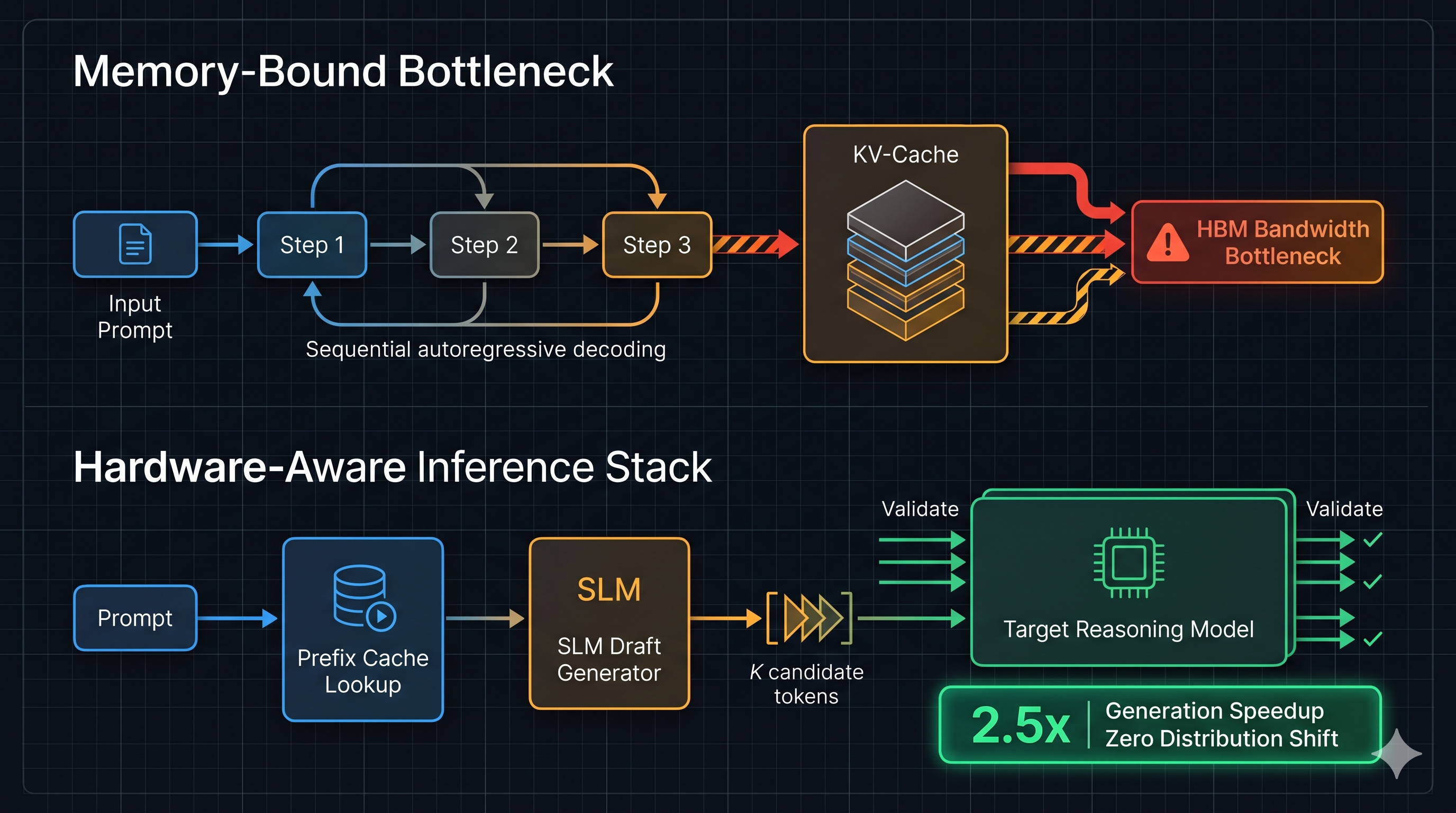
    As frontier reasoning models and agent pipelines scale, the primary production bottleneck is no longer raw FLOPs—it is the memory bus.
    Every autoregressive token generated requires loading hundreds of billions of weights and reading an ever-expanding Key-Value (KV) cache from High Bandwidth Memory (HBM). When your context window balloons, GPU memory throughput stalls out, driving Time-To-First-Token (TTFT) and per-token generation latency into unacceptable SLA territory.
    Building enterprise-grade AI applications requires transitioning from naive prompting to hardware-aware inference engineering:1. Speculative Decoding (Draft-Verify Architecture)Instead of forcing a 70B+ target model to sequentially compute predictable syntax, punctuation, and structural boilerplate, deploy a lightweight colocated draft model (e.g., 3B–7B).The small model drafts $K$ candidate tokens in parallel.
    The large target model evaluates all $K$ tokens in a single forward pass.
    Verified tokens are accepted; rejected tokens branch back without quality loss.
    The payoff: High acceptance rates ($\alpha > 80\%$) in structured JSON generation, code synthesis, and retrieval-augmented workflows—effectively doubling generation speed without changing output distributions.2. Tiered KV-Cache Management & Prefix CachingDynamic agent loops often re-send identical system instructions, schema toolsets, and few-shot exemplars across multi-turn conversations.
    Prefix Caching: Hash common system prefixes so downstream turns read pre-computed KV tensors directly from GPU cache rather than recomputing prompt attention.
    Cache Eviction Strategies: Ditch sliding windows. Implement attention-guided retention (pruning tokens with historically low cumulative attention weights) to cap HBM usage on long-running worker loops.3. Shift from Retrieval "Dumping" to Structured Context HydrationDo not treat the context window as a bottomless database. Route routine structural checks through edge small language models (SLMs) and feed the central reasoning engine only validated, high-signal state diffs.
    Optimizing your system boundaries yields bigger performance and cost dividends than simply upgrading your base model tier.
    Discussion Question
    For teams running high-throughput production LLM pipelines: have you benchmarked Speculative Decoding or dynamic KV-cache eviction against native continuous batching, and what acceptance rate ($\alpha$) threshold justified the added orchestrator complexity in your stack?
    CTA
    Join AI Builders & Enthusiasts: Dive deep into low-latency inference patterns, LLM system architecture, and production deployment designs with fellow engineers inside the Techawks AI community. Link in bio/comments.
    Stop Brute-Forcing Context: Why Speculative Decoding & KV-Cache Partitioning Are Replacing Massive Prompt Stuffing As frontier reasoning models and agent pipelines scale, the primary production bottleneck is no longer raw FLOPs—it is the memory bus. Every autoregressive token generated requires loading hundreds of billions of weights and reading an ever-expanding Key-Value (KV) cache from High Bandwidth Memory (HBM). When your context window balloons, GPU memory throughput stalls out, driving Time-To-First-Token (TTFT) and per-token generation latency into unacceptable SLA territory. Building enterprise-grade AI applications requires transitioning from naive prompting to hardware-aware inference engineering:1. Speculative Decoding (Draft-Verify Architecture)Instead of forcing a 70B+ target model to sequentially compute predictable syntax, punctuation, and structural boilerplate, deploy a lightweight colocated draft model (e.g., 3B–7B).The small model drafts $K$ candidate tokens in parallel. The large target model evaluates all $K$ tokens in a single forward pass. Verified tokens are accepted; rejected tokens branch back without quality loss. The payoff: High acceptance rates ($\alpha > 80\%$) in structured JSON generation, code synthesis, and retrieval-augmented workflows—effectively doubling generation speed without changing output distributions.2. Tiered KV-Cache Management & Prefix CachingDynamic agent loops often re-send identical system instructions, schema toolsets, and few-shot exemplars across multi-turn conversations. Prefix Caching: Hash common system prefixes so downstream turns read pre-computed KV tensors directly from GPU cache rather than recomputing prompt attention. Cache Eviction Strategies: Ditch sliding windows. Implement attention-guided retention (pruning tokens with historically low cumulative attention weights) to cap HBM usage on long-running worker loops.3. Shift from Retrieval "Dumping" to Structured Context HydrationDo not treat the context window as a bottomless database. Route routine structural checks through edge small language models (SLMs) and feed the central reasoning engine only validated, high-signal state diffs. Optimizing your system boundaries yields bigger performance and cost dividends than simply upgrading your base model tier. Discussion Question For teams running high-throughput production LLM pipelines: have you benchmarked Speculative Decoding or dynamic KV-cache eviction against native continuous batching, and what acceptance rate ($\alpha$) threshold justified the added orchestrator complexity in your stack? CTA Join AI Builders & Enthusiasts: Dive deep into low-latency inference patterns, LLM system architecture, and production deployment designs with fellow engineers inside the Techawks AI community. Link in bio/comments.
    0 Yorumlar 0 hisse senetleri 14 Views 0 önizleme
Arama Sonuçları